

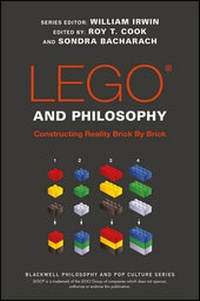
LEGO and Philosophy
Description

More details
Other editions
Additional editions
Persons
Content
Notes on Contributors
Sondra Bacharach is a Senior Lecturer in the philosophy department at Victoria University of Wellington (New Zealand). She works in philosophy of art, and is the coeditor of Collaborating Now: Art in the Twenty-first Century (with Jeremy Booth and Siv Fjaerstag, Routledge, 2016) and former coeditor of the American Society of Aesthetics Newsletter. When she's not doing philosophy, she can be found building Classic Spaceships (Spaceship, Spaceship, SPACESHIP!) with her kids' big box of LEGO.
Steve Bein is Assistant Professor of Philosophy at the University of Dayton. He is a regular contributor to Blackwell's Philosophy and Pop Culture series, including Wonder Woman and Philosophy and The Ultimate Star Trek and Philosophy. He's also a novelist and his sci-fi short stories have been used in philosophy and science fiction courses across the U.S. His books include Purifying Zen (University of Hawai'i Press, 2011), Compassion and Moral Guidance (University of Hawai'i Press, 2012), and the critically acclaimed Fated Blades trilogy from Penguin Roc. Steve is the proud owner of some 40,000 LEGO bricks. Don't judge.
Samantha J. Boardman is a public history and research consultant who received her PhD in American Studies from Rutgers University-Newark. Her projects have included research into expressions of U.S. nationalism in miniature tourist attractions, the digital preservation of Great Migration oral histories, short digital documentaries on civic and community institutions and curatorial services for a wide variety of exhibits. She has a five year-old daughter with whom she builds bangin' LEGO pirate ships.
Eric Chelstrom is Assistant Professor of Philosophy at St. Mary's University. Tacos in San Antonio are so awesome, they aren't just for Tuesdays. He worries about things like oppression and whether his children will share their LEGOs. Sure, they have been told to keep away from their father's precious LEGOs. He might sometimes also wonder if it's okay to make his kids share a double-decker-couch so that there's more space for LEGOs. In this he struggles with being maybe too much like The Man Upstairs, even if his students probably think he's way more like Emmet, before Emmet got special.
Roy T. Cook is CLA Scholar of the College and Professor of Philosophy at the University of Minnesota Twin Cities, and Resident Fellow at the Minnesota Center for the Philosophy of Science. He is the author of Paradoxes (Polity, 2013) and The Yablo Paradox (Oxford, 2014), the editor of The Arché Papers on the Mathematics of Abstraction (Springer, 2007), and coeditor of The Art of Comics: A Philosophical Approach (with Aaron Meskin, Blackwell, 2012) and The Routledge Companion to Comics (with Frank Bramlett and Aaron Meskin, Routledge, 2016). No matter how much LEGO he buys, he never seems to have enough headlight bricks.
Ramon Das is a Senior Lecturer in philosophy at Victoria University of Wellington (New Zealand). He works mainly in normative ethics and political philosophy, and more recently has branched out into meta-ethics and philosophy of mathematics. An ex-patriot American, he occasionally (not often) wishes that he lived in a country where he could purchase a LEGO set for less than the cost of his monthly power bill.
Bob Fischer is an Assistant Professor of Philosophy at Texas State University. He is coeditor of two volumes-The Moral Complexities of Eating Meat (Oxford University Press, 2015) and Modal Epistemology After Rationalism (Springer, 2016)-the sole editor of College Ethics: A Reader on Moral Issues That Affect You (Oxford University Press, 2016), and the author of Modal Justification via Theories (Springer, 2017). In his spare time, he searches for vintage LEGO sets at garage sales. (The quest is quixotic, but he soldiers on anyway.)
Saul Fisher is Visiting Associate Professor of Philosophy at Mercy College (NY), where he serves as Executive Director for Grants and Academic Initiatives in the Office of the Provost. His work in philosophical aesthetics is centered on architecture, for which he was awarded a Graham Foundation grant (2009), and which includes the Stanford Encyclopedia of Philosophy article on philosophy of architecture (2015). The greatest works of his own architectural oeuvre, realized in the LEGO medium, are lost to the ages.
Michael Gettings is Associate Professor of Philosophy at Hollins University. Some of his philosophical work ranges from analyzing arguments for God's existence to developing new ontological categories for works of art. He has also contributed philosophical musings on topics from the Grateful Dead to the Daily Show. One of his proudest moments as a parent was the day his son presented him with a LEGO brick portrait of Ole Kirk Christiansen.
Rhiannon Grant is Tutor for Quaker Roles at Woodbrooke Quaker Study Centre (UK). Her work covers the philosophy of Wittgenstein, feminism in religion, and studies of British Quakers. She enjoys using tools from diverse academic disciplines, including philosophy, theology, sociology, and gender studies. If her career were a LEGO wall, it would be multicolored, with roof bricks dotted here and there in the middle and an upside-down door on the left-hand side.
Rebecca Gutwald is an Associate Professor of Philosophy at the University of Munich, Germany. Her main areas of research are political philosophy, feminism, and social ethics. Currently she is working on a book on the political philosophy of resilience and its role for future ethics. This includes gauging the potential of philosophy to solve problems in practice. She urges the philosopher to leave the armchair and visit the real world. As part of her own experience of doing so, she has taught philosophy outside of academia, especially to her children. Since her own children had to endure her philosophy lessons, she suspects that they are retaliating by leaving around their LEGOs for her to step on, which results in a severe form of pain which only parents know about. She has now bought some sturdy slippers and begun to wonder about the increasing gendering of toys, longing for the old days of LEGO in which boys and girls could just simply sit down, build a LEGO house, and dream of a better future.
David Kahn, PhD, is the author of Case, Spandex, Briefcase: Leadership Lessons from Superheroes (Starewell, 2015) and writes on ways to make leadership theories and research accessible through pop culture. David is a Leadership Expert, Human Resource Executive, Speaker, and Consultant concentrating on incorporating the principles of culture, leadership and organizational development to improve business strategies and, ultimately, performance. In his spare time, he is on a lifetime pursuit to "Create the Impossible" . or at least a life-sized LEGO Yoda.
Alice Leber-Cook has an MEd in Adult Education and an MA in Curriculum and Instruction, focusing on Family, Youth, and Community education, both from the University of Minnesota - Twin Cities. She keeps herself busy both as an educational researcher and as a very active Female Fan of LEGO (FFOL), LEGO User Group (LUG) member (go VirtuaLUG!), and coordinator for Brickworld, the largest Adult Fan of LEGO (AFOL) convention in North America. She breaks out in hives when she hears someone say "Legos."
Stephan Leuenberger is a Lecturer in Philosophy at the University of Glasgow, working mainly in metaphysics and philosophical logic. He likes to give his papers pretentious titles, preferably including Latin words. Representative examples are "Ceteris absentibus physicalism" and "De jure and de facto validity in the logic of tense and modality." He tried to do some clever word play with the Latin meaning of "lego," but failed.
David Lueth is a Professional Writing Tutor at Anoka Ramsey Community College. He is slowly collecting college degrees; his third and most recent is an MFA in Creative Writing from Hamline University, and he is pondering how a couple more degrees in cultural anthropology would look on his wall. When not tutoring students on the finer points of comma splices or subjecting all his friends to monologues on the increasing relevance of Jean Baudrillard's concept of the hyperreal, he reminds himself that he really ought to finish that novel he's been working on for the past twelve years. Sometimes, to avoid the guilt those reminders bring up, he plays with his LEGO collection.
Robert M. Mentyka grew up as a fervent "LEGO Maniac" during the 1990s and long considered going into engineering or architecture thanks to the influence of these addictive little blocks. Although his attention was eventually won over by the charms of philosophy, he is still a lifelong LEGO fan and part-time builder of the "most radical" of spaceships. Having earned both his Bachelors and Masters in Philosophy at the Franciscan University of Steubenville, Ohio, he...
