

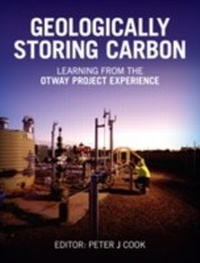
Geologically Storing Carbon
Learning from the Otway Project Experience
1st Edition
Published on 18. August 2014
598 pages
978-1-4863-0231-4 (ISBN)
Description

Carbon capture and geological storage (CCS) is presently the only way that we can make deep cuts in emissions from fossil fuel-based, large-scale sources of CO2 such as power stations and industrial plants. But if this technology is to be acceptable to the community, it is essential that it is credibly demonstrated by world-class scientists and engineers in an open and transparent manner at a commercially significant scale. The aim of the Otway Project was to do just this. Geologically Storing Carbon provides a detailed account of the CO2CRC Otway Project, one of the most comprehensive demonstrations of the deep geological storage or geosequestration of carbon dioxide undertaken anywhere. This book of 18 comprehensive chapters written by leading experts in the field is concerned with outstanding science, but it is not just a collection of scientific papers - it is about 'learning by doing'. For example, it explains how the project was organised, managed, funded and constructed, as well as the approach taken to community issues, regulations and approvals. It also describes how to understand the site: Are the rocks mechanically suitable? Will the CO2 leak? Is there enough storage capacity? Is monitoring effective? This is the book for geologists, engineers, regulators, project developers, industry, communities or anyone who wants to better understand how a carbon storage project really 'works'. It is also for people concerned with obtaining an in-depth appreciation of one of the key technology options for decreasing greenhouse emissions to the atmosphere.
More details
Other editions
Additional editions
Book
08/2014
CSIRO Publishing
€157.73
Shipment within 3-4 weeks
Content
- Intro
- Title
- Copyright
- Contents
- Foreword 1
- Foreword 2
- Preface
- Authors
- Acknowledgements
- 1. Developing the Project
- 1.1 Introduction
- 1.2 Developing an Australian project
- 1.3 Developing a suitable corporate structure
- 1.4 Formation of CO2CRC Pilot Project LTD
- 1.5 Funding the project
- 1.6 Designing the Otway Project
- 1.7 Project liability and risk
- 1.8 Conclusions
- 1.9 References
- 2. Communications and the Otway Project
- 2.1 Introduction
- 2.2 Strategic communications and the Otway Project
- 2.3 Social research and the Otway Project
- 2.4 Operational issues relating to communications and the community
- 2.5 Conclusions
- 2.6 References
- 3. Government approvals
- 3.1 Introduction
- 3.2 Challenges of regulating a pilot project
- 3.3 Impact assessment and planning approvals
- 3.4 Environmental authority approvals
- 3.5 Petroleum authority approvals
- 3.6 Water authority approvals
- 3.7 Land access and acquisition
- 3.8 Miscellaneous approvals
- 3.9 Transitional arrangements
- 3.10 Liability and responsibility
- 3.11 Stakeholder engagement
- 3.12 Conclusions
- 3.13 References
- 4. Design and operational considerations
- 4.1 Introduction
- 4.2 Options for gas processing
- 4.3 Facilities and pipeline design considerations
- 4.4 Facilities design
- 4.5 Unanticipated operational problems
- 4.6 Conclusions
- 5. Characterising the storage site
- 5.1 Introduction
- 5.2 Site details
- 5.3 Injectivity
- 5.4 Capacity
- 5.5 Reservoir heterogeneity
- 5.6 Containment
- 5.7 Site analogue
- 5.8 The evolution of the static models
- 5.9 Conclusions
- 5.10 References
- 6. Evaluating CO2 column height retention of cap rocks
- 6.1 Introduction
- 6.2 Mercury injection capillary pressure
- 6.3 Methodology
- 6.4 Pore throat size determination
- 6.5 CO2 contact angle
- 6.6 Determination of seal capacity or column height
- 6.7 Interpreting threshold (breakthrough) pressure
- 6.8 Results for CRC-1 and CRC-2
- 6.9 Conclusions
- 6.10 References
- 7. Geomechanical investigations
- 7.1 Introduction
- 7.2 Key data for geomechanical assessment of the Otway site
- 7.3 Geomechanical workflow at the Otway site
- 7.4 3D geomechanical modelling
- 7.5 The Iona gas storage facility as an analogue for CO2 storage
- 7.6 Conclusions
- 7.7 References
- 8. Containment risk assessment
- 8.1 Introduction
- 8.2 Methodology
- 8.3 Risk assessment context
- 8.4 Storage complex
- 8.5 Risk items
- 8.6 Risk assessment output
- 8.7 Conclusions
- 8.8 References
- 9. Monitoring and verification
- 9.1 Introduction
- 9.2 Designing a monitoring programme
- 9.3 Designing the Otway monitoring programme
- 9.4 Evaluation of monitoring techniques
- 9.5 Conclusions
- 9.6 References
- 10. 2D and 3D seismic investigations for Stages 1 and 2C
- 10.1 Introduction
- 10.2 Modelling seismic response of injected CO2 in Stage 1
- 10.3 Modelling seismic response of CO2 leakage for 2C
- 10.4 Time-lapse repeatability in Stage 1
- 10.5 Time-lapse surface seismic monitoring for Stage 1
- 10.6 Downhole seismic methods for Stage 1
- 10.7 Laboratory studies of CO2 acoustic response as an adjunct to field studies
- 10.8 Conclusions
- 10.9 References
- 11. Seismic and microseismic monitoring
- 11.1 Introduction
- 11.2 High resolution travel time (HRTT) monitoring and offset VSP
- 11.3 Passive seismic monitoring
- 11.4 Microseismic monitoring using surface stations
- 11.5 Conclusions
- 11.6 References
- 12. Monitoring the geochemistry of reservoir fluids
- 12.1 Introduction
- 12.2 Sampling the Buttress-1 well
- 12.3 Sampling the CRC-1 injection well
- 12.4 Sampling the Naylor-1 monitoring well
- 12.5 Injecting tracers at the CRC-1 injection well
- 12.6 Analytical methods
- 12.7 Composition of hydrocarbons
- 12.8 Formation water composition and behaviour
- 12.9 Constraining CO2 breakthrough
- 12.10 In-reservoir behaviour of tracers
- 12.11 Liquid hydrocarbons
- 12.12 Solid hydrocarbons
- 12.13 Conclusions
- 12.14 References
- 13. Monitoring groundwaters
- 13.1 Introduction
- 13.2 Monitoring groundwater level
- 13.3 Monitoring groundwater composition
- 13.4 Interpreting groundwater results
- 13.5 Groundwater composition
- 13.6 Operational issues relating to groundwater monitoring
- 13.7 Quality control
- 13.8 Conclusions
- 13.9 References
- 14. Soil gas monitoring
- 14.1 Introduction
- 14.2 Surficial geology
- 14.3 Soil gas sampling at Otway
- 14.4 Analysis of soil gas
- 14.5 Soil gas results
- 14.6 Interpretation of soil gas results
- 14.7 Conclusions
- 14.8 References
- 15. Atmospheric monitoring
- 15.1 Introduction
- 15.2 Sensitivity
- 15.3 Simulated emissions and monitoring design
- 15.4 Background CO2
- 15.5 Data filtering
- 15.6 Bayesian inverse modelling
- 15.7 Conclusions
- 15.8 References
- 16. Reservoir engineering for Stage 1
- 16.1 Introduction
- 16.2 Description of field data
- 16.3 Well history
- 16.4 Well locations
- 16.5 Well completions
- 16.6 Initial pre-production conditions
- 16.7 Initial fluid compositions
- 16.8 Production data
- 16.9 Post-production conditions
- 16.10 Composition of injected gas
- 16.11 Downhole pressure and temperature during injection
- 16.12 Tracer injection
- 16.13 Gas and tracer sampling
- 16.14 Post-injection conditions
- 16.15 Simulation approach
- 16.16 Dynamic modelling process
- 16.17 Pre-injection modelling results
- 16.18 Injection and post-injection modelling results
- 16.19 Dynamic storage capacity of a depleted gas field
- 16.20 Conclusions
- 16.21 References
- 17. CO2CRC Otway Stage 2B residual saturation and dissolution test
- 17.1 Introduction
- 17.2 Test concept
- 17.3 Injection target
- 17.4 Test sequence
- 17.5 Downhole completion
- 17.6 Measurements
- 17.7 Surface data
- 17.8 Thermal logging
- 17.9 Noble gas tracer tests
- 17.10 Testing phases
- 17.11 Downhole data (memory gauges)
- 17.12 Downhole data (permanent gauges)
- 17.13 Pulsed neutron logging
- 17.14 The organic tracer test
- 17.15 The dissolution test
- 17.16 Conclusions
- 17.17 References
- 18. What was learned from the Otway Project?
- 18.1 Introduction
- 18.2 Organising a project
- 18.3 Managing a project
- 18.4 Funding a project
- 18.5 Project communications and collaboration
- 18.6 Regulating a project
- 18.7 Identifying a suitable project site
- 18.8 Deciding on project science
- 18.9 Deciding on project monitoring
- 18.10 Curating project data
- 18.11 Lessons for the future?
- 18.12 Conclusions
- 18.13 References
- Index
