

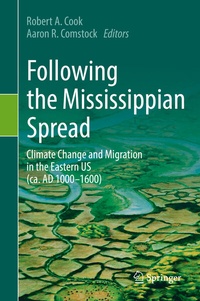
Following the Mississippian Spread
Description

The volume provides a broader case study of the links between climate change, migration, and the spread of agriculture that is relevant to archaeologists and anthropologists studying early agricultural societies throughout the world. Key patterns of adaptation to and mitigation of the effects of droughts, for example, provide a framework for understanding the options available to societies in the face of climate change afforded by the time-depth of an archaeological perspective.
More details
Other editions
Additional editions
Persons
Aaron R. Comstock is an Assistant Professor of Anthropology at Indiana University East and has been active in professional archaeology for about 15 years. His primary research interests focus on better understanding the relationships between farming societies and their local environments, particularly as this relates to long term adaptations to changing climate. Ongoing research helps shed light on the complex processes underlying the emergence of the agrarian village life in the Middle Ohio Valley of North America. Numerous publications, presentations, and public outreach events, highlight his passion for educating professional and public communities as to the importance of understanding past societies in this area of the world.
Content
Part I: Mississippian Migration and Climate Change in Global Context.- Ch 1. Migration and Climate Change in Global Context.- Ch 2.Defining Mississippian Worlds.- Part II: Cahokia and the Middle Mississippian Region.- Ch 3.Temporal Patterns in Diet and Population Movement within Greater Cahokia.- Ch 4. Migration, Population Change, and Climate at Cahokia.- Part III: Into the Upper Mississippian Region.- Ch 5. Drought, Demography, and Diaspora during the Mississippian Period: A View from the Central Illinois River Valley.- Ch 6. Late Precolumbian Subsistence Change, Socio-Political Transformation, and Ethnogenesis in the Upper Illinois River Valley.- Ch 7. Pushing and Pulling the Mississippian Moment Into the Western Great Lakes.- Part IV: Into the Midsouth, Ohio Valley, and the Southeast.- Ch 8. Middle Cumberland to Dallas: Constructing Peace in the Valley.- Ch 9. Migration and Ethnic Hybridity: Examining the Middle Ohio Valley Mississippian Periphery.- Ch 10. Population Aggregationand Dispersal as a Driver for Settlement Change in the Lower Chattahoochee River Valley between AD 1100-1550.- Part V: Into the Lower Mississippian Region.- Ch 11. Environment, Climate, and Mississippian Origins in the Lower Mississippi Valley and the Mississippi River Delta.- Ch 12. Migration, Climate Change, and Ritual in the Lower Mississippi Valley.- Ch 13. Migration and Climate Change in the Deep South (Stefan Brannan).- Part VI: Conclusion.- Ch 14. Bringing it all Back Home.
