

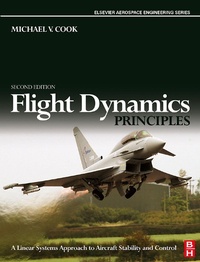
Flight Dynamics Principles
A Linear Systems Approach to Aircraft Stability and Control
2nd Edition
Published on 24. February 2011
488 pages
978-0-08-055036-7 (ISBN)
Description

The study of flight dynamics requires a thorough understanding of the theory of the stability and control of aircraft, an appreciation of flight control systems and a comprehensive grounding in the theory of automatic control. Flight Dynamics Principles provides all three in an accessible and student focussed text. Written for those coming to the subject for the first time the book is suitable as a complete first course text. It provides a secure foundation from which to move on to more advanced topics such a non-linear flight dynamics, simulation and advanced flight control, and is ideal for those on course including flight mechanics, aircraft handling qualities, aircraft stability and control. Enhances by detailed worked examples, case studies and aircraft operating condition software, this complete course text, by a renowned flight dynamicist, is widely used on aircraft engineering courses
- Suitable as a complete first course text, it provides a secure foundation from which to move on to more advanced topics such a non-linear flight dynamics, simulation and advanced flight control
- End of chapter exercises, detailed worked examples, and case studies aid understanding and relate concepts to real world applications
- Covers key contemporary topics including all aspects of optimization, emissions, regulation and automatic flight control and UAVs
- Accompanying MathCAD software source code for performance model generation and optimization
More details
Other editions
Additional editions
Michael V. Cook
Flight Dynamics Principles
A Linear Systems Approach to Aircraft Stability and Control
Book
08/2007
2nd Edition
Butterworth-Heinemann
€73.03
Article exhausted; check for reprint
Previous edition
Michael V. Cook
Flight Dynamics Principles
E-Book
10/2013
1st Edition
Butterworth-Heinemann
€45.95
Available for download
Person
After graduating Michael Cook joined Elliott Flight Automation as a Systems Engineer and contributed flight control systems design to several major projects. Later he joined the College of Aeronautics to research and teach flight dynamics, experimental flight mechanics and flight control. Previously leader of the Dynamics, Simulation and Control Research Group he is now retired and continues to provide part time support. In 2003 the Group was recognised as the Preferred Academic Capability Partner for Flight Dynamics by BAE SYSTEMS and in 2007 he received a Chairman's Bronze award for his contribution to a joint UAV research programme.
Content
- Front cover
- Flight Dynamics Principles
- Copyright page
- Contents
- Preface to the first edition
- Preface to the second edition
- Acknowledgements
- Nomenclature
- Chapter 1. Introduction
- 1.1 Overview
- 1.2 Flying and handling qualities
- 1.3 General considerations
- 1.4 Aircraft equations of motion
- 1.5 Aerodynamics
- 1.6 Computers
- 1.7 Summary
- References
- Chapter 2. Systems of axes and notation
- 2.1 Earth axes
- 2.2 Aircraft body fixed axes
- 2.3 Euler angles and aircraft attitude
- 2.4 Axes transformations
- 2.5 Aircraft reference geometry
- 2.6 Controls notation
- 2.7 Aerodynamic reference centres
- References
- Problems
- Chapter 3. Static equilibrium and trim
- 3.1 Trim equilibrium
- 3.2 The pitching moment equation
- 3.3 Longitudinal static stability
- 3.4 Lateral static stability
- 3.5 Directional static stability
- 3.6 Calculation of aircraft trim condition
- References
- Problems
- Chapter 4. The equations of motion
- 4.1 The equations of motion of a rigid symmetric aircraft
- 4.2 The linearised equations of motion
- 4.3 The decoupled equations of motion
- 4.4 Alternative forms of the equations of motion
- References
- Problems
- Chapter 5. The solution of the equations of motion
- 5.1 Methods of solution
- 5.2 Cramer's rule
- 5.3 Aircraft response transfer functions
- 5.4 Response to controls
- 5.5 Acceleration response transfer functions
- 5.6 The state space method
- 5.7 State space model augmentation
- References
- Problems
- Chapter 6. Longitudinal dynamics
- 6.1 Response to controls
- 6.2 The dynamic stability modes
- 6.3 Reduced order models
- 6.4 Frequency response
- 6.5 Flying and handling qualities
- 6.6 Mode excitation
- References
- Problems
- Chapter 7. Lateral-directional dynamics
- 7.1 Response to controls
- 7.2 The dynamic stability modes
- 7.3 Reduced order models
- 7.4 Frequency response
- 7.5 Flying and handling qualities
- 7.6 Mode excitation
- References
- Problems
- Chapter 8. Manoeuvrability
- 8.1 Introduction
- 8.2 The steady pull-up manoeuvre
- 8.3 The pitching moment equation
- 8.4 Longitudinal manoeuvre stability
- 8.5 Aircraft dynamics and manoeuvrability
- References
- Chapter 9. Stability
- 9.1 Introduction
- 9.2 The characteristic equation
- 9.3 The Routh-Hurwitz stability criterion
- 9.4 The stability quartic
- 9.5 Graphical interpretation of stability
- References
- Problems
- Chapter 10. Flying and handling qualities
- 10.1 Introduction
- 10.2 Short term dynamic models
- 10.3 Flying qualities requirements
- 10.4 Aircraft role
- 10.5 Pilot opinion rating
- 10.6 Longitudinal flying qualities requirements
- 10.7 Control anticipation parameter
- 10.8 Lateral-directional flying qualities requirements
- 10.9 Flying qualities requirements on the s-plane
- References
- Problems
- Chapter 11. Stability augmentation
- 11.1 Introduction
- 11.2 Augmentation system design
- 11.3 Closed loop system analysis
- 11.4 The root locus plot
- 11.5 Longitudinal stability augmentation
- 11.6 Lateral-directional stability augmentation
- 11.7 The pole placement method
- References
- Problems
- Chapter 12. Aerodynamic modelling
- 12.1 Introduction
- 12.2 Quasi-static derivatives
- 12.3 Derivative estimation
- 12.4 The effects of compressibility
- 12.5 Limitations of aerodynamic modelling
- References
- Chapter 13. Aerodynamic stability and control derivatives
- 13.1 Introduction
- 13.2 Longitudinal aerodynamic stability derivatives
- 13.3 Lateral-directional aerodynamic stability derivatives
- 13.4 Aerodynamic control derivatives
- 13.5 North American derivative coefficient notation
- References
- Problems
- Chapter 14. Coursework Studies
- 14.1 Introduction
- 14.2 Working the assignments
- 14.3 Reporting
- Assignment 1. Stability augmentation of the North American X-15 hypersonic research aeroplane
- Assignment 2. The stability and control characteristics of a civil transport aeroplane with relaxed longitudinal static stability
- Assignment 3. Lateral-directional handling qualities design for the Lockheed F-104 Starfighter aircraft
- Assignment 4. Analysis of the effects of Mach number on the longitudinal stability and control characteristics of the LTV A7-A Corsair aircraft
- Appendices
- 1 AeroTrim - A Symmetric Trim Calculator for Subsonic Flight Conditions
- 2 Definitions of Aerodynamic Stability and Control Derivatives
- 3 Aircraft Response Transfer Functions Referred to Aircraft Body Axes
- 4 Units, Conversions and Constants
- 5 A Very Short Table of Laplace Transforms
- 6 The Dynamics of a Linear Second Order System
- 7 North American Aerodynamic Derivative Notation
- 8 Approximate Expressions for the Dimensionless Aerodynamic Stability and Control Derivatives
- 9 The Transformation of Aerodynamic Stability Derivatives from a Body Axes Reference to a Wind Axes Reference
- 10 The Transformation of the Moments and Products of Inertia from a Body Axes Reference to a Wind Axes Reference
- 11 The Root Locus Plot
- Index
- A
- B
- C
- D
- E
- F
- G
- H
- I
- J
- K
- L
- M
- N
- O
- P
- Q
- R
- S
- T
- U
- V
- W
- Y
