

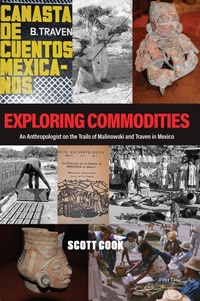
Exploring Commodities
Description

Commodities of one type or other have been produced, transferred and consumed in the economic life of humanity through every epoch of its development and forms of sociocultural organization, but are pervasive in the varieties of capitalism dominating contemporary world economies. Even labor, a necessary element in all forms of commodity production, has itself been commoditized. Embodying three kinds of potentially realizable value - use, exchange, and symbolic - commodities reflect and affect various facets of humanity's sociocultural life. They have been investigated by knowledge producers ranging from Aristotle and Ibn Khaldun through Adam Smith, David Ricardo, and Karl Marx down to a whole host of twentieth-century economists and others like the anthropologist, Bronislaw Malinowski, and the storyteller, B. Traven.
In this book noted economic anthropologist Scott Cook draws on many decades of fieldwork in the Mexican states of Oaxaca and Tamaulipas to take on the challenge of crafting an academic memoir designed to provide insights into the role of commodities in his own life and times and especially in his anthropological career. He undertakes this project in conjunction with a running interpretation of the contrasting approaches of Malinowski and Traven to the topic of commodity production and exchange in Mexico.
More details
Other editions
Additional editions
Person
After completing undergraduate studies at the University of Texas and American University (BA Economics, 1959), Scott Cook did graduate work at the University of Wisconsin (economics), the University of Puerto Rico, and completed his doctoral studies at the University of Pittsburgh in 1968. Subsequently, he served on the faculty at Michigan State University (1968-1971), and at the University of Connecticut (1971-1997) where he is currently a Professor emeritus. At UConn he also directed the Center for Latin American and Caribbean Studies (1987-1992) and the Puerto Rican and Latino Studies Institute (1996-2000). His most recent book is Land, Livelihood, and Civility in Southern Mexico (2014). Several earlier books, including Understanding Commodity Cultures (2004) and many journal articles dating back to the 1960s address various themes in economic anthropology, peasant-artisan studies, Mexican studies, and border studies, and draw upon extensive fieldwork in Oaxaca, Mexico and the Texas-Mexico border.
Content
Contents: From Pennsylvania to Texas, Places in Between, and Back Again - Encountering and Learning Anthropology at the University of Puerto Rico and the University of Pittsburgh - Appointment to the Professoriate: Negotiating the Labyrinth at a Midwestern Megaversity - Back East to New England: Career at the University of Connecticut - Malinowski and Metates in Four Oaxaca Communities, 1965- 1974 - OVSIP, the Inflation Crisis Study and the Shoot, 1978- 1990 - Traven, Handmade Bricks, and the Texas- Mexico Border - Global Change, Information Overload, and Trends in Economic Anthropology - Commodities and Unresolved Issues of Theory and Analysis - An Uncertain Future for Economic Anthropology.
