

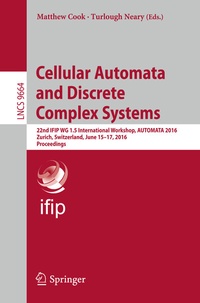
Cellular Automata and Discrete Complex Systems
22nd IFIP WG 1.5 International Workshop, AUTOMATA 2016, Zurich, Switzerland, June 15-17, 2016, Proceedings
Published on 1. June 2016
XVI, 199 pages
978-3-319-39300-1 (ISBN)
Description

This volume constitutes the thoroughly refereed proceedings of the 22nd IFIP WG 1.5International Workshop on Cellular Automata and Discrete ComplexSystems, AUTOMATA 2016, held in Zurich, Switzerland, in June 2016.
This volume contains 3 invited talks in full-paper length and 12 regularpapers, which were carefully reviewed and selected from a total of 23submissions. The papers feature research on all fundamental aspects of cellular automata and related discrete complex systems and deal with the following topics: dynamical, topological, ergodic and algebraic aspects; algorithmic and complexity issues; emergent properties; formal language processing; symbolic dynamics; models of parallelism and distributed systems; timing schemes; phenomenological descriptions; scientific modeling; and practical applications.
This volume contains 3 invited talks in full-paper length and 12 regularpapers, which were carefully reviewed and selected from a total of 23submissions. The papers feature research on all fundamental aspects of cellular automata and related discrete complex systems and deal with the following topics: dynamical, topological, ergodic and algebraic aspects; algorithmic and complexity issues; emergent properties; formal language processing; symbolic dynamics; models of parallelism and distributed systems; timing schemes; phenomenological descriptions; scientific modeling; and practical applications.
More details
Other editions
Additional editions
Matthew Cook | Turlough Neary
Cellular Automata and Discrete Complex Systems
22nd IFIP WG 1.5 International Workshop, AUTOMATA 2016, Zurich, Switzerland, June 15-17, 2016, Proceedings
Book
06/2016
Springer
€53.49
Shipment within 10-15 days
Content
- Intro
- Preface
- Organization
- Invited Talk Abstracts
- Automata, Semigroups and Dynamical Systems
- Propagation, Diffusion and Randomization in Cellular Automata
- What Automata Can Provide a Medium for Life?
- A Brief Tour of Theoretical Tile Self-Assembly
- Contents
- Invited Papers
- Propagation, Diffusion and Randomization in Cellular Automata
- 1 Introduction
- 2 Formal Definitions
- 2.1 Diamonds and Their Dynamics
- 2.2 Ergodic Dynamics
- 3 The Ideal World of 1D Abelian Linear Cellular Automata
- 3.1 A Characterization of Randomizing CA
- 3.2 Interesting Reversible Examples
- References
- What Automata Can Provide a Medium for Life?
- 1 Introduction
- 2 Some Historical Notes
- 3 Methodological Problems
- 3.1 von Neumann's Fixed-Point Trick
- 3.2 Computation Universality Is Not Enough
- 3.3 The Fragility of ``All Mine!''
- 4 Specific Ergodicity
- 5 Emergence
- 6 Life and Evolution
- 7 Conclusions
- References
- A Brief Tour of Theoretical Tile Self-Assembly
- References
- Regular Papers
- The Corona Limit of Penrose Tilings Is a Regular Decagon
- 1 Introduction
- 2 Corona Limit
- 3 Penrose Tilings
- 4 Growth Cellular Automaton on Penrose Tilings
- 5 Rhombus von Neumann Neighborhood Case
- 6 The Difference of Growth Speeds
- 7 Conclusion
- References
- The Group of Reversible Turing Machines
- 1 Introduction
- 1.1 Turing Machines and Their Generalization
- 1.2 Our Results and Comparisons with Other Groups
- 1.3 Preliminaries
- 2 Two Models for Turing Machine Groups
- 2.1 The Moving Head Model
- 2.2 The Moving Tape Model
- 2.3 The Uniform Measure and Reversibility
- 2.4 Classical Turing Machines
- 3 Properties of RTM and Interesting Subgroups
- 3.1 Local Permutations and Oblivious Turing Machines
- 3.2 Finite-State Automata
- 3.3 Elementary Turing Machines and the LEF Property of RTM
- 4 Computability Aspects
- 4.1 Basic Decidability Results
- 4.2 The Torsion Problem
- References
- Exact Discretization of 3-Speed Rational Signal Machines into Cellular Automata
- 1 Introduction
- 2 Definitions and Properties
- 3 Dynamics, Simulation and Normalization
- 4 Formal Discretization
- 5 Correctness
- 6 Conclusion
- References
- An ``almost dual'' to Gottschalk's Conjecture
- 1 Introduction
- 2 Background
- 3 Post-surjectivity
- 4 Post-surjectivity on Sofic Groups
- 5 Conclusions
- References
- On Finite Monoids of Cellular Automata
- 1 Introduction
- 2 Basic Results
- 3 The Structure of ICA(G
- A)
- 4 Generating Sets of of CA(G
- A)
- References
- Sum of Exit Times in Series of Metastable States in Probabilistic Cellular Automata
- 1 Introduction
- 2 The Model
- 3 Metastable States and Main Results
- 3.1 Potential Theoretic Approach and Capacities
- 3.2 Series of Metastable States for PCA Without Self-interaction
- 4 Sketch of proof of Theorem3.1
- 4.1 Proof of Lemma3.5
- References
- Partial Reversibility of One-Dimensional Cellular Automata
- 1 Introduction
- 2 Background
- 2.1 Basics
- 2.2 Partial Reversibility Classes
- 3 Reversibility Degree
- 3.1 Reappraisal of Relative Partial Reversibility in
- 3.2 Absolute Partial Reversibility
- 3.3 Partial Reversibility Degree of Individual Elementary Rules
- 4 Concluding Remarks
- References
- Two-Dimensional Traffic Rules and the Density Classification Problem
- 1 Introduction
- 2 Basics
- 2.1 Setting
- 2.2 Presentation of the Problem
- 2.3 Known Results with Cellular Automata
- 3 Particle Systems Solutions to the Spacing Problem
- 3.1 Our Model of IPS
- 3.2 No Solution to the Strict Spacing Problem
- 3.3 An IPS that Synchronises Checkerboards
- 3.4 Glauber Dynamics
- 4 The Density Classification Problem on Finite Lattices
- 5 Some Questions
- References
- Constant Acceleration Theorem for Extended von Neumann Neighbourhoods
- 1 Definitions
- 1.1 Cellular Automata
- 1.2 Picture Recognition
- 2 Main Result
- References
- Shrinking and Expanding Cellular Automata
- 1 Introduction
- 2 Basics
- 2.1 Standard CA
- 2.2 Shrinking and Expanding CA
- 3 Relating ATM Time to SXCA Time
- 4 Relating SXCA Time to TM Space
- 5 Conclusion and Outlook
- References
- An 8-State Simple Reversible Triangular Cellular Automaton that Exhibits Complex Behavior
- 1 Introduction
- 2 Elementary Triangular Partitioned Cellular Automata
- 3 RETPCA T0347 and Its Properties
- 3.1 Glider, Block, Fin, and Rotator in T0347
- 3.2 Changing the Move Direction of a Glider by Blocks
- 3.3 Glider Guns in T0347
- 4 T0347 is Computationally Universal
- 4.1 Showing Turing Universality of Reversible CA
- 4.2 Making Switch Gate and Inverse Switch Gate Modules in T0347
- 5 Concluding Remarks
- References
- Cellular Automata on Group Sets and the Uniform Curtis-Hedlund-Lyndon Theorem
- 1 Left Group Actions
- 2 Right Quotient Set Semi-Actions
- 3 Semi-Cellular and Cellular Automata
- 4 Invariance, Equivariance, Determination, and Composition of Global Transition Functions
- 5 Curtis-Hedlund-Lyndon Theorems
- 6 Invertibility
- References
- Author Index
