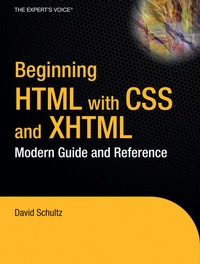
Beginning HTML with CSS and XHTML
Description

If you want to get into developing web sites, the most important thing you need is a solid understanding of Hypertext Markup Language, or HTML-the language that the majority of web site content is written in.
Beginning HTML with CSS and XHTML: Modern Guide and Reference incorporates practical examples that will show you how to structure your data correctly using (X)HTML, along with styling and layout basics using Cascading Style Sheets (CSS). Youll also learn how to add dynamic behavior to your data using the JavaScriptT language.
This book is forward-thinking because all the featured code and techniques are standards-compliant and demonstrate best practices-so you won't waste time on outdated, bad techniques. Your web pages will work properly in most web browsers and be accessible to web users with disabilities, easily locatable with popular search engines, and compact in file size.
Even if you already know HTML and CSS basics, this book will still be useful to you. It features comprehensive reference tables at the back, so you can look up all of the troublesome attributes, codes, and properties quickly and easily.
Bruce Lawson and Gez Lemon acted as technical reviewers of Beginning HTML with CSS and XHTML. Bruce and Gez are active members of the Web Standards Project's Accessibility Task Force, and have helped ensure that the book follows guidelines and best practices.
Reviews / Votes
From the reviews:
"After reading this book, an average reader should be able to create a reasonably attractive Web page . . The book explains the creation of Web pages using Hypertext Markup Language (HTML), Extensible Hypertext Markup Language (XTML), cascading style sheets (CSS), and JavaScript. The book is concise and easy to read . . Overall, I liked this book, and feel that it could be used in a general survey class on Web design and programming." (J. Miller, ACM Computing Reviews, October, 2008)
More details
Other editions
Additional editions