

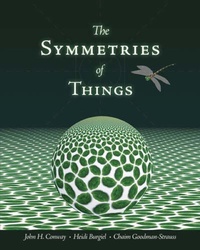
The Symmetries of Things
Published on 5. April 2016
448 pages
978-1-4398-6489-0 (ISBN)
Description

Start with a single shape. Repeat it in some way-translation, reflection over a line, rotation around a point-and you have created symmetry.
Symmetry is a fundamental phenomenon in art, science, and nature that has been captured, described, and analyzed using mathematical concepts for a long time. Inspired by the geometric intuition of Bill Thurston and empowered by his own analytical skills, John Conway, with his coauthors, has developed a comprehensive mathematical theory of symmetry that allows the description and classification of symmetries in numerous geometric environments.
This richly and compellingly illustrated book addresses the phenomenological, analytical, and mathematical aspects of symmetry on three levels that build on one another and will speak to interested lay people, artists, working mathematicians, and researchers.
Symmetry is a fundamental phenomenon in art, science, and nature that has been captured, described, and analyzed using mathematical concepts for a long time. Inspired by the geometric intuition of Bill Thurston and empowered by his own analytical skills, John Conway, with his coauthors, has developed a comprehensive mathematical theory of symmetry that allows the description and classification of symmetries in numerous geometric environments.
This richly and compellingly illustrated book addresses the phenomenological, analytical, and mathematical aspects of symmetry on three levels that build on one another and will speak to interested lay people, artists, working mathematicians, and researchers.
Reviews / Votes
The book contains many new results. ... [and] is printed on glossy pages with a large number of beautiful full-colour illustrations, which can be enjoyed even by non-mathematicians.-- EMS Newsletter, June 2009
One of the most base concepts of art [is] symmetry. The Symmetries of Things is a guide to this most basic concept showing that even the most basic of things can be beautiful-and addresses why the simplest of patterns mesmerizes humankind and the psychological and mathematical importance of symmetry in ones every day life. The Symmetries of Things is an intriguing book from first page to last, highly recommended to the many collections that should welcome it.
-- The Midwest Book Review, June 2008
Conway, Burgiel, and Goodman-Strauss have written a wonderful book which can be appreciated on many levels. ... [M]athematicians and math-enthusiasts at a wide variety of levels will be able to learn some new mathematics. Even better, the exposition is lively and engaging, and the authors find interesting ways of telling you the things you already know in addition to the things you don't.
-- Darren Glass, MAA Reviews, July 2008
This rich study of symmetrical things . . . prepares the mind for abstract group theory. It gets somewhere, it justifies the time invested with striking results, and it develops . . . phenomena that demand abstraction to yield their fuller meaning. . . . the fullest available exposition with many new results.
-- D. V. Feldman, CHOICE Magazine , January 2009
This book is a plaything, an inexhaustible exercise in brain expansion for the reader, a work of art and a bold statement of what the culture of math can be like, all rolled into one. Like any masterpiece, The Symmetries of Things functions on a number of levels simultaneously. . . . It is imperative to get this book into the hands of as many young mathematicians as possible. And then to get it into everyone else's hands.
-- Jaron Lanier, American Scientist, January 2009
You accompany the authors as they learn about the structures they so beautifully illustrate on over 400 hundred glossy and full-colour pages. Tacitly, you are given an education in the ways of thought and skills of way-finding in mathematics. . . . The style of writing is relaxed and playful . . . we see the fusing of the best aspects of textbooks-conciseness, flow, reader-independence-with the best bit of popular writing-accessibility, fun, beauty.
-- Phil Wilson, Plus Magazine, February 2009
This book gives a refreshing and comprehensive account of the subject of symmetry-a subject that has fascinated humankind for centuries. . . . Overall, the book is a treasure trove, full of delights both old and new. Much of it should be accessible for anyone with an undergraduate-level background in mathematics, and is likely to stimulate further interest.
-- Marston Conder, Mathematical Reviews, March 2009
Inspired by the geometric intuition of Bill Thurston and empowered by his own analytical skills, John Conway, together with his coauthors, has developed a comprehensive mathematical theory of symmetry that allows the description and classification of symmetries in numerous geometric environments. This richly and compellingly illustrated book addresses the phenomenological, analytical, and mathematical aspects of symmetry on three levels that build on one another and will speak to interested lay people, artists, working mathematicians, and researchers.
-- L'Enseignement Mathematique, December 2009
More details
Series
Language
English
Place of publication
Florida
United States
Publishing group
Taylor & Francis Inc
Target group
Professional and scholarly
File size
42,22 MB
ISBN-13
978-1-4398-6489-0 (9781439864890)
Copyright in bibliographic data and cover images is held by Nielsen Book Services Limited or by the publishers or by their respective licensors: all rights reserved.
Schweitzer Classification
Other editions
Additional editions

John H. Conway | Heidi Burgiel | Chaim Goodman-Strauss
The Symmetries of Things
Book
04/2008
1st Edition
A K Peters
€107.50
Shipment within 3-4 weeks
Persons
John H. Conway is the John von Neumann Chair of Mathematics at Princeton University. He obtained his BA and his PhD from the University of Cambridge (England). He is a prolific mathematician active in the theory of finite groups, knot theory, number theory, combinatorial game theory, and coding theory. He has also contributed to many branches of recreational mathematics, notably the invention of the Game of Life.
Heidi Burgiel is a professor in the Department of Mathematics and Computer Science at Bridgewater State College. She obtained her BS in Mathematics from MIT and her PhD in Mathematics from the University of Washington. Her primary interests are educational technology and discrete geometry.
Chaim Goodman-Strauss is a professor in the department of mathematical sciences at the University of Arkansas. He obtained both his BS and PhD in Mathematics at the University of Texas at Austin. His research interests include low-dimensional topology, discrete geometry, differential geometry, the theory of computation, and mathematical illustration. Since 2004 he has been broadcasting mathematics on a weekly radio segment.
Heidi Burgiel is a professor in the Department of Mathematics and Computer Science at Bridgewater State College. She obtained her BS in Mathematics from MIT and her PhD in Mathematics from the University of Washington. Her primary interests are educational technology and discrete geometry.
Chaim Goodman-Strauss is a professor in the department of mathematical sciences at the University of Arkansas. He obtained both his BS and PhD in Mathematics at the University of Texas at Austin. His research interests include low-dimensional topology, discrete geometry, differential geometry, the theory of computation, and mathematical illustration. Since 2004 he has been broadcasting mathematics on a weekly radio segment.
Content
Symmetries of Finite Objects and Plane Repeating Patterns
Symmetries
Planar Patterns
The Magic Theorem
The Spherical Patterns
Frieze Patterns
Why the Magic Theorems Work
Euler's Map Theorem
Classification of Surfaces
Orbifolds
Color Symmetry, Group Theory, and Tilings
Presenting Presentations
Twofold Colorations
Threefold Colorings of Plane Patterns
Searching for Relations
Types of Tilings
Abstract Groups
Repeating Patterns in Other Spaces
Introducing Hyperbolic Groups
More on Hyperbolic Groups
Archimedean Tilings
Generalized Schlaefli Symbols
Naming Archimedean and Catalan Polyhedra and Tilings
The 35 "Prime" Space Groups
Objects with Prime Symmetry
Flat Universes
The 184 Composite Space Groups
Higher Still
Symmetries
Planar Patterns
The Magic Theorem
The Spherical Patterns
Frieze Patterns
Why the Magic Theorems Work
Euler's Map Theorem
Classification of Surfaces
Orbifolds
Color Symmetry, Group Theory, and Tilings
Presenting Presentations
Twofold Colorations
Threefold Colorings of Plane Patterns
Searching for Relations
Types of Tilings
Abstract Groups
Repeating Patterns in Other Spaces
Introducing Hyperbolic Groups
More on Hyperbolic Groups
Archimedean Tilings
Generalized Schlaefli Symbols
Naming Archimedean and Catalan Polyhedra and Tilings
The 35 "Prime" Space Groups
Objects with Prime Symmetry
Flat Universes
The 184 Composite Space Groups
Higher Still
