

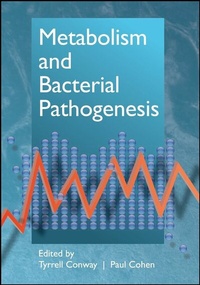
Metabolism and Bacterial Pathogenesis
Description

Groundbreaking thinking on how bacterial metabolism is foundational to pathogenesis
For too long, bacterial metabolism and bacterial pathogenesis have been studied as separate entities. However, the scientific community is beginning to realize that not only are bacterial nutrient acquisition and utilization essential for pathogenesis, but that interfering with the pathogen-specific metabolic pathways used during infection can regulate virulence factor expression and might lead to effective breakthroughs in a variety of treatments.
Editors Paul Cohen and Tyrrell Conway, who pioneered the use of metabolic mutants in competitive colonization assays, an approach now widely used to investigate the nutrition of pathogens in vivo, are uniquely qualified to advance our knowledge of this integrative field of research. They convened a group of contributors who are breaking new ground in understanding how bacterial metabolism is foundational to pathogenesis to share their expert perspectives and outlook for the future.
Beginning with overviews, Metabolism and Bacterial Pathogenesis covers
- a wide range of diseases and both Gram-positive and -negative bacteria that serve as model systems for in vitro and in vivo investigations
- intracellular, respiratory, and enteric pathogens
- pathogen-specific nutrient acquisition in hosts
- mechanisms of host-driven metabolic adaptation by pathogens
- metabolic regulation of virulence gene expression
Useful for specialists in bacterial pathogenesis and specialists in metabolism as well as molecular biologists, physicians, veterinarians, dentists, graduate and undergraduate students, and laboratory technicians, Metabolism and Bacterial Pathogenesis is also essential reading for scientists studying the microbiome.
More details
Other editions
Additional editions
Content
1 Glycolysis for the Microbiome Generation
2 Pathogenesis - Thoughts from the Front Line
3 Metabolic Adaptations of Intracellullar Bacterial Pathogens and their Mammalian Host Cells during Infection ("Pathometabolism")
4 Small RNAs Regulate Primary and Secondary Metabolism in Gram-negative Bacteria
5 Sialic acid and N-acetylglucosamine Regulate type 1 Fimbriae Synthesis
6 Trigger Enzymes: Coordination of Metabolism and Virulence Gene Expression
7 Regulating the Intersection of Metabolism and Pathogenesis in Gram-positive Bacteria
8 Borrelia burgdorferi: Carbon Metabolism and the Tick-Mammal Enzootic Cycle
9 Metabolism and Pathogenicity of Pseudomonas aeruginosa Infections in the Lungs of Individuals with Cystic Fibrosis
10 Metabolism and Fitness of Urinary Tract Pathogens
11 Bacterial Metabolism in the Host Environment: Pathogen Growth and Nutrient Assimilation in the Mammalian Upper Respiratory Tract
12 Saliva as the Sole Nutritional Source in the Development of Multispecies Communities in Dental Plaque
13 Enteric Pathogens Exploit the Microbiota-generated Nutritional Environment of the Gut
14 The Roles of Inflammation, Nutrient Availability and the Commensal Microbiota in Enteric Pathogen Infection
15 Host Sialic Acids: A Delicacy for the Pathogen with Discerning Taste
16 Commensal and Pathogenic Escherichia coli Metabolism in the Gut
Index
1 Glycolysis for Microbiome Generation
ALAN J. WOLFE1
BENEATH BEHAVIOR LIES METABOLISM
There is no life without metabolism. There is nothing surprising about this statement; it is blatantly obvious and true for both host and bacteria, whether commensal or pathogen. What is surprising is the delayed general recognition that metabolism plays a, or perhaps, the central role in pathogenesis, which is simply a manifestation of the need for certain "bad" bacteria to grow and divide on or in a host. Perhaps this delay is natural, as researchers tend to focus on particularities, in this case, cellular processes unique to pathogenesis. Another reason for this delay is likely the aversion of late 20th Century microbiologists, who came to science after the heyday of bacterial metabolic research and who were forced to memorize whole swaths of the metabolic chart, usually out of context and with little understanding of the intricate linkages between metabolic pathways and their connections to other cellular processes.
This certainly had been my experience, at least until the day Pat Conley and I added acetate to Escherichia coli cells "gutted" for all but one of the chemotaxis proteins (CheY) and unexpectedly observed flagellar motors intermittently rotate clockwise instead of incessant counterclockwise rotation (1). Although we strongly suspected that this behavior required that the acetate be metabolized, we had no idea how. So, in the days before the Internet, we went looking for the metabolic chart, which we quickly discovered was pristine, still in its plastic wrapper within its cylinder, behind one of the lab doors. Apparently, this biophysics lab (headed by Howard Berg) had had no prior need for metabolism. The lab was studying bacterial behavior-chemotaxis and motility-not metabolism. However, on that day, I began to investigate the metabolism that underlay that bacterial behavior.
From the metabolic chart, we learned that E. coli cells convert acetate into acetyl coenzyme A (acCoA) by means of the reversible acetate kinase (AckA)-phosphotransacetylase (Pta) pathway, whose intermediate is acetyl phosphate (acP) or through the irreversible acetyl CoA synthetase (Acs), whose intermediate is acetyladenylate (acAMP) (Fig. 1). From my subsequent reading of the "ancient" literature, typically JBC volumes stored horizontally on the top shelf in Harvard's Biolabs library and covered in years of dust, I discovered Fritz Lipmann, Feodor Lynen, Hans Krebs, and others who had sought the "activated acetate" that we now know to be acCoA (2, 3). Whether derived from glucose via glycolysis or from acetate via Acs or the AckA-Pta pathway, the resultant acCoA replenishes the tricarboxylic acid (TCA) cycle and the glyoxylate shunt to generate energy and provide building blocks for the synthesis of amino acids, nucleotides, and other essential compounds. AcCoA also plays direct roles in the synthesis of fatty acids, amino acids, and most secondary metabolites, including many antibiotics. As such, acCoA could be considered the keystone molecule of central metabolism.
FIGURE 1 Acetyl-coenzyme A (AcCoA) is the keystone molecule of central metabolism. Glucose is metabolized via the EMP pathway to AcCoA in an NAD+-dependent manner. The AcCoA is interconverted with amino acids and fatty acids. It replenishes the NAD+-dependent tricarboxylic acid (TCA) cycle. It is the substrate for most secondary metabolites and the acetyl donor for some lysine acetylations, such as the PAT-dependent acetylation of ACS (acCoA synthetase). Acetate dissimilation requires the Pta-AckA pathway. The enzyme PTA (phosphotransacetylase) converts AcCoA and inorganic phosphate (Pi) into coenzyme A (CoA) and the high-energy pathway intermediate AcP. AcP donates its phosphoryl group to certain two-component response regulators (RR). AcP also can donate its acetyl group to hundreds of proteins. The enzyme ACKA (acetate kinase) converts AcP and ADP to acetate and ATP. The acetate freely diffuses across the cell envelope into the environment. Acetate assimilation requires the high-affinity enzyme ACS. In a two-step process that involves an enzyme-bound intermediate (acAMP), Acs converts acetate, ATP, and CoA into AMP, pyrophosphate (PPi), and acCoA. ACS activity is inhibited by acetylation of a conserved lysine catalyzed by the lysine acetyltransferase (PAT, also known as YfiQ and Pka). Reactivation is catalyzed by the NAD+-dependent deacetylase CobB. Adapted from Hu et al., 2010. GAPDH, glyceraldehyde-3-phosphate dehydrogenase; PDH, pyruvate dehydrogenase. doi:10.1128/microbiolspec.MBP-0014-2014.f1
In our 1988 report, we provided evidence that an activated acetate molecule was responsible for our acetate effect on flagellar rotation. We thought that it was acetyladenylate (acAMP), the intermediate of the Acs pathway (1). Subsequently, others determined that multiple mechanisms were at work, that Acs could acetylate the two-component response regulator CheY, presumably using acAMP as the acetyl donor, that acP could donate either its phosphoryl or acetyl group to CheY or that acCoA could donate its acetyl group. Each posttranslational modification (phosphorylation and acetylation) inhibits the other, but both independently increase the probability that CheY will bind the flagellar motor and induce clockwise rotation (1, 4-17). We now know that, under physiologically relevant conditions, acP can donate its phosphoryl group to and activate other response regulators, including NtrC, OmpR, RcsB, CpxR, RssB, SirA/UvrY, Rpr2, DegU, and FlgR from E. coli, Salmonella enterica, Yersinia pestis, Campylobacter jejuni, Listeria monocytogenes, and Borrelia burgdorferi (18-37).
Following the initial reports that CheY could be acetylated (4, 6), Jorge Escalante-Semerena and his student Vincent Starai reported that a protein acetyltransferase (known as Pat in S. enterica and YfiQ, Pka, or PatZ in E. coli) catalyzes the Ne-lysine acetylation of Acs using acCoA as the acetyl donor (38). They had earlier linked acetylation to central metabolism by showing that the reversal of Acs acetylation required CobB (39), a member of the NAD+-dependent sirtuin family of lysine deacetylases (40). It is now known that lysine acetyltransferases and deacetylases are ubiquitous in bacteria (41-44).
More recently, Choudhary's group and ours reported that acP can donate its acetyl group to thousands of lysines on hundreds of proteins, many of which are central to pathogenesis. Amazingly, this process does not require an enzyme (45, 46) but does require that the molecular environment of the lysine residue permit binding of the phosphoryl group and the activation (deprotonation) of the lysine (45). The full impact of protein acetylation remains to be investigated, but several studies have hinted that it could affect pathogenesis (20-22, 47, 48).
A GLYCOLYSIS PRIMER
Having made an argument that one small but central part of metabolism likely plays a role in bacterial pathogenesis, I will attempt to make that metabolism a bit more accessible. I will specifically devote the rest of this chapter to glycolysis. In this context, you should notice that NAD+, acCoA, and acP are mentioned often.
Metabolism refers to biochemical pathways that either generate biologically usable energy (catabolism) or consume that energy to permit growth (anabolism). Catabolism converts chemical or electromagnetic energy into the high-energy bonds of ATP. Cells generate ATP via two distinctly different mechanisms: substrate-level phosphorylation and oxidative phosphorylation. Substrate-level phosphorylation is a process that synthesizes ATP by converting an organic molecule from one form to another (Fig. 2). In contrast, oxidative phosphorylation generates ATP via an ATP synthetase that uses a proton motive force established by driving electrons through a membrane-bound electron transport system associated with respiration, photosynthesis, or some other type of bacterial metabolism. Anabolism uses the energy of ATP to synthesize cellular components. Some pathways are strictly catabolic, while some are strictly anabolic. The central metabolic pathways, however, tend to be amphibolic; they contribute both energy (catabolism) and biosynthetic precursors (anabolism). Glycolysis is amphibolic.
FIGURE 2 Three substrate-level phosphorylations. The first two examples are steps in the lower half of the EMP pathway. The third is a step in acetate fermentation. doi:10.1128/microbiolspec.MBP-0014-2014.f2
Given the knowledge that the human microbiome consists of thousands of different species (49-51) that are mostly uncharacterized, it is important to remember that different metabolic programs exist. Some bacteria are strict anaerobes, others are strict aerobes, and facultative anaerobes can do both. Some are strict fermenters, others are strict nonfermenters (i.e., they rely on respiration), and some can do both. In this context, note that diverse glycolytic strategies are available. These include (but are not limited to) the Embden-Meyerhof-Parnas, the Pentose Phosphate, and the Entner-Doudoroff pathways, which are...
