

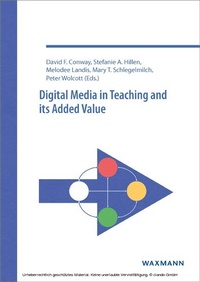
Digital Media in Teaching and its Added Value
1st Edition
Published on 1. December 2015
236 pages
978-3-8309-8287-6 (ISBN)
Description

This book project was initiated in fall 2013 at the University of Nebraska at Omaha (UNO), Nebraska during a Global Engagement Research and Teaching Workshop between faculty from UNO and the University of Agder (UiA), Norway.
The anthology presents articles that center on the application of digital technologies that add value to the teaching and learning process in a globalized context. The unique focus of the book is the intersection between pedagogy and technology, specifically the innovative use of technology to improve higher education teaching and learning. With the increased mobility of faculty and students, more diversity among our students and faculty, increased cross-disciplinary designs, alternative environments enabled by technology, and greater demand from the millennial generation for increased access and flexibility, it is important to share accounts where technology has made a positive impact on the instructional process.
Topics that are discussed are local studies with implications for the global environment and the innovative use of technology to improve higher education teaching and learning.
The target audiences for the book are researchers, teachers and stakeholders in learning organizations interested in using IT for teaching and learning.
The anthology presents articles that center on the application of digital technologies that add value to the teaching and learning process in a globalized context. The unique focus of the book is the intersection between pedagogy and technology, specifically the innovative use of technology to improve higher education teaching and learning. With the increased mobility of faculty and students, more diversity among our students and faculty, increased cross-disciplinary designs, alternative environments enabled by technology, and greater demand from the millennial generation for increased access and flexibility, it is important to share accounts where technology has made a positive impact on the instructional process.
Topics that are discussed are local studies with implications for the global environment and the innovative use of technology to improve higher education teaching and learning.
The target audiences for the book are researchers, teachers and stakeholders in learning organizations interested in using IT for teaching and learning.
More details
Other editions
Additional editions
David F. Conway | Stefanie Hillen | Melodee Landis
Digital Media in Teaching and its Added Value
Book
02/2020
Waxmann
€34.90
Shipment within 10-15 days
Content
1 - Buchtitel [Seite 1]
1.1 - Contents [Seite 5]
1.2 - Preface [Seite 7]
2 - The Value of Investigating Information Technology Applications for Teaching and Learning Purposes (David F. Conway, Melodee Landis, Stefanie A. Hillen, Mary T. Schlegelmilch and Peter Wolcott) [Seite 11]
2.1 - 1. Overview on the Value of Investigating Information Technology Applications for Teaching and Learning Purposes [Seite 11]
2.1.1 - 1.1 IT-Pedagogy in Education [Seite 11]
2.1.2 - 1.2 Theoretical Frameworks [Seite 12]
2.2 - 2. The Volume's Discussions in Detail [Seite 13]
2.2.1 - 2.1 Instruction in Higher Education [Seite 14]
2.2.2 - 2.2 Education and Training [Seite 15]
2.2.3 - 2.3 Globalization and Social Media [Seite 15]
2.3 - 3. Challenges Made Visible, Preliminary Overarching Findings and Outlook [Seite 16]
2.4 - References [Seite 17]
3 - Adding Value with Constructivism - Using a Constructivist Model to Expand Teachers' Uses of Digital Technology (Melodee Landis) [Seite 21]
3.1 - Abstract [Seite 21]
3.2 - 1. Using a Constructivist Model to Expand Teachers' Uses of Digital Technology [Seite 21]
3.3 - 2. Procedure [Seite 22]
3.4 - 3. The Model [Seite 23]
3.5 - 4. The Study [Seite 24]
3.6 - 5. Results [Seite 25]
3.7 - 6. Conclusion [Seite 31]
3.8 - References [Seite 32]
4 - Towards a Contingency Theory of eLearning (Deepak Khazanchi, Bjørn Erik Munkvold and Aleksandra Lazareva) [Seite 35]
4.1 - Abstract [Seite 35]
4.2 - 1. Background and Purpose [Seite 35]
4.3 - 2. Theory Development [Seite 36]
4.4 - 3. Discussion and an Illustration [Seite 42]
4.5 - 4. Implications and Concluding Remarks [Seite 47]
4.6 - References [Seite 48]
5 - Collaborative Technologies and Digital Media in Teaching and Learning: Starting Small and Learning Along the Way (Jeanne L. Surface, Mary T. Schlegelmilch and Phyllis Adcock) [Seite 52]
5.1 - Abstract [Seite 52]
5.2 - 1. Introduction - Starting Small [Seite 52]
5.3 - 2. Purpose [Seite 53]
5.4 - 3. Research Design [Seite 53]
5.5 - 4. Challenges, Discoveries and Experiences Made [Seite 55]
5.5.1 - 4.1 Jeanne's Journey [Seite 55]
5.5.2 - 4.2 Phyllis's Journey [Seite 58]
5.5.3 - 4.3 Mary's Journey [Seite 61]
5.6 - 5. Conclusions [Seite 65]
5.7 - Outlook [Seite 66]
5.8 - References [Seite 66]
6 - IT-Integrated Approaches in Everyday Teaching in Higher Education: Supporting Interaction and Communication in High Enrollment Classes (Stefanie A. Hillen) [Seite 67]
6.1 - Abstract [Seite 67]
6.2 - Introduction [Seite 67]
6.3 - 1. Learning with IT-Tools: Theoretical Platform and Research Objective [Seite 68]
6.4 - 2. Applied Tools and their Organizational and Educational Functions for Teaching and Learning [Seite 69]
6.4.1 - 2.1 Baseline for Feedback and Formative Assessment [Seite 69]
6.4.2 - 2.2 Tools Applied to Lectures, Seminars and Accompanying Learning Activities [Seite 70]
6.5 - 3. Analysis on the ICT Integrated Course and Students Results [Seite 76]
6.5.1 - 3.1 Descriptive Quantitative Results - Distribution and Correlation [Seite 76]
6.5.2 - 3.2 Students' Perceptions and Students' Data [Seite 78]
6.6 - 4. On the Educational Added Value of the IT Application and Requirements for Its Use [Seite 80]
6.7 - References [Seite 81]
7 - Information Technology for Development: Service Learning from Classroom to Community and Back Again (Peter Wolcott and R. J. Redden) [Seite 85]
7.1 - Abstract [Seite 85]
7.2 - 1. Introduction [Seite 85]
7.2.1 - 1.1 From Classroom [Seite 86]
7.2.2 - 1.2 To Community [Seite 87]
7.3 - 2. Methods and Techniques Applied [Seite 88]
7.3.1 - 2.1 Agile Training [Seite 88]
7.3.2 - 2.2 Pair Training [Seite 91]
7.3.3 - 2.3 Parallel Tracks [Seite 91]
7.3.4 - 2.4 Refocus on the User [Seite 92]
7.3.5 - 2.5 The OODA Loop [Seite 92]
7.3.6 - 2.6 Demonstrationless Training [Seite 93]
7.4 - 3. Agile Training Process [Seite 94]
7.5 - 4. Measuring Impact [Seite 94]
7.6 - 5. And Back Again [Seite 96]
7.7 - 6. Summary and Conclusions [Seite 97]
7.8 - References [Seite 98]
8 - Educating Programming Students for the Industry (Morten Goodwin, Christian Auby, Rune Andersen and Vera Barstad) [Seite 100]
8.1 - Abstract [Seite 100]
8.2 - 1. Introduction [Seite 100]
8.3 - 2. Motivation [Seite 101]
8.3.1 - 2.1 Business Environments [Seite 101]
8.3.2 - 2.2 Immediate Feedback [Seite 102]
8.3.3 - 2.3 Peer Review [Seite 103]
8.4 - 3. Design of Study [Seite 103]
8.4.1 - 3.1 Prototype [Seite 104]
8.4.2 - 3.2 Version Control [Seite 106]
8.4.3 - 3.3 Build and Test Environment [Seite 106]
8.4.4 - 3.4 Build Plan [Seite 107]
8.4.5 - 3.5 Student Activities [Seite 108]
8.4.6 - 3.6 Peer Review [Seite 109]
8.5 - 4. Test Case - Basic Programming [Seite 110]
8.5.1 - 4.1 Usage - Commits [Seite 110]
8.5.2 - 4.2 Assignment and Feedback [Seite 111]
8.6 - 5. Discussion [Seite 113]
8.6.1 - 5.1 Typical Student Mistakes [Seite 113]
8.6.2 - 5.2 Cursing over Version Control [Seite 114]
8.6.3 - 5.3 Unforeseen Advantages [Seite 114]
8.6.4 - 5.4 Possibilities of Cheating [Seite 114]
8.6.5 - 5.5 Tests which are not Passed in the Automatic Testing [Seite 115]
8.6.6 - 5.6 Learning Outcome [Seite 115]
8.7 - 6. Conclusion [Seite 115]
8.8 - Acknowledgement [Seite 116]
8.9 - References [Seite 116]
9 - The World Needs More Computer Science! What to do? (Victor Winter) [Seite 119]
9.1 - 1. Introduction: Computer Science Education [Seite 119]
9.2 - 2. The Bricklayer System [Seite 121]
9.2.1 - 2.1 Target Audience [Seite 121]
9.2.2 - 2.2 System Components [Seite 123]
9.2.3 - 2.3 System Requirements [Seite 124]
9.3 - 3. Method: The "Vitruvia Way" [Seite 125]
9.3.1 - 3.1 Vitruvia Basics - Before Coding [Seite 125]
9.3.2 - 3.2 Vitruvia Level 1 Coding [Seite 129]
9.3.3 - 3.3 Vitruvia Level 2 Coding [Seite 131]
9.3.4 - 3.4 Vitruvia Level 3 Coding [Seite 132]
9.3.5 - 3.5 Vitruvia Level 4 Coding [Seite 134]
9.3.6 - 3.6 Vitruvia Level 5 Coding [Seite 134]
9.4 - 4. Future Work - Level 6 and Beyond [Seite 136]
9.5 - 5. Summary and Conclusion [Seite 140]
9.6 - References [Seite 140]
10 - Building an Online Systems Development Course - Experiences with Content and Interaction Design (Paul J. A. van Vliet) [Seite 142]
10.1 - Abstract [Seite 142]
10.2 - 1. Introduction [Seite 142]
10.3 - 2. The Systems Development Courses: An Overview [Seite 142]
10.4 - 3. A Pedagogical Basis for Course Redevelopment [Seite 144]
10.5 - 4. Course Redevelopment Initiation [Seite 144]
10.6 - 5. Online Course Content Development [Seite 145]
10.7 - 6. Online Course Content Delivery [Seite 147]
10.8 - 7. Software Development Tools for Online Students [Seite 147]
10.9 - 8. Online Collaboration Tools and Usage [Seite 148]
10.10 - 9. Lessons Learned from the Course Redevelopment Effort [Seite 150]
10.10.1 - 9.1 Today's Students and Their Expectations [Seite 150]
10.10.2 - 9.2 Establishing a Course Rhythm [Seite 151]
10.10.3 - 9.3 The Value of Preparation [Seite 151]
10.10.4 - 9.4 The Value of Media Flexibility [Seite 152]
10.10.5 - 9.5 The Value of Collaboration Platform Flexibility [Seite 153]
10.10.6 - 9.6 Establishing Collaboration Protocols [Seite 153]
10.10.7 - 9.7 The Instructor's Role(s) [Seite 154]
10.10.8 - 9.8 Course Redevelopment Effort Summary [Seite 155]
10.11 - 10. Conclusion [Seite 156]
10.12 - References [Seite 157]
11 - How to Teach Habits? (Rune Andersen, Andreas Prinz and Halvard Øysæd) [Seite 159]
11.1 - Abstract [Seite 159]
11.2 - 1. Introduction [Seite 159]
11.3 - 2. Background: Changes in Project Management [Seite 160]
11.3.1 - 2.1 Changes in National Engineering Curriculum [Seite 160]
11.3.2 - 2.2 The Industry [Seite 161]
11.3.3 - 2.3 Learning Outcomes for Project Management [Seite 161]
11.4 - 3. Theory: Habits related to Bloom's Taxonomy [Seite 162]
11.4.1 - 3.1 Bloom's taxonomy [Seite 162]
11.4.1.1 - 3.1.1 The Cognitive Domain [Seite 162]
11.4.1.2 - 3.1.2 The Affective Domain [Seite 163]
11.4.1.3 - 3.1.3 The Psychomotor Domain [Seite 163]
11.4.2 - 3.2 Learning by Doing [Seite 164]
11.4.3 - 3.3 Transfer of Learning [Seite 165]
11.5 - 4. Experiment [Seite 165]
11.5.1 - 4.1 Learning Outcomes for Project Management [Seite 165]
11.5.2 - 4.2 Experiment Description [Seite 166]
11.5.3 - 4.3 Experiment Results [Seite 166]
11.5.4 - 4.4 Conclusions from the Experiment [Seite 167]
11.6 - 5. Discussion [Seite 167]
11.6.1 - 5.1 Habits in Bloom's Taxonomy [Seite 168]
11.6.2 - 5.2 Teaching Habits [Seite 169]
11.6.3 - 5.3 The Role of Digital Media in Teaching Habits [Seite 170]
11.7 - 6. Summary [Seite 171]
11.8 - Acknowledgments [Seite 171]
11.9 - References [Seite 172]
12 - Education for Sustainable Development Going Online (Sven Åke Bjørke) [Seite 177]
12.1 - Abstract [Seite 177]
12.2 - 1. Introduction [Seite 177]
12.3 - 2. Towards Constructivism in Education for Sustainable Development [Seite 178]
12.4 - 3. ICT-Supported Learning and Education for Sustainable Development [Seite 179]
12.5 - 4. Holistic Education Promoted by ICT and Education for Sustainable Development [Seite 180]
12.6 - 5. Online Education in Developing Countries? [Seite 181]
12.7 - 6. ICT and E-Pedagogy [Seite 183]
12.8 - 7. Conclusion [Seite 188]
12.9 - References [Seite 189]
13 - Social Media Communication in the Classroom: A Pedagogical Case Study of Social Network Analysis (Jeremy Harris Lipschultz) [Seite 191]
13.1 - Abstract [Seite 191]
13.2 - Introduction [Seite 191]
13.3 - CMC: Identity, Interaction and Community [Seite 191]
13.4 - Social Media Communication (SMC) Academic Disruption [Seite 192]
13.5 - SNA Network Context and Research Framework [Seite 193]
13.6 - Case Study: #Milk4Kids Twitter Hashtag [Seite 195]
13.7 - Conclusion [Seite 204]
13.8 - References [Seite 205]
14 - Online Learning Needs Assessment in Uganda (Godfrey Mayende, Paul B. Muyinda, Andreas Prinz, Ghislain Maurice N. Isabwe and Dianah Nampijja) [Seite 208]
14.1 - Abstract [Seite 208]
14.2 - 1. Introduction [Seite 208]
14.3 - 2. Methodology [Seite 210]
14.4 - 3. Findings [Seite 211]
14.4.1 - 3.1 Social Demographic Characteristics [Seite 211]
14.4.2 - 3.2 ICT Infrastructures in the Higher Education Institutions in Uganda [Seite 212]
14.4.3 - 3.3 Modes of Delivery of Distance Learning in Higher Education Institutions in Uganda [Seite 217]
14.4.4 - 3.4 ICT Integration in the Teaching and Learning [Seite 218]
14.4.5 - 3.5 Awareness of Learning Management System (LMS) [Seite 219]
14.4.6 - 3.6 Opportunities for Capacity Building [Seite 219]
14.4.7 - 3.7 Challenges and suggestions in the use of ICT in teaching and learning [Seite 220]
14.5 - 4. Discussion [Seite 221]
14.6 - 5. Summary and Conclusion [Seite 222]
14.7 - 6. Acknowledgements [Seite 223]
14.8 - References [Seite 223]
15 - About the authors [Seite 225]
16 - Matrix of digital themes [Seite 234]
1.1 - Contents [Seite 5]
1.2 - Preface [Seite 7]
2 - The Value of Investigating Information Technology Applications for Teaching and Learning Purposes (David F. Conway, Melodee Landis, Stefanie A. Hillen, Mary T. Schlegelmilch and Peter Wolcott) [Seite 11]
2.1 - 1. Overview on the Value of Investigating Information Technology Applications for Teaching and Learning Purposes [Seite 11]
2.1.1 - 1.1 IT-Pedagogy in Education [Seite 11]
2.1.2 - 1.2 Theoretical Frameworks [Seite 12]
2.2 - 2. The Volume's Discussions in Detail [Seite 13]
2.2.1 - 2.1 Instruction in Higher Education [Seite 14]
2.2.2 - 2.2 Education and Training [Seite 15]
2.2.3 - 2.3 Globalization and Social Media [Seite 15]
2.3 - 3. Challenges Made Visible, Preliminary Overarching Findings and Outlook [Seite 16]
2.4 - References [Seite 17]
3 - Adding Value with Constructivism - Using a Constructivist Model to Expand Teachers' Uses of Digital Technology (Melodee Landis) [Seite 21]
3.1 - Abstract [Seite 21]
3.2 - 1. Using a Constructivist Model to Expand Teachers' Uses of Digital Technology [Seite 21]
3.3 - 2. Procedure [Seite 22]
3.4 - 3. The Model [Seite 23]
3.5 - 4. The Study [Seite 24]
3.6 - 5. Results [Seite 25]
3.7 - 6. Conclusion [Seite 31]
3.8 - References [Seite 32]
4 - Towards a Contingency Theory of eLearning (Deepak Khazanchi, Bjørn Erik Munkvold and Aleksandra Lazareva) [Seite 35]
4.1 - Abstract [Seite 35]
4.2 - 1. Background and Purpose [Seite 35]
4.3 - 2. Theory Development [Seite 36]
4.4 - 3. Discussion and an Illustration [Seite 42]
4.5 - 4. Implications and Concluding Remarks [Seite 47]
4.6 - References [Seite 48]
5 - Collaborative Technologies and Digital Media in Teaching and Learning: Starting Small and Learning Along the Way (Jeanne L. Surface, Mary T. Schlegelmilch and Phyllis Adcock) [Seite 52]
5.1 - Abstract [Seite 52]
5.2 - 1. Introduction - Starting Small [Seite 52]
5.3 - 2. Purpose [Seite 53]
5.4 - 3. Research Design [Seite 53]
5.5 - 4. Challenges, Discoveries and Experiences Made [Seite 55]
5.5.1 - 4.1 Jeanne's Journey [Seite 55]
5.5.2 - 4.2 Phyllis's Journey [Seite 58]
5.5.3 - 4.3 Mary's Journey [Seite 61]
5.6 - 5. Conclusions [Seite 65]
5.7 - Outlook [Seite 66]
5.8 - References [Seite 66]
6 - IT-Integrated Approaches in Everyday Teaching in Higher Education: Supporting Interaction and Communication in High Enrollment Classes (Stefanie A. Hillen) [Seite 67]
6.1 - Abstract [Seite 67]
6.2 - Introduction [Seite 67]
6.3 - 1. Learning with IT-Tools: Theoretical Platform and Research Objective [Seite 68]
6.4 - 2. Applied Tools and their Organizational and Educational Functions for Teaching and Learning [Seite 69]
6.4.1 - 2.1 Baseline for Feedback and Formative Assessment [Seite 69]
6.4.2 - 2.2 Tools Applied to Lectures, Seminars and Accompanying Learning Activities [Seite 70]
6.5 - 3. Analysis on the ICT Integrated Course and Students Results [Seite 76]
6.5.1 - 3.1 Descriptive Quantitative Results - Distribution and Correlation [Seite 76]
6.5.2 - 3.2 Students' Perceptions and Students' Data [Seite 78]
6.6 - 4. On the Educational Added Value of the IT Application and Requirements for Its Use [Seite 80]
6.7 - References [Seite 81]
7 - Information Technology for Development: Service Learning from Classroom to Community and Back Again (Peter Wolcott and R. J. Redden) [Seite 85]
7.1 - Abstract [Seite 85]
7.2 - 1. Introduction [Seite 85]
7.2.1 - 1.1 From Classroom [Seite 86]
7.2.2 - 1.2 To Community [Seite 87]
7.3 - 2. Methods and Techniques Applied [Seite 88]
7.3.1 - 2.1 Agile Training [Seite 88]
7.3.2 - 2.2 Pair Training [Seite 91]
7.3.3 - 2.3 Parallel Tracks [Seite 91]
7.3.4 - 2.4 Refocus on the User [Seite 92]
7.3.5 - 2.5 The OODA Loop [Seite 92]
7.3.6 - 2.6 Demonstrationless Training [Seite 93]
7.4 - 3. Agile Training Process [Seite 94]
7.5 - 4. Measuring Impact [Seite 94]
7.6 - 5. And Back Again [Seite 96]
7.7 - 6. Summary and Conclusions [Seite 97]
7.8 - References [Seite 98]
8 - Educating Programming Students for the Industry (Morten Goodwin, Christian Auby, Rune Andersen and Vera Barstad) [Seite 100]
8.1 - Abstract [Seite 100]
8.2 - 1. Introduction [Seite 100]
8.3 - 2. Motivation [Seite 101]
8.3.1 - 2.1 Business Environments [Seite 101]
8.3.2 - 2.2 Immediate Feedback [Seite 102]
8.3.3 - 2.3 Peer Review [Seite 103]
8.4 - 3. Design of Study [Seite 103]
8.4.1 - 3.1 Prototype [Seite 104]
8.4.2 - 3.2 Version Control [Seite 106]
8.4.3 - 3.3 Build and Test Environment [Seite 106]
8.4.4 - 3.4 Build Plan [Seite 107]
8.4.5 - 3.5 Student Activities [Seite 108]
8.4.6 - 3.6 Peer Review [Seite 109]
8.5 - 4. Test Case - Basic Programming [Seite 110]
8.5.1 - 4.1 Usage - Commits [Seite 110]
8.5.2 - 4.2 Assignment and Feedback [Seite 111]
8.6 - 5. Discussion [Seite 113]
8.6.1 - 5.1 Typical Student Mistakes [Seite 113]
8.6.2 - 5.2 Cursing over Version Control [Seite 114]
8.6.3 - 5.3 Unforeseen Advantages [Seite 114]
8.6.4 - 5.4 Possibilities of Cheating [Seite 114]
8.6.5 - 5.5 Tests which are not Passed in the Automatic Testing [Seite 115]
8.6.6 - 5.6 Learning Outcome [Seite 115]
8.7 - 6. Conclusion [Seite 115]
8.8 - Acknowledgement [Seite 116]
8.9 - References [Seite 116]
9 - The World Needs More Computer Science! What to do? (Victor Winter) [Seite 119]
9.1 - 1. Introduction: Computer Science Education [Seite 119]
9.2 - 2. The Bricklayer System [Seite 121]
9.2.1 - 2.1 Target Audience [Seite 121]
9.2.2 - 2.2 System Components [Seite 123]
9.2.3 - 2.3 System Requirements [Seite 124]
9.3 - 3. Method: The "Vitruvia Way" [Seite 125]
9.3.1 - 3.1 Vitruvia Basics - Before Coding [Seite 125]
9.3.2 - 3.2 Vitruvia Level 1 Coding [Seite 129]
9.3.3 - 3.3 Vitruvia Level 2 Coding [Seite 131]
9.3.4 - 3.4 Vitruvia Level 3 Coding [Seite 132]
9.3.5 - 3.5 Vitruvia Level 4 Coding [Seite 134]
9.3.6 - 3.6 Vitruvia Level 5 Coding [Seite 134]
9.4 - 4. Future Work - Level 6 and Beyond [Seite 136]
9.5 - 5. Summary and Conclusion [Seite 140]
9.6 - References [Seite 140]
10 - Building an Online Systems Development Course - Experiences with Content and Interaction Design (Paul J. A. van Vliet) [Seite 142]
10.1 - Abstract [Seite 142]
10.2 - 1. Introduction [Seite 142]
10.3 - 2. The Systems Development Courses: An Overview [Seite 142]
10.4 - 3. A Pedagogical Basis for Course Redevelopment [Seite 144]
10.5 - 4. Course Redevelopment Initiation [Seite 144]
10.6 - 5. Online Course Content Development [Seite 145]
10.7 - 6. Online Course Content Delivery [Seite 147]
10.8 - 7. Software Development Tools for Online Students [Seite 147]
10.9 - 8. Online Collaboration Tools and Usage [Seite 148]
10.10 - 9. Lessons Learned from the Course Redevelopment Effort [Seite 150]
10.10.1 - 9.1 Today's Students and Their Expectations [Seite 150]
10.10.2 - 9.2 Establishing a Course Rhythm [Seite 151]
10.10.3 - 9.3 The Value of Preparation [Seite 151]
10.10.4 - 9.4 The Value of Media Flexibility [Seite 152]
10.10.5 - 9.5 The Value of Collaboration Platform Flexibility [Seite 153]
10.10.6 - 9.6 Establishing Collaboration Protocols [Seite 153]
10.10.7 - 9.7 The Instructor's Role(s) [Seite 154]
10.10.8 - 9.8 Course Redevelopment Effort Summary [Seite 155]
10.11 - 10. Conclusion [Seite 156]
10.12 - References [Seite 157]
11 - How to Teach Habits? (Rune Andersen, Andreas Prinz and Halvard Øysæd) [Seite 159]
11.1 - Abstract [Seite 159]
11.2 - 1. Introduction [Seite 159]
11.3 - 2. Background: Changes in Project Management [Seite 160]
11.3.1 - 2.1 Changes in National Engineering Curriculum [Seite 160]
11.3.2 - 2.2 The Industry [Seite 161]
11.3.3 - 2.3 Learning Outcomes for Project Management [Seite 161]
11.4 - 3. Theory: Habits related to Bloom's Taxonomy [Seite 162]
11.4.1 - 3.1 Bloom's taxonomy [Seite 162]
11.4.1.1 - 3.1.1 The Cognitive Domain [Seite 162]
11.4.1.2 - 3.1.2 The Affective Domain [Seite 163]
11.4.1.3 - 3.1.3 The Psychomotor Domain [Seite 163]
11.4.2 - 3.2 Learning by Doing [Seite 164]
11.4.3 - 3.3 Transfer of Learning [Seite 165]
11.5 - 4. Experiment [Seite 165]
11.5.1 - 4.1 Learning Outcomes for Project Management [Seite 165]
11.5.2 - 4.2 Experiment Description [Seite 166]
11.5.3 - 4.3 Experiment Results [Seite 166]
11.5.4 - 4.4 Conclusions from the Experiment [Seite 167]
11.6 - 5. Discussion [Seite 167]
11.6.1 - 5.1 Habits in Bloom's Taxonomy [Seite 168]
11.6.2 - 5.2 Teaching Habits [Seite 169]
11.6.3 - 5.3 The Role of Digital Media in Teaching Habits [Seite 170]
11.7 - 6. Summary [Seite 171]
11.8 - Acknowledgments [Seite 171]
11.9 - References [Seite 172]
12 - Education for Sustainable Development Going Online (Sven Åke Bjørke) [Seite 177]
12.1 - Abstract [Seite 177]
12.2 - 1. Introduction [Seite 177]
12.3 - 2. Towards Constructivism in Education for Sustainable Development [Seite 178]
12.4 - 3. ICT-Supported Learning and Education for Sustainable Development [Seite 179]
12.5 - 4. Holistic Education Promoted by ICT and Education for Sustainable Development [Seite 180]
12.6 - 5. Online Education in Developing Countries? [Seite 181]
12.7 - 6. ICT and E-Pedagogy [Seite 183]
12.8 - 7. Conclusion [Seite 188]
12.9 - References [Seite 189]
13 - Social Media Communication in the Classroom: A Pedagogical Case Study of Social Network Analysis (Jeremy Harris Lipschultz) [Seite 191]
13.1 - Abstract [Seite 191]
13.2 - Introduction [Seite 191]
13.3 - CMC: Identity, Interaction and Community [Seite 191]
13.4 - Social Media Communication (SMC) Academic Disruption [Seite 192]
13.5 - SNA Network Context and Research Framework [Seite 193]
13.6 - Case Study: #Milk4Kids Twitter Hashtag [Seite 195]
13.7 - Conclusion [Seite 204]
13.8 - References [Seite 205]
14 - Online Learning Needs Assessment in Uganda (Godfrey Mayende, Paul B. Muyinda, Andreas Prinz, Ghislain Maurice N. Isabwe and Dianah Nampijja) [Seite 208]
14.1 - Abstract [Seite 208]
14.2 - 1. Introduction [Seite 208]
14.3 - 2. Methodology [Seite 210]
14.4 - 3. Findings [Seite 211]
14.4.1 - 3.1 Social Demographic Characteristics [Seite 211]
14.4.2 - 3.2 ICT Infrastructures in the Higher Education Institutions in Uganda [Seite 212]
14.4.3 - 3.3 Modes of Delivery of Distance Learning in Higher Education Institutions in Uganda [Seite 217]
14.4.4 - 3.4 ICT Integration in the Teaching and Learning [Seite 218]
14.4.5 - 3.5 Awareness of Learning Management System (LMS) [Seite 219]
14.4.6 - 3.6 Opportunities for Capacity Building [Seite 219]
14.4.7 - 3.7 Challenges and suggestions in the use of ICT in teaching and learning [Seite 220]
14.5 - 4. Discussion [Seite 221]
14.6 - 5. Summary and Conclusion [Seite 222]
14.7 - 6. Acknowledgements [Seite 223]
14.8 - References [Seite 223]
15 - About the authors [Seite 225]
16 - Matrix of digital themes [Seite 234]
