

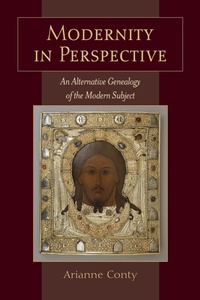
Modernity in Perspective
Description

Draws on the work of the Renaissance theologian and mystic Nicolas of Cusa to offer an alternative to Cartesian subjectivity.
The normative history of modernity begins with the Renaissance and the invention of linear perspective, which places man, instead of God, at the center of the world. The vanishing point of linear perspective portrays the world from the perspective of the single right eye of a singular subject, and it is this perspective that inspired Descartes's optics and his isolated cogito as the prime example of modern subjectivity. This book returns to the invention of linear perspective to seek another interpretation, offering an alternative to the Cartesian subject. Using the work of Renaissance theologian and mystic Nicolas of Cusa, Arianne Conty traces an alternative genealogy of the modern subject, one that allows the world, and the painting, to return our gaze. In elucidating the critique of the Cartesian subject by twentieth-century philosophers Benjamin, Heidegger, Lacan, Sartre, Merleau-Ponty, and Marion, she asks how modernity could be reconceived if philosophers were to take into account the geometric vision of Nicolas of Cusa and how his alternative vision might enable us to escape narcissism and share our world with the absolute other.
More details
Other editions
Additional editions
Person
Arianne Conty is Senior Lecturer of Philosophy at Nanyang Technological University, Singapore. She is the author of Grounding God: Religious Responses to the Anthropocene Age, also published by SUNY Press.
Content
List of Illustrations
Acknowledgments
1. Introduction
Part I: The Premodern History of the Image
2. The Icon as a Gospel: Reading the Christian Image in the Wake of the Iconoclastic Controversy
Part II: The Seeing I/Eye: Interpretations of Linear Perspectives
3. Linear Perspective in the Renaissance
4. An Alternative Renaissance: Nicolas of Cusa
5. With a Clear, Mental Gaze: The Cartesian Subject
Part III. Seeing the Blind Spot in Cartesian Optics
6. They Have Eyes That They Might Not See: Walter Benjamin's Aura
7. I Am Because the Other Thinks Me: Martin Heidegger and Jacques Lacan
8. The Vibration of Appearances: Sartre and Merleau-Ponty
9. Jean-Luc Marion: Crossing Out God
10. Conclusion: White Ecstasy
Bibliography
Index
