

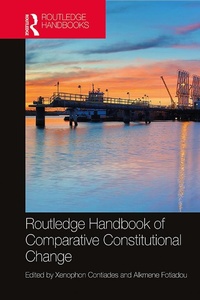
Routledge Handbook of Comparative Constitutional Change
1st Edition
Published on 11. June 2020
468 pages
978-1-351-02097-8 (ISBN)
Description

Comparative constitutional change has recently emerged as a distinct field in the study of constitutional law. It is the study of the way constitutions change through formal and informal mechanisms, including amendment, replacement, total and partial revision, adaptation, interpretation, disuse and revolution. The shift of focus from constitution-making to constitutional change makes sense, since amendment power is the means used to refurbish constitutions in established democracies, enhance their adaptation capacity and boost their efficacy. Adversely, constitutional change is also the basic apparatus used to orchestrate constitutional backslide as the erosion of liberal democracies and democratic regression is increasingly affected through legal channels of constitutional change.
Routledge Handbook of Comparative Constitutional Change provides a comprehensive reference tool for all those working in the field and a thorough landscape of all theoretical and practical aspects of the topic. Coherence from this aspect does not suggest a common view, as the chapters address different topics, but reinforces the establishment of comparative constitutional change as a distinct field. The book brings together the most respected scholars working in the field, and presents a genuine contribution to comparative constitutional studies, comparative public law, political science and constitutional history.
Routledge Handbook of Comparative Constitutional Change provides a comprehensive reference tool for all those working in the field and a thorough landscape of all theoretical and practical aspects of the topic. Coherence from this aspect does not suggest a common view, as the chapters address different topics, but reinforces the establishment of comparative constitutional change as a distinct field. The book brings together the most respected scholars working in the field, and presents a genuine contribution to comparative constitutional studies, comparative public law, political science and constitutional history.
More details
Edition
1. Auflage
Language
English
Place of publication
London
United Kingdom
Publishing group
Taylor & Francis Ltd
Target group
College/higher education
Illustrations
13 Tables, black and white; 11 Line drawings, black and white; 11 Illustrations, black and white
ISBN-13
978-1-351-02097-8 (9781351020978)
Copyright in bibliographic data and cover images is held by Nielsen Book Services Limited or by the publishers or by their respective licensors: all rights reserved.
Schweitzer Classification
Other editions
Additional editions
Xenophon Contiades | Alkmene Fotiadou
Routledge Handbook of Comparative Constitutional Change
Book
02/2022
1st Edition
Routledge
€73.00
Shipment within 15-20 days
Xenophon Contiades | Alkmene Fotiadou
Routledge Handbook of Comparative Constitutional Change
Book
07/2020
1st Edition
Routledge
€314.30
Shipment within 10-20 days
Persons
Xenophon Contiades is Professor of Public Law, Panteion University and President of the Centre for European Constitutional Law, Athens, Greece.
Alkmene Fotiadou is a Research Fellow at the Centre for European Constitutional Law, Athens, Greece.
Alkmene Fotiadou is a Research Fellow at the Centre for European Constitutional Law, Athens, Greece.
Content
1 Introduction. Comparative constitutional change: a new academic field
Xenophon Contiades and Alkmene Fotiadou
PART I The study of comparative constitutional change: theoretical and methodological aspects
2 Comparative methodology and constitutional change
Jaakko Husa
3 Order from chaos? Typologies and models of constitutional change
Oran Doyle
4 Constitutional endurance
Tom Ginsburg
5 Constitutional amendment versus constitutional replacement: an empirical comparison
David S. Law and Ryan Whalen
6 Varieties of liberal constitutionalism
Mark Tushnet
PART II Formal constitutional change
7 Formal amendment rules: functions and design
Richard Albert
8 Constitutional design through amendment
Manfred Stelzer
9 The uses and abuses of constitutional unamendability
Yaniv Roznai
10 Federalism and constitutional change
Nathalie Behnke and Arthur Benz
11 Participatory constitutional change: constitutional referendums
Eoin Carolan
PART III Informal constitutional change
12 Political practice and constitutional change
David Feldman
13 Judge-made constitutional change
Joel I. Colon-Rios
14 Global values, international organizations and constitutional change
Helle Krunke
15 Crises, emergencies and constitutional change
Giacomo Delledonne
16 The material study of constitutional change
Marco Goldoni and Tarik Olcay
PART IV Contemporary challenges in the theory and practice of comparative constitutional change
17 Constituent power and European constitutionalism
Chris Thornhill
18 Populism and constitutional change
Paul Blokker
19 The democratic backsliding in the European Union and the challenge of constitutional design
Tomasz Tadeusz Koncewicz
20 Constitution and self-determination
Zoran Oklopcic
21 Gender in comparative constitutional change
Silvia Suteu
PART V Case studies: distinct profiles of constitutional change
22 The future of UK constitutional law
Robert Blackburn
23 Constitutional change in Australia: the paradox of the frozen continent
Elisa Arcioni and Adrienne Stone
24 Preservationist constitutional change in Latin America: the cases of Chile and Brazil
Juliano Zaiden Benvindo
25 Informal constitutional change in unlikely places: the case of South Africa
James Fowkes
26 Constitutional changes in Japan
Yasuo Hasebe
Xenophon Contiades and Alkmene Fotiadou
PART I The study of comparative constitutional change: theoretical and methodological aspects
2 Comparative methodology and constitutional change
Jaakko Husa
3 Order from chaos? Typologies and models of constitutional change
Oran Doyle
4 Constitutional endurance
Tom Ginsburg
5 Constitutional amendment versus constitutional replacement: an empirical comparison
David S. Law and Ryan Whalen
6 Varieties of liberal constitutionalism
Mark Tushnet
PART II Formal constitutional change
7 Formal amendment rules: functions and design
Richard Albert
8 Constitutional design through amendment
Manfred Stelzer
9 The uses and abuses of constitutional unamendability
Yaniv Roznai
10 Federalism and constitutional change
Nathalie Behnke and Arthur Benz
11 Participatory constitutional change: constitutional referendums
Eoin Carolan
PART III Informal constitutional change
12 Political practice and constitutional change
David Feldman
13 Judge-made constitutional change
Joel I. Colon-Rios
14 Global values, international organizations and constitutional change
Helle Krunke
15 Crises, emergencies and constitutional change
Giacomo Delledonne
16 The material study of constitutional change
Marco Goldoni and Tarik Olcay
PART IV Contemporary challenges in the theory and practice of comparative constitutional change
17 Constituent power and European constitutionalism
Chris Thornhill
18 Populism and constitutional change
Paul Blokker
19 The democratic backsliding in the European Union and the challenge of constitutional design
Tomasz Tadeusz Koncewicz
20 Constitution and self-determination
Zoran Oklopcic
21 Gender in comparative constitutional change
Silvia Suteu
PART V Case studies: distinct profiles of constitutional change
22 The future of UK constitutional law
Robert Blackburn
23 Constitutional change in Australia: the paradox of the frozen continent
Elisa Arcioni and Adrienne Stone
24 Preservationist constitutional change in Latin America: the cases of Chile and Brazil
Juliano Zaiden Benvindo
25 Informal constitutional change in unlikely places: the case of South Africa
James Fowkes
26 Constitutional changes in Japan
Yasuo Hasebe
