

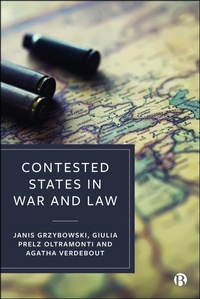
Contested States in War and Law
Bristol University Press
1st Edition
Published on 18. September 2025
282 pages
978-1-5292-4690-2 (ISBN)
Description

Available open access digitally under CC-BY-NC-ND licence.
The precarious status of contested states both reflects and begets conflict. From Taiwan to Western Sahara and from Nagorno-Karabakh to the Liberation Tigers of Tamil Eelam, contested states call into question the standard categories of international law that divide inside and outside, state and non-state, war and rebellion. They inevitably fall in-between them, while alternatively disputing and negotiating their applicability.
Bringing together perspectives from a range of disciplines, the book focuses on some of the most entrenched conflicts around the world. It reveals how different actors, including de facto governments, parent and patron states, local populations, and international courts, navigate the grey zone as they redraw, or work around, the fault lines of war and law.
The precarious status of contested states both reflects and begets conflict. From Taiwan to Western Sahara and from Nagorno-Karabakh to the Liberation Tigers of Tamil Eelam, contested states call into question the standard categories of international law that divide inside and outside, state and non-state, war and rebellion. They inevitably fall in-between them, while alternatively disputing and negotiating their applicability.
Bringing together perspectives from a range of disciplines, the book focuses on some of the most entrenched conflicts around the world. It reveals how different actors, including de facto governments, parent and patron states, local populations, and international courts, navigate the grey zone as they redraw, or work around, the fault lines of war and law.
Reviews / Votes
'State sovereignty and the violence wrought in its name are justified and resisted, defined and unsettled in legal terms as these terrific chapters illuminate with careful case studies and a clarifying theoretical insight.' David Kennedy, Harvard University 'Centred on legal aspects, cross-regional and interdisciplinary - a great addition to the literature.' Magdalena Dembinska, Universite de MontrealMore details
Edition
First Edition
Language
English
Place of publication
Bristol
United Kingdom
Target group
Professional and scholarly
Illustrations
Not illustrated
File size
0,77 MB
ISBN-13
978-1-5292-4690-2 (9781529246902)
Copyright in bibliographic data and cover images is held by Nielsen Book Services Limited or by the publishers or by their respective licensors: all rights reserved.
Schweitzer Classification
Other editions
Additional editions
Book
09/2025
1st Edition
Bristol University Press
€37.50
Shipment within 3-4 weeks
Persons
Janis Grzybowski is Associate Professor of International Relations at the Catholic University of Lille, and currently Jean Monnet Fellow at the European University Institute (EUI) in Florence.
Giulia Prelz Oltramonti is Research Fellow at the Centre for Security and Defence Studies (CSDS) at the Royal Higher Institute for Defence and member of the Recherche et etudes en politique internationale (REPI) at the Universite libre de Bruxelles (ULB).
Agatha Verdebout is a senior researcher at the Research and Information on Peace and Security Group (GRIP) and an associate member of the Center for International Law (CDI) at the Universite libre de Bruxelles (ULB).
Giulia Prelz Oltramonti is Research Fellow at the Centre for Security and Defence Studies (CSDS) at the Royal Higher Institute for Defence and member of the Recherche et etudes en politique internationale (REPI) at the Universite libre de Bruxelles (ULB).
Agatha Verdebout is a senior researcher at the Research and Information on Peace and Security Group (GRIP) and an associate member of the Center for International Law (CDI) at the Universite libre de Bruxelles (ULB).
Content
Introduction: Contested States in War and Law - Janis Grzybowski, Giulia Prelz-Oltramonti & Agatha Verdebout
Part 1: Ambiguous Status and the (Il)legal Use of Force
1. The Ratione Personae Element of the Jus ad Bellum and Taiwan - Christian Henderson
2. The Use of Force against Taiwan as a Contested State: An Analysis of Legality and Great-Power Politics - Ming-chin Monique Chu
3. International Law and the Legitimation of State Violence in the Fourth Eelam War (2006-2009) - Megan Price
4. Russia-Manufactured 'Secessions' in Ukraine: The Attempted Ambiguity of Status, Kosovo and International Law - Julia Miklasova
5. Legitimization of Violence and State Dissolution in Nagorno-Karabakh: A Critical Legal Analysis - Sheila Paylan
Part 2: Vulnerability and Agency on the Ground: People and Institutions Navigating War and Law
6. Contested Statehood, Ambiguities and Volatility: The Effects of Lawfare and Warfare in the Western Sahara Conflict - Irene Fernandez-Molina
7. Hardening Ceasefire Lines in Protracted Secessionist Conflicts: From the Negotiating Table and International Law to Realities on the Ground in the Case of the Abkhaz-Georgian War - Giulia Prelz Oltramonti and Gaelle Le Pavic
8. Sovereign Experimentation by Separatist Insurgencies: A Performative Perspective - Bart Klem
Part 3: Contesting and Constructing States at International Courts
9. Contested States Framed by the European Court of Human Rights - Anne Lagerwall
10. Hide and Seek: Bracketing and Projecting the States of Kosovo and Palestine at International Courts - Janis Grzybowski
Part 4: Conclusions
11. Four Normative Positions on the Contestation of Statehood in War and Law - Bruno Coppieters
12. Speculative Legalities and the Ambiguities of Contested States - Rebecca Bryant
13. The Melancholy Statehood - Martti Koskenniemi
Part 1: Ambiguous Status and the (Il)legal Use of Force
1. The Ratione Personae Element of the Jus ad Bellum and Taiwan - Christian Henderson
2. The Use of Force against Taiwan as a Contested State: An Analysis of Legality and Great-Power Politics - Ming-chin Monique Chu
3. International Law and the Legitimation of State Violence in the Fourth Eelam War (2006-2009) - Megan Price
4. Russia-Manufactured 'Secessions' in Ukraine: The Attempted Ambiguity of Status, Kosovo and International Law - Julia Miklasova
5. Legitimization of Violence and State Dissolution in Nagorno-Karabakh: A Critical Legal Analysis - Sheila Paylan
Part 2: Vulnerability and Agency on the Ground: People and Institutions Navigating War and Law
6. Contested Statehood, Ambiguities and Volatility: The Effects of Lawfare and Warfare in the Western Sahara Conflict - Irene Fernandez-Molina
7. Hardening Ceasefire Lines in Protracted Secessionist Conflicts: From the Negotiating Table and International Law to Realities on the Ground in the Case of the Abkhaz-Georgian War - Giulia Prelz Oltramonti and Gaelle Le Pavic
8. Sovereign Experimentation by Separatist Insurgencies: A Performative Perspective - Bart Klem
Part 3: Contesting and Constructing States at International Courts
9. Contested States Framed by the European Court of Human Rights - Anne Lagerwall
10. Hide and Seek: Bracketing and Projecting the States of Kosovo and Palestine at International Courts - Janis Grzybowski
Part 4: Conclusions
11. Four Normative Positions on the Contestation of Statehood in War and Law - Bruno Coppieters
12. Speculative Legalities and the Ambiguities of Contested States - Rebecca Bryant
13. The Melancholy Statehood - Martti Koskenniemi
