

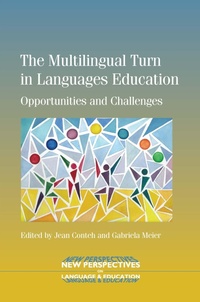
The Multilingual Turn in Languages Education
Opportunities and Challenges
Published on 16. September 2014
320 pages
978-1-78309-225-3 (ISBN)
Description

Starting from the key idea that learners and teachers bring diverse linguistic knowledge and resources to education, this book establishes and explores the concept of the 'multilingual turn' in languages education and the potential benefits for individuals and societies. It takes account of recent research, policy and practice in the fields of bilingual and multilingual education as well as foreign and second language education. The chapters integrate theory and practice, bringing together researchers and practitioners from five continents to illustrate the effects of the multilingual turn in society and evaluate the opportunities and challenges of implementing multilingual curricula and activities in a variety of classrooms. Based on the examples featured, the editors invite students, teachers, teacher educators and researchers to reflect on their own work and to evaluate the relevance and applicability of the multilingual turn in their own contexts.
Reviews / Votes
The volume edited by Conteh and Meier is a more diverse collection consisting of three parts: (a) societal perspectives on the multilingual turn in language(s) education, (b) perspectives on the multilingual turn in education, and (c) visions of the multilingual turn in pedagogy and practice. Consisting of new research, these articles, many of which are co-authored by new and established researchers, show multilingual practices in a variety of contexts in education and around the world, in countries ranging from New Zealand to China to the Alsace region of France. What appealed to me in this volume was precisely this variety, and I hoped that the students would be interested in the different contexts too, as well as in the research methods and findings that are described. -- Alison Stewart, Gakushuin University, Japan * The Learner Development Journal, Issue 5 * This volume is a very welcome addition to a number of recent books on multilingual pedagogy and is a must for teacher educators/researchers and students of applied linguistics who wish to rethink their approach to languages education and embrace linguistic and cultural diversity as a resource to implement equality and social cohesion in their classrooms. * Christine Helot, University of Strasbourg, France * Conteh & Meier's important volume builds and expands upon recent key developments that have increasingly problematized and contested the monolingual norm that still underpins so much theory, pedagogy and practice in language teaching and learning. With an emphasis on schools and pedagogical practices, the volume solidifies and exemplifies how 'the multilingual turn' in education can make a difference for all, especially for those whose multilingualism has been ignored and/or pathologized until now. Like the multilingual turn itself, this volume provides us with a timely and important intervention into the theory, practice and pedagogies needed for a multilingual, globalized world - and not before time. * Stephen May, The University of Auckland, New Zealand * Drawing on recent theoretical developments in sociolinguistics, this charming and important book reminds us once again of how our schools can value and build on multilingualism, and why it is important that they do so if we want more socially just education for not only multilingual learners but ALL learners. * Nancy H. Hornberger, University of Pennsylvania, USA *More details
Series
Language
English
Place of publication
Bristol
United Kingdom
Publishing group
Channel View Publications Ltd
Target group
Professional and scholarly
ISBN-13
978-1-78309-225-3 (9781783092253)
Copyright in bibliographic data and cover images is held by Nielsen Book Services Limited or by the publishers or by their respective licensors: all rights reserved.
Schweitzer Classification
Other editions
Additional editions
Jean Conteh | Gabriela Meier
The Multilingual Turn in Languages Education
Opportunities and Challenges
Book
09/2014
Multilingual Matters
€56.50
Shipment within 10-20 days
Persons
Dr. Jean Conteh is Senior Lecturer in the School of Education at the University of Leeds, UK. Her research interests include EAL in the British system and teacher development and professional knowledge. Dr. Gabriela Meier is a Lecturer in Language Education at the Graduate School of Education, University of Exeter, UK. She is especially interested in language education and social cohesion, including bilingual and multilingual approaches to learning.
Content
Contributors
Foreword
Acknowledgments
Jean Conteh and Gabriela Meier: Introduction
PART I
Gabriela Meier: Introduction to Part I
1. Mooznah Auleear Owodally: Socialized into Multilingualism: A Case Study of Mauritian Preschools
2. Ken Cruickshank: Exploring the -Lingual between Bi- and Mono-: Young People and their Language in an Australian Context
3. Guangwei Hu and Sandra McKay: Multilingualism as Portrayed in a Chinese English Textbook
4. Andrea Young: Looking through the Language Lens: Monolingual Taint or Plurilingual Tint?
PART II
Jean Conteh: Introduction to Part II
5. Laurent Gajo: From Description to Didactization of Multilingualism: European and Francophone Research at the Crossroads between Linguistics and Didactics
6. Gabriela Meier: Our Mother Tongue is Plurilingualism: An Orientation Framework for Integrated Multilingual Curricula
7. Jean Conteh, Fiona Copland and Angela Creese: Multilingual Teachers' Resources in three different Contexts: Empowering Learning
8. Gabriela Meier: Multilingualism and Social Cohesion: Two-Way Immersion Education meets Diverse Needs
PART III
Jean Conteh and Gabriela Meier: Introduction to Part III
9. Jean Conteh, Shila Begum and Saiqa Riasat: Multilingual Learning in Primary Settings - From the Margins to the Mainstream
10. Enrica Piccardo and Joelle Aden: Plurilingualism and Empathy: Beyond Instrumental Language Learning
11. Ofelia Garcia and Naomi Kano: Translanguaging as Process and Pedagogy: Developing the English Writing of Japanese Students in the US
12. Jim Anderson and Yu-Chiao Chung: Transforming Learning, Building Identities: Arts Based Creativity in the Community Languages Classroom
Gabriela Meier and Jean Conteh: Conclusion
Foreword
Acknowledgments
Jean Conteh and Gabriela Meier: Introduction
PART I
Gabriela Meier: Introduction to Part I
1. Mooznah Auleear Owodally: Socialized into Multilingualism: A Case Study of Mauritian Preschools
2. Ken Cruickshank: Exploring the -Lingual between Bi- and Mono-: Young People and their Language in an Australian Context
3. Guangwei Hu and Sandra McKay: Multilingualism as Portrayed in a Chinese English Textbook
4. Andrea Young: Looking through the Language Lens: Monolingual Taint or Plurilingual Tint?
PART II
Jean Conteh: Introduction to Part II
5. Laurent Gajo: From Description to Didactization of Multilingualism: European and Francophone Research at the Crossroads between Linguistics and Didactics
6. Gabriela Meier: Our Mother Tongue is Plurilingualism: An Orientation Framework for Integrated Multilingual Curricula
7. Jean Conteh, Fiona Copland and Angela Creese: Multilingual Teachers' Resources in three different Contexts: Empowering Learning
8. Gabriela Meier: Multilingualism and Social Cohesion: Two-Way Immersion Education meets Diverse Needs
PART III
Jean Conteh and Gabriela Meier: Introduction to Part III
9. Jean Conteh, Shila Begum and Saiqa Riasat: Multilingual Learning in Primary Settings - From the Margins to the Mainstream
10. Enrica Piccardo and Joelle Aden: Plurilingualism and Empathy: Beyond Instrumental Language Learning
11. Ofelia Garcia and Naomi Kano: Translanguaging as Process and Pedagogy: Developing the English Writing of Japanese Students in the US
12. Jim Anderson and Yu-Chiao Chung: Transforming Learning, Building Identities: Arts Based Creativity in the Community Languages Classroom
Gabriela Meier and Jean Conteh: Conclusion
