

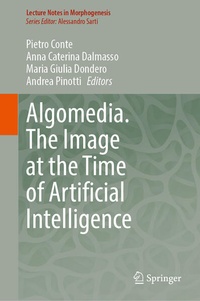
Algomedia. The Image at the Time of Artificial Intelligence
Description

Contemporary media ecosystems are deeply entangled with algorithms, which play an increasingly pervasive role in shaping our environment and mediating our perception of reality. This book aims to provide a critical map of a rapidly evolving mediascape in which humans, machines, and data negotiate forms of agency, cultural imaginaries, and scopic regimes.
In particular, the volume addresses the multiple challenges posed by algorithmic media within the domain of visual culture, and identifies a paradigmatic shift: in the age of artificial intelligence, images are no longer merely captured or represented-they are synthesized, inferred, and predicted by probabilistic models. As active agents shaping creativity and meaning-making, AI systems carry far-reaching epistemological, aesthetic, and political implications. They open new possibilities for content accessibility and participatory engagement, yet they also encode existing asymmetries. Trained on massive datasets, machine learning models often reproduce structural biases, amplify cultural and social exclusions, and perpetuate inequalities. At the same time, algorithmic systems are being subverted and reappropriated by artists and curators, transforming them into sites of resistance and experimentation for imagining alternative futures.
Bringing together perspectives from computer science, semiotics, philosophy, critical theory, aesthetics, art theory, visual culture, and film and media studies, this book sets out an interdisciplinary exploration to make key concepts-such as algorithm, latent space, neural networks, generative models, and NFTs-accessible to a humanities audience, while providing a set of critical tools to interrogate both the ruptures and continuities that define this ongoing transformation.
The contributions span a wide array of topics: from machine vision and facial recognition to social robots; from computational art analysis to generative AI, distributed authorship, and curatorial practices; from biometric surveillance and predictive modeling to the politics of datasets and decolonial critique; from virtual and augmented reality to posthuman imagery, digital afterlives, and AI-mediated memory.
Compelling us to revisit foundational categories in media studies, this book offers an analytical framework to open a debate that is not merely about "technology's impact" but about how algorithms have become the media themselves: veritable algomedia.
More details
Other editions
Additional editions
Content
The Black Box of Computational Imaging.- Algorithmic Mediascapes.- Algorithms and the Arts.- Cultural Critique of Algorithmic Media.- Posthuman/Non-Human Imagery.
