

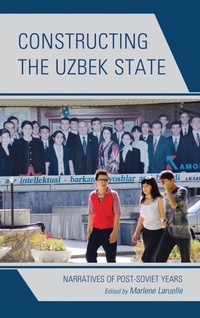
Constructing the Uzbek State
Narratives of Post-Soviet Years
Lexington Books (Publisher)
1st Edition
Published on 20. December 2017
1 pages
979-8-216-20475-6 (ISBN)
Description

Over the past three decades, Uzbekistan has attracted the attention of the academic and policy communities because of its geostrategic importance, its critical role in shaping or unshaping Central Asia as a region, its economic and trade potential, and its demographic weight: every other Central Asian being Uzbek, Uzbekistan's political, social, and cultural evolutions largely exemplify the transformations of the region as a whole. And yet, more than 25 years after the collapse of the Soviet Union, evaluating Uzbekistan's post-Soviet transformation remains complicated. Practitioners and scholars have seen access to sources, data, and fieldwork progressively restricted since the early 2000s.
The death of President Islam Karimov, in power for a quarter of century, in late 2016, reopened the future of the country, offering it more room for evolution. To better grasp the challenges facing post-Karimov Uzbekistan, this volume reviews nearly three decades of independence. In the first part, it discusses the political construct of Uzbekistan under Karimov, based on the delineation between the state, the elite, and the people, and the tight links between politics and economy. The second section of the volume delves into the social and cultural changes related to labor migration and one specific trigger - the difficulties to reform agriculture. The third part explores the place of religion in Uzbekistan, both at the state level and in society, while the last part looks at the renegotiation of collective identities.
The death of President Islam Karimov, in power for a quarter of century, in late 2016, reopened the future of the country, offering it more room for evolution. To better grasp the challenges facing post-Karimov Uzbekistan, this volume reviews nearly three decades of independence. In the first part, it discusses the political construct of Uzbekistan under Karimov, based on the delineation between the state, the elite, and the people, and the tight links between politics and economy. The second section of the volume delves into the social and cultural changes related to labor migration and one specific trigger - the difficulties to reform agriculture. The third part explores the place of religion in Uzbekistan, both at the state level and in society, while the last part looks at the renegotiation of collective identities.
More details
Series
Edition
1. Auflage
Language
English
Place of publication
United States
Publishing group
Bloomsbury Publishing Plc
Target group
Professional and scholarly
Illustrations
1 Graph, 7 Tables
ISBN-13
979-8-216-20475-6 (9798216204756)
Copyright in bibliographic data and cover images is held by Nielsen Book Services Limited or by the publishers or by their respective licensors: all rights reserved.
Schweitzer Classification
Other editions
Additional editions
Book
12/2017
Lexington Books
€169.80
Shipment within 15-20 days
Persons
Marlene Laruelle is research professor, director of the Central Asia Program, and associate director of the Institute for European, Russian, and Eurasian Studies (IERES) at the Elliott School of International Affairs of George Washington University.
Content
Introduction, Marlene Laruelle
Part I: Uzbekistan's Political Construct
Chapter 1: When Security Trumps Identity: Uzbekistan's Foreign Policy under Islam Karimov, Matteo Fumagalli
Chapter 2: The Magic of Territory: Remaking of Border Landscapes as a Spatial Manifestation of Nationalist Ideology, Nick Megoran
Chapter 3: Grand Corruption in Uzbekistan's Telecommunications Sector: Root Causes and Social Costs, Alisher Ilkhamov
Chapter 4: Uzbek Political Thinking in the Third Decade of Independence, Morgan Y. Liu
Part II: Agriculture and Labor Migration. Changing the Social Fabric
Chapter 5: Government, Cotton Farms, and Labor Migration from Uzbekistan, Russell Zanca
Chapter 6: Uzbeks in Russia: A New Diaspora or a Transnational Society?, Sergei Abashin
Chapter 7: Establishing an "Uzbek Mahalla" via Smartphones and Social Media: Everyday Transnational Lives of Uzbek Labor Migrants in Russia, Rustamjon Urinboyev
Part III: Uzbek Islam: State Control, Resilience, and Resistance
Chapter 8: Counter-Extremism, Secularism, and the Category of Religion in the United Kingdom and Uzbekistan: Should We Be Studying Islam at All?, Johan Rasanayagam
Chapter 9: At the Crossroads of Religion and Regime Security: Teaching Islam in Uzbekistan,
Sebastien Peyrouse
Chapter 10: Moral Exemplars and Ordinary Ethics: Sufism in Bukhara, Maria Louw
Chapter 11: The Evolving "Uzbek Jihad": Islamist Militant Recruiting and State Responses, Noah Tucker
Part IV: Renegotiating Identities and Cultural Legacies
Chapter 12: Be(com)ing Uzbek: Patterns of Identification and Processes of Assimilation,
Peter Finke
Chapter 13: The Nation Narrated: Uzbekistan's Political and Cultural Nationalism, Marlene Laruelle
Chapter 14: Public Life in Private Spaces in Uzbekistan: Women, Religion, and Politics, Svetlana Peshkova
Chapter 15: Gender and Changing Women's Roles in Uzbekistan: From Soviet Workers to Post-Soviet Entrepreneurs, Rano Turaeva-Hoehne
Part I: Uzbekistan's Political Construct
Chapter 1: When Security Trumps Identity: Uzbekistan's Foreign Policy under Islam Karimov, Matteo Fumagalli
Chapter 2: The Magic of Territory: Remaking of Border Landscapes as a Spatial Manifestation of Nationalist Ideology, Nick Megoran
Chapter 3: Grand Corruption in Uzbekistan's Telecommunications Sector: Root Causes and Social Costs, Alisher Ilkhamov
Chapter 4: Uzbek Political Thinking in the Third Decade of Independence, Morgan Y. Liu
Part II: Agriculture and Labor Migration. Changing the Social Fabric
Chapter 5: Government, Cotton Farms, and Labor Migration from Uzbekistan, Russell Zanca
Chapter 6: Uzbeks in Russia: A New Diaspora or a Transnational Society?, Sergei Abashin
Chapter 7: Establishing an "Uzbek Mahalla" via Smartphones and Social Media: Everyday Transnational Lives of Uzbek Labor Migrants in Russia, Rustamjon Urinboyev
Part III: Uzbek Islam: State Control, Resilience, and Resistance
Chapter 8: Counter-Extremism, Secularism, and the Category of Religion in the United Kingdom and Uzbekistan: Should We Be Studying Islam at All?, Johan Rasanayagam
Chapter 9: At the Crossroads of Religion and Regime Security: Teaching Islam in Uzbekistan,
Sebastien Peyrouse
Chapter 10: Moral Exemplars and Ordinary Ethics: Sufism in Bukhara, Maria Louw
Chapter 11: The Evolving "Uzbek Jihad": Islamist Militant Recruiting and State Responses, Noah Tucker
Part IV: Renegotiating Identities and Cultural Legacies
Chapter 12: Be(com)ing Uzbek: Patterns of Identification and Processes of Assimilation,
Peter Finke
Chapter 13: The Nation Narrated: Uzbekistan's Political and Cultural Nationalism, Marlene Laruelle
Chapter 14: Public Life in Private Spaces in Uzbekistan: Women, Religion, and Politics, Svetlana Peshkova
Chapter 15: Gender and Changing Women's Roles in Uzbekistan: From Soviet Workers to Post-Soviet Entrepreneurs, Rano Turaeva-Hoehne
