

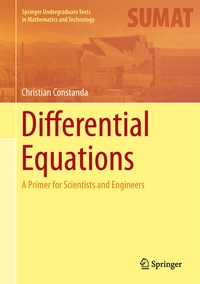
Differential Equations
Description

Differential Equations for Scientists and Engineers is a book designed with students in mind. It attempts to take a concise, simple, and no-frills approach to differential equations. The approach used in this text is to give students extensive experience in main solution techniques with a lighter emphasis on the physical interpretation of the results. With a more manageable page count than comparable titles, and over 400 exercises that can be solved without a calculating device, this book emphasizes the understanding and practice of essential topics in a succinct fashion. At the end of each worked example, the author provides the Mathematica commands that can be used to check the results and where applicable, to generate graphical representations. It can be used independently by the average student, while those continuing with the subject will develop a fundamental framework with which to pursue more advanced material. This book is designed for undergraduate students with some basic knowledge of precalculus algebra and a first course in calculus.
Reviews / Votes
From the reviews:
"The author of this book does a does a very creditable job of providing the basic material of ordinary differential equations. . The book is largely aimed at average students in mathematics, science or engineering. The author suggests that stronger students can use the text as a bridge to more specialized books or more advanced courses. . There are many exercises." (William J. Satzer, MAA Reviews, November, 2013)
"The author writes this book respecting his readers and caring about the way of exposing his ideas. The book is written in a style that uses words as a bonding agent between consecutive mathematical passages, which creates a pleasant and comfortable lecture. . The book contains 232 worked examples and 810 exercises. . We kindly recommend this book to future engineers and scientists as well as to all those interested in the topic, who encounter differential equations in their professional work." (Alexandru Negrescu, zbMATH, Vol. 1272, 2013)More details
Other editions
New editions
Additional editions
Person
Content
1. Introduction.- 2. First Order Equations.- 3. Mathematical Models with First-Order Equations.- 4. Linear Second-Order Equations.- 4. Higher-Order Equations.- 5. Mathematical Models with Second-Order Equations.- 6. Higher-Order Linear Equations.- 7. Systems of Differential Equations.- 8. The Laplace Transformation.- 9. Series Solutions.- A. Algebra Techniques.- B. Calculus Techniques.- C. Table of Laplace Transforms.- D. The Greek Alphabet.
