

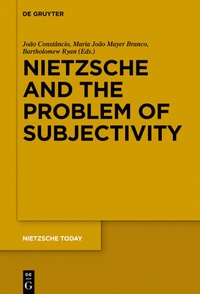
Nietzsche and the Problem of Subjectivity
Description

Nietzsche's critique of the modern subject is often presented as a radical break with modern philosophy and associated with the so-called 'death of the subject' in 20th century philosophy. But Nietzsche claimed to be a 'psychologist' who was trying to open up the path for 'new versions and sophistications of the soul hypothesis.' Although there is no doubt that Nietzsche gave expression to a fundamental crisis of the modern conception of subjectivity (both from a theoretical and from a practical-existential perspective), it is open to debate whether he wanted to abandon the very idea of subjectivity or only to pose the problem of subjectivity in new terms.
The volume includes 26 articles by top Nietzsche scholars. The chapters in Part I, "Tradition and Context", deal with the relationship between Nietzsche's views on subjectivity and modern philosophy, as well as with the late 19th century context in which his thought emerged; Part II, "The Crisis of the Subject", examines the impact of Nietzsche's critique of the subject on 20th century philosophy, from Freud to Heidegger to Dennett, but also in such authors as Deleuze, Foucault, Derrida, or Luhmann; Part III, "Current Debates - From Embodiment and Consciousness to Agency", shows that the way in which Nietzsche engaged with such themes as the self, agency, consciousness, embodiment and self-knowledge makes his thought highly relevant for philosophy today, especially for philosophy of mind and ethics.
More details
Other editions
Additional editions
Persons
Content
- Intro
- Contents
- References, Citations, and Abbreviations
- Introduction to Nietzsche and the Problem of Subjectivity
- Part I: Tradition and Context
- 1 Writing from a First-Person Perspective: Nietzsche's Use of the Cartesian Model
- 2 Power, Affect, Knowledge: Nietzsche on Spinoza
- 3 Leibnizian Ideas in Nietzsche's Philosophy: On Force, Monads, Perspectivism, and the Subject
- 4 Kant and Nietzsche on Self-Knowledge
- 5 Nietzsche and Schopenhauer on the 'Self' and the 'Subject'
- 6 Psychology without a Soul, Philosophy without an I. Nietzsche and 19th Century Psychophysics (Fechner, Lange, Mach)
- 7 Helmholtz, Lange, and Unconscious Symbols of the Self
- 8 Nietzsche and "the French Psychologists": Stendhal, Taine, Ribot, Bourget
- 9 Social Ties and the Emergence of the Individual: Nietzsche and the English Perspective
- 10 "Know Yourself" And "Become What You Are". The Development of Character in Nietzsche and Emerson
- Part II: The Crisis of the Subject
- 11 Nietzsche on Decentered Subjectivity or, the Existential Crisis of the Modern Subject
- 12 The Plurality of the Subject in Nietzsche and Kierkegaard: Confronting Nihilism with Masks, Faith and Amor Fati
- 13 Nietzsche vs. Heidegger on the Self: Which I Am I?
- 14 Nietzsche and Freud: The 'I' and its Drives
- 15 Nietzsche, Deleuze: Desubjectification and Will to Power
- 16 Questions of the Subject in Nietzsche and Foucault: A Reading of Dawn
- 17 Gapping the Subject: Nietzsche and Derrida
- 18 Questioning Introspection: Nietzsche and Wittgenstein on 'The Peculiar Grammar of the Word "I"'
- 19 Subjects as Temporal Clues to Orientation: Nietzsche and Luhmann on Subjectivity
- 20 Three Senses of Selfless Consciousness. Nietzsche and Dennett on Mind, Language and Body
- Part III: Current Debates-From Embodiment and Consciousness to Agency
- 21 Nietzsche on the Embodiment of Mind and Self
- 22 Self-Knowledge, Genealogy, Evolution
- 23 Moralities Are a Sign-Languages of the Affects
- 24 Nietzsche on Consciousness, Unity, and the Self
- 25 Nietzsche's Socio-Physiology of the Self
- 26 The Expressivist Nietzsche
- Complete Bibliography
- List of Contributors/Affiliations
- Index
