

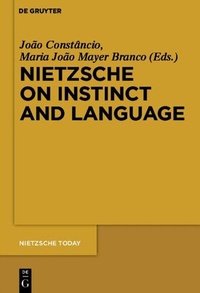
Nietzsche on Instinct and Language
Description

This volume consists of the revised and expanded versions of the papers presented at the International Conference "Nietzsche On Instinct and Language", held at the Universidade Nova de Lisboa (Portugal) in December 2009. The list of contributors includes top Nietzsche scholars, like Werner Stegmaier, Patrick Wotling, and Scarlett Marton.
The volume as a whole represents a fresh look at Nietzsche's attempt to connect language to the instinctive activity of the human body. Four of the papers focus on Nietzsche's early
Nachlass
notes and writings, including
The
Birth of Tragedy
and
On Truth and Lying in a Non-Moral Sense
; the other seven deal with his mature views on this important subject, especially in
Beyond Good and Evil
,
The Gay Science
, and the
Nachlass
. In focusing on how Nietzsche tries to dissolve the traditional opposition between instinct and language, as well as between instinct and consciousness and instinct and reason, the different papers consider, from this viewpoint, such Nietzschean themes as morality, value, the concept of philosophy, dogmatism, naturalization, metaphor, affectivity and emotion, health and sickness, tragedy, and laughter.
More details
Other editions
Additional editions
Persons
Content
2 - References, Citations, and Abbreviations [Seite 8]
3 - Acknowledgements [Seite 14]
4 - Editors' Introduction [Seite 16]
5 - I. Nietzschean Beginnings and Developments [Seite 26]
5.1 - 'As with Bees?' Notes on Instinct and Language in Nietzsche and Herder [Seite 28]
5.2 - Nietzsche on Metaphor, Musicality, and Style. From Language to the Life of the Drives [Seite 60]
6 - II. Dissolving an Opposition [Seite 86]
6.1 - What Language Do Drives Speak? [Seite 88]
6.2 - Instinct and Language in Nietzsche's Beyond Good and Evil [Seite 105]
6.3 - Greed and Love: Genealogy, Dissolution and Therapeutical Effects of a Linguistic Distinction in FW 14 [Seite 142]
7 - III. Instinct, Language, and Philosophy [Seite 190]
7.1 - Afternoon Thoughts. Nietzsche and the Dogmatism of Philosophical Writing [Seite 192]
7.2 - Fearless Findings. Instinct and Language in Book V of the Gay Science [Seite 210]
8 - IV. The Critique of Morality and the Affi rmation of Life [Seite 226]
8.1 - Philosophy as a 'Misunderstanding of the Body' and the 'Great Health' of the New Philosophers [Seite 228]
8.2 - From the Nietzschean Interpretation of Philosophical Language to the Semiotics of Moral Phenomena: Thoughts on Beyond Good and Evil [Seite 244]
8.3 - Zarathustra's Laughter or the Birth of Tragedy from the Experience of the Comic [Seite 268]
8.4 - Stammering in a Strange Tongue: The Limits of Language in The Birth of Tragedy in the Light of Nietzsches 'Attempt At a Self-Criticism' [Seite 284]
9 - Contributors [Seite 305]
10 - Complete Bibliography [Seite 306]
11 - Name Index [Seite 316]
12 - Subject Index [Seite 317]
