

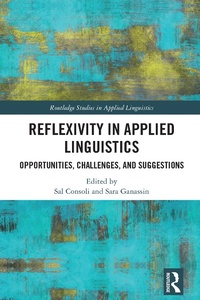
Reflexivity in Applied Linguistics
Opportunities, Challenges, and Suggestions
1st Edition
Published on 18. January 2023
230 pages
978-1-000-78631-6 (ISBN)
Description

This edited collection provides research-informed guidance on how reflexivity may be practised in applied linguistics research. Specifically, we promote reflexivity as an essential hallmark of quality research and argue that doing reflexivity confers greater transparency, methodological rigour, depth, and trustworthiness to our scholarly inquiries.
The collection features perspectives from different sub-fields of applied linguistics, including intercultural communication, language education, and multilingualism, and draws on data from a range of settings, including language cafes, classrooms, workplaces, and migration and displacement contexts. Each chapter follows a unified structure: theoretical background, context of the empirical study used as a backdrop for the chapter, an analysis of how reflexivity played out throughout the study, and conclusions which include takeaway points for other researchers. This approach allows readers to gain a sound understanding of the challenges and affordances of doing reflexivity in concrete examples of applied linguistics research whilst also gaining guidance on how to nurture and report on researcher reflexivity as this unfolds throughout the lifetime of a project.
This book will appeal to students and scholars in applied linguistics, particularly those with an interest in research methods in the areas of language education, multilingualism, and intercultural communication.
The collection features perspectives from different sub-fields of applied linguistics, including intercultural communication, language education, and multilingualism, and draws on data from a range of settings, including language cafes, classrooms, workplaces, and migration and displacement contexts. Each chapter follows a unified structure: theoretical background, context of the empirical study used as a backdrop for the chapter, an analysis of how reflexivity played out throughout the study, and conclusions which include takeaway points for other researchers. This approach allows readers to gain a sound understanding of the challenges and affordances of doing reflexivity in concrete examples of applied linguistics research whilst also gaining guidance on how to nurture and report on researcher reflexivity as this unfolds throughout the lifetime of a project.
This book will appeal to students and scholars in applied linguistics, particularly those with an interest in research methods in the areas of language education, multilingualism, and intercultural communication.
Reviews / Votes
"Representing a range of researcher perspectives, approaches, and contexts, this timely volume offers much-needed models for defining, documenting, and "doing" reflexivity while generating keen, original insights for harnessing its transformative potential. Together, these chapters challenge simplistic notions of reflexive practice as self-reflection/self-awareness by foregrounding the importance of other-connectedness/other-awareness in accountable, ethical, moral, and, ultimately, human-centered applied linguistics research." - Matthew T. Prior, Arizona State University, USA"This volume nicely illustrates the extent to which applied linguistics researchers are grappling with reflexivity - reflecting deeply on their research positions, processes and contexts, and making their reflections transparent in their research activities and reports. It does so in a way that gives us hope. This stunning collection of chapters shows us what reflexivity looks like; in the process of being reflexive, the authors display their reflexivity for all to see. It is both enlightening and fascinating. Definitely worth a read!" - Gary Barkhuizen, University of Auckland, New Zealand
It is particularly welcome to have a volume on "doing" reflexivity rather than simply "talking about" reflexivity. ?? The volume contains diverse and useful chapters revealing 'researcher-in-context' subjectivities and inter-subjectivities; showing how these can be foregrounded and accounted for in our research processes and writing-up practices. The focus of the book takes a fresh perspective on reflexivity as a (social) practice and goes beyond an exclusive focus on the Self. There are plenty of usable and helpful guidelines for the researcher to reflexively navigate language education, intercultural communication, and professional communication. This is an excellent resource for those of us who wish to grapple with the complexities of the Self and Other(s) as these emerge and develop our individual and collaborative research journeys. - Steve Mann, University of Warwick, UK
More details
Series
Edition
1. Auflage
Language
English
Place of publication
London
United Kingdom
Publishing group
Taylor & Francis Ltd
Target group
College/higher education
Professional and scholarly
Illustrations
3 Tables, black and white; 2 Line drawings, black and white; 2 Illustrations, black and white
ISBN-13
978-1-000-78631-6 (9781000786316)
Copyright in bibliographic data and cover images is held by Nielsen Book Services Limited or by the publishers or by their respective licensors: all rights reserved.
Schweitzer Classification
Other editions
Additional editions
Sal Consoli | Sara Ganassin
Reflexivity in Applied Linguistics
Opportunities, Challenges, and Suggestions
Book
10/2024
1st Edition
Routledge
€65.20
Shipment within 15-20 days
Sal Consoli | Sara Ganassin
Reflexivity in Applied Linguistics
Opportunities, Challenges, and Suggestions
Book
01/2023
1st Edition
Routledge
€186.00
Shipment within 15-20 days
Persons
Sal Consoli is Assistant Professor in Language Education at the Moray House School of Education, University of Edinburgh. Previously, he worked at other universities in the UK and Hong Kong. His research examines the psychology of language learning and methodological debates in the domains of narrative inquiry and practitioner research.
Sara Ganassin is Senior Lecturer in Applied Linguistics and Communication in the School of Education, Communication and Language Sciences, Newcastle University, UK. Her research examines the interplay of language, culture, and identity in contexts of mobility and displacement. She co-authored Intercultural Challenges for the Reintegration of Displaced Professionals (2022, Routledge).
Sara Ganassin is Senior Lecturer in Applied Linguistics and Communication in the School of Education, Communication and Language Sciences, Newcastle University, UK. Her research examines the interplay of language, culture, and identity in contexts of mobility and displacement. She co-authored Intercultural Challenges for the Reintegration of Displaced Professionals (2022, Routledge).
Content
Foreword Ema Ushioda
1. Navigating the waters of reflexivity in applied linguistics Sal Consoli and Sara Ganassin
2. Emotional reflexivity during a global health crisis: emotion 'work' in online health communication research Margo Turnbull and Xiaoyan Ivy Wu
3. 'Making the familiar strange': reflexivity in linguistic ethnography within a context of former legal professional practice Judith Reynolds
4. Journeying through languages and voices: A reflexive account of researching teachers' language practices in the multilingual and multicultural context of Mauritius Aruna Ankiah-Gangadeen and Pascal Nadal
5. "There would be no project if I were to disregard my own self!": An autoethnography of becoming reflexive as a doctoral student in applied linguistics Samuel C. S. Tsang
6. Critical reflexive phenomenography in a study abroad context: navigating Arab sojourners' international academic experiences in Britain Anas Hajar
7. Researching language cafes: engaging the researcher's authentic multilingual self Nuria Polo-Perez
8. Collaborative reflexivity through feedback dialogues: developing the research and the doctoral researcher Maxine Gillway and Hugo Santiago Sanchez
9. Reflexivity, Emerging Expertise, and Mi[S-STEP]s: A Collaborative Self-Study of Two TESOL Teacher Educators Laura M. Kennedy and Peter I. De Costa
10: Reflexivity, emerging expertise, and Mi[S-STEP]s: A collaborative self-study of two TESOL teacher educators Helen Sauntson
11. Learning from the messiness of research: Reflexivity in sharing sessions with domestic migrant workers Hans J. Ladegaard
Afterword. Journey into applied linguistics: reflecting on reflexivity and positionality Li Wei
1. Navigating the waters of reflexivity in applied linguistics Sal Consoli and Sara Ganassin
2. Emotional reflexivity during a global health crisis: emotion 'work' in online health communication research Margo Turnbull and Xiaoyan Ivy Wu
3. 'Making the familiar strange': reflexivity in linguistic ethnography within a context of former legal professional practice Judith Reynolds
4. Journeying through languages and voices: A reflexive account of researching teachers' language practices in the multilingual and multicultural context of Mauritius Aruna Ankiah-Gangadeen and Pascal Nadal
5. "There would be no project if I were to disregard my own self!": An autoethnography of becoming reflexive as a doctoral student in applied linguistics Samuel C. S. Tsang
6. Critical reflexive phenomenography in a study abroad context: navigating Arab sojourners' international academic experiences in Britain Anas Hajar
7. Researching language cafes: engaging the researcher's authentic multilingual self Nuria Polo-Perez
8. Collaborative reflexivity through feedback dialogues: developing the research and the doctoral researcher Maxine Gillway and Hugo Santiago Sanchez
9. Reflexivity, Emerging Expertise, and Mi[S-STEP]s: A Collaborative Self-Study of Two TESOL Teacher Educators Laura M. Kennedy and Peter I. De Costa
10: Reflexivity, emerging expertise, and Mi[S-STEP]s: A collaborative self-study of two TESOL teacher educators Helen Sauntson
11. Learning from the messiness of research: Reflexivity in sharing sessions with domestic migrant workers Hans J. Ladegaard
Afterword. Journey into applied linguistics: reflecting on reflexivity and positionality Li Wei
