

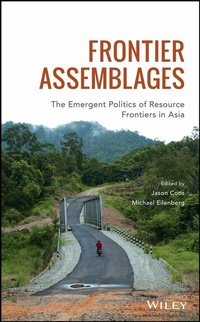
Frontier Assemblages
Description

* Presents an empirical understanding of resource frontiers and provides tools for broader engagements and linkages
* Filled with rich ethnographic and historical case studies and contains contributions from noted scholars in the field
* Explores the political ecology of extraction, expansion and production in marginal spaces in Asia
* Maps the flows, frictions, interests and imaginations that accumulate in Asia to transformative effect
* Brings together noted anthropologists, geographers and sociologists
More details
Other editions
Additional editions
Persons
Jason Cons is Assistant Professor in the Department of Anthropology at the University of Texas at Austin, USA.
Michael Eilenberg is Associate Professor in the Department of Anthropology at Aarhus University, Hojbjerg, Denmark.
Content
List of Figures vii
Series Editors'Preface ix
Notes on Contributors xi
Acknowledgements xvii
Introduction: On the New Politics of Margins in Asia: Mapping Frontier Assemblages 1
Jason Cons and Michael Eilenberg
Part I Frontier Experimentations 19
Framing Essay: Assemblages and Assumptions 21
Christian Lund
1 All that Is Solid Melts into the Bay: Anticipatory Ruination on Bangladesh's Climate Frontier 25
Kasia Paprocki
2 Subsurface Workings: How the Underground Becomes a Frontier 41
Gokce Gunel
3 Groundwork in the Margins: Symbiotic Governance in a Chinese Dust-Shed 59
Jerry Zee
Part II Frontier Cultivations and Materialities 75
Framing Essay: Frontier Cultivations and Materialities 77
Nancy Lee Peluso
4 Mainstreaming Green: Translating the Green Economy in an Indonesian Frontier 83
Zachary R. Anderson
5 Growing at the Margins: Enlivening a Neglected Post-Soviet Frontier 99
Igor Rubinov
6 Patterns of Naturecultures: Political Economy and the Spatial Distribution of Salmon Populations in Hokkaido, Japan 117
Heather Anne Swanson
Part III Frontier Expansions 131
Framing Essay: Assembling Frontier Urbanizations 133
K. Sivaramakrishnan
7 China's Coasts, a Contested Sustainability Frontier 139
Young Rae Choi
8 Spaces of the Gigantic: Extraction and Urbanization on China's Energy Frontier 155
Max D. Woodworth
9 Private Healthcare in Imphal, Manipur: Liberalizing the Unruly Frontier 171
Duncan McDuie-Ra
Part IV Frontier Re(Assemblies) 187
Framing Essay: Framing Frontier Assemblages 189
Prasenjit Duara
10 Frontier 2.0: The Recursive Lives and Death of Cinchona in Darjeeling 195
Townsend Middleton
11 Frontier Making and Erasing: Histories of Infrastructure Development in Vietnam 213
Christian C. Lentz
Conclusion: Assembling the Frontier 229
Michael Eilenberg and Jason Cons
Bibliography 235
Index 259
Notes on Contributors
Zachary R. Anderson is a PhD candidate in the Department of Geography at the University of Toronto. He has conducted research on the cultural politics of conservation, development, and resource extraction in frontier spaces across Southeast Asia. His doctoral research investigates the emergence of the 'green economy' in Indonesia in the province of East Kalimantan. He has published in Journal of Peasant Studies, the Austrian Journal of South-East Asian Studies, Global Environmental Change, and Conservation Biology.
Young Rae Choi is an assistant professor of Geography in the Department of Global and Sociocultural Studies at Florida International University. Her research interrogates the complexity and interwovenness of development-conservation relations with a focus on large-scale coastal development in East Asia. Previously, she worked on marine policy and strategic planning of ocean science research at the Korea Institute of Ocean Science and Technology and led the Korean side of the Worldwide Fund for Nature Yellow Sea Ecoregion Support Project as the national conservation coordinator. Her work has been published in Ocean & Coastal Management, Dialogues in Human Geography, and Marine Pollution Bulletin.
Jason Cons is an assistant professor of Anthropology at the University of Texas at Austin. He works on borders in South Asia, especially the India-Bangladesh border; on agrarian change and rural development in Bangladesh; and, most recently on climate change, development, conservation, and security along the India-Bangladesh border. His book, Sensitive Space: Anxious Territory at the India-Bangladesh Border was published by the University of Washington Press in 2016. His work has also been published in Antipode, Cultural Anthropology, Ethnography, Journal of Peasant Studies, Limn, Modern Asian Studies, Political Geography, SAMAJ, and Third World Quarterly. He is an Associate editor of the journal South Asia.
Prasenjit Duara is the Oscar Tang Chair of East Asian Studies at Duke University. In 1988, he published Culture, Power and the State: Rural North China, 1900-1942 (Stanford University Press) which won the Fairbank Prize of the AHA and the Levenson Prize of the AAS, USA. Among his other books are Rescuing History from the Nation (University of Chicago Press, 1995), Sovereignty and Authenticity: Manchukuo and the East Asian Modern (Rowman 2003), and most recently, The Crisis of Global Modernity: Asian Traditions and a Sustainable Future (Cambridge University Press, 2014).
Michael Eilenberg is an associate professor of Anthropology at Aarhus University. His research focuses on issues of state formation, sovereignty, autonomy, citizenship and agrarian expansion in frontier regions of Southeast Asia with a special focus on Indonesia and Malaysia. His book, At the Edges of States, first published by KITLV Press (2012) and later reprinted by Brill Academic Publishers (2014), deals with the dynamics of state formation and resource struggle in the Indonesian borderlands. His articles have appeared in Asia Pacific Viewpoint, Identities: Global Studies in Culture and Power, Journal of Borderland Studies, Journal of Peasant Studies, Modern Asian Studies and Development and Change.
Gökçe Günel is an assistant professor in the School of Middle Eastern and North African Studies at the University of Arizona, and specializes in social studies of energy and climate change. She is the author of Spaceship in the Desert: Energy, Climate Change and Urban Design in Abu Dhabi (Duke University Press, 2019). Her articles have appeared in Ephemera, Public Culture, Anthropological Quarterly, The Yearbook of Comparative Literature, The ARPA Journal, Avery Review, International Journal of Middle Eastern Studies (IJMES), Engineering Studies, and PoLAR.
Christian C. Lentz is assistant professor of Geography at the University of North Carolina at Chapel Hill. He specializes in Southeast Asia with particular focus on agrarian studies, development, state formation, nationalism, and nature-society relations. His articles have appeared in Geopolitics, Journal of Vietnamese Studies, Political Geography, Modern Asian Studies, and Journal of Peasant Studies. His book manuscript Contested Territory: Dien Bien Phu and the Making of Northwest Vietnam, forthcoming with Yale University Press (2019), explores hidden histories of territorial construction and political struggle during and after the battle that toppled French Indochina in 1954.
Christian Lund is a professor of Development, Resource Management, and Governance, at the Department of Food and Resource Economics, University of Copenhagen. His research focuses on property, local politics and state formation; in particular socio-legal processes of conflict over land and natural resources. He is the author of Law, Power and Politics in Niger: Land Struggles and the Rural Code (Lit Verlag/Transaction Publishers) and Local Politics and the Dynamics of Property in Africa (Cambridge University Press). He currently is working on a book manuscript, Nine-Tenths of the Law: Enduring Dispossession in Indonesia.
Duncan McDuie-Ra is professor of Development Studies at University of New South Wales, Sydney. His most recent books include Northeast Migrants in Delhi: Race, Refuge and Retail (Amsterdam University Press, 2012), Debating Race in Contemporary India (Palgrave Macmillan, 2015) and Borderland City in New India: Frontier to Gateway (Amsterdam University Press, 2016). His articles have appeared in South Asia: Journal of South Asian Studies, Geoforum, Urban Studies, Geographical Journal, Energy Policy, Men and Masculinities, and Violence Against Women among others. He is associate editor for the journal South Asia, for the book series Asian Borderlands (Amsterdam University Press) and editor in chief of the ASAA South Asia monograph series (Routledge).
Townsend Middleton is an associate professor of anthropology at the University of North Carolina at Chapel Hill. He is the author of The Demands of Recognition: State Anthropology and Ethnopolitics in Darjeeling (Stanford University Press, 2015); and author of various articles in journals such as Public Culture (2018), American Anthropologist (2013), American Ethnologist (2011), Ethnography (2014), Political Geography (2013), and Focaal (2013). In addition to his ongoing research on cinchona, he is currently leading a collaborative interdisciplinary project examining logistical and infrastructural 'chokepoints' around the world and writing on topics ranging from colonial history to contemporary political violence in South Asia.
Kasia Paprocki is an assistant professor of Environment in the Department of Geography and Environment at the London School of Economics and Political Science. Her research is focused on the political ecology of development and climate change adaptation, particularly in Bangladesh. Her work has been published in academic and popular outlets including Annals of the Association of American Geographers, Geoforum, Climate and Development, Journal of Peasant Studies, Third World Quarterly, Economic and Political Weekly, and Himal Southasian.
Nancy Lee Peluso is Henry J. Vaux Distinguished Professor of Forest Policy and professor of Society and Environment in the Department of Environmental Science, Policy, and Management (ESPM) at University of California, Berkeley. Her work explores agrarian and forest politics, focusing in particular on the political ecologies of resource access, use, and control. She is the author of Rich Forests, Poor People: Resource Control and Resistance in Java (UC Press, 1992); and co-editor of six books, including Violent Environments (Cornell Press, 2001, with Michael Watts), New Frontiers of Land Control (2011, Routledge, with Christian Lund) and author or co-author of more than 70 journal articles and book chapters. She is currently working on a book examining historical entanglements of violence and territorialities in resource landscapes of West Kalimantan, Indonesia.
Igor Rubinov is a PhD candidate in Anthropology at Princeton University. He has conducted research on development, migration and the environment in Central Asia. His dissertation project, conducted over 16 months, examines the impact of climate change adaptation on governance and livelihoods in Tajikistan. As state and international agencies worked to incorporate this novel paradigm, people improvised material and social entanglements to nourish life. He has published in Anthropological Quarterly.
K. Sivaramakrishnan is Dinakar Singh Professor of Anthropology, professor of Forestry and Environmental Studies, and co-director of the Program in Agrarian Studies at Yale University. His current research includes work on environmental jurisprudence in India and urban ecology in Asia. His published work covers environmental history and political anthropology, science and technology studies, and cultural geography. He is the author of Modern Forests (Stanford University Press, 1999). Most recently he is the co-editor of Places of Nature in Ecologies of Urbanism (Hong Kong University Press, 2017).
Heather Anne Swanson is an associate professor of Anthropology at Aarhus University, deputy...
