

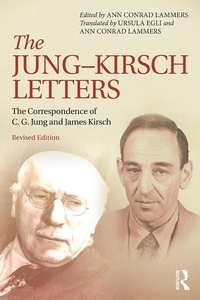
The Jung-Kirsch Letters
The Correspondence of C.G. Jung and James Kirsch
2nd Edition
Published on 22. February 2016
394 pages
978-1-317-27691-3 (ISBN)
Description

This book charts Carl Gustav Jung's 33-year (1928-61) correspondence with James Kirsch, adding depth and complexity to the previously published record of the early Jungian movement. Kirsch was a German-Jewish psychiatrist, a first-generation follower of Jung, who founded Jungian communities in Berlin, Tel Aviv, London, and Los Angeles. Their letters tell of heroic survival, brilliant creativity, and the building of generative institutions, but these themes are darkened by personal and collective shadows.
The Nazi era looms over the first half of the book, shaping the story in ways that were fateful not only for Kirsch and his career but also for Jung and his. Kirsch trained with Jung and acted as a tutor in Jewish psychology and culture to him. In 1934, fearing that anti-Semitism had seized his teacher, Kirsch challenged Jung to explain some of his publications for the Nazi-dominated Medical Society for Psychotherapy. Jung's answer convinced Kirsch of his sincerity, and from then on Kirsch defended him fiercely against any allegation of anti-Semitism.
We also witness Kirsch's lifelong struggle with states of archetypal possession: his identification with the interior God-image on the one hand, and with unconscious feminine aspects of his psyche on the other. These complexes were expressed, for Kirsch, in physical symptoms and emotional dilemmas, and they led him into clinical boundary violations which were costly to his analysands, his family and himself.
The text of these historical documents is translated with great attention to style and accuracy, and generous editorial scaffolding gives glimpses into the writers' world. Four appendices are included: two essays by Kirsch, a series of letters between Hilde Kirsch and Jung, and a brief, incisive essay on the Medical Society for Psychotherapy. This revised edition includes primary material that was unavailable when the book was first published, as well as updated footnotes and minor corrections to the translated letters.
The Nazi era looms over the first half of the book, shaping the story in ways that were fateful not only for Kirsch and his career but also for Jung and his. Kirsch trained with Jung and acted as a tutor in Jewish psychology and culture to him. In 1934, fearing that anti-Semitism had seized his teacher, Kirsch challenged Jung to explain some of his publications for the Nazi-dominated Medical Society for Psychotherapy. Jung's answer convinced Kirsch of his sincerity, and from then on Kirsch defended him fiercely against any allegation of anti-Semitism.
We also witness Kirsch's lifelong struggle with states of archetypal possession: his identification with the interior God-image on the one hand, and with unconscious feminine aspects of his psyche on the other. These complexes were expressed, for Kirsch, in physical symptoms and emotional dilemmas, and they led him into clinical boundary violations which were costly to his analysands, his family and himself.
The text of these historical documents is translated with great attention to style and accuracy, and generous editorial scaffolding gives glimpses into the writers' world. Four appendices are included: two essays by Kirsch, a series of letters between Hilde Kirsch and Jung, and a brief, incisive essay on the Medical Society for Psychotherapy. This revised edition includes primary material that was unavailable when the book was first published, as well as updated footnotes and minor corrections to the translated letters.
Reviews / Votes
'The Jung and Kirsch letters offer an inner look at the ever-deepening exchange of thoughts, dreams and concepts of early Jungian psychology between these two influential and powerful men.As Kirsch journeys from Nazi Germany to Israel, to England, and finally to Los Angeles, California, we experience his seeking for a homeland, an outer and inner home for his brilliance and commitment to Jungian psychoanalysis, and his personal family.
Kirsch's profound identity with his Jewish roots and his challenge to Jung to understand and integrate the philosophy and history of the Jewish people gives a deeply meaningful insight into the collective and individual struggle of that era, and is equally important today.
Reading this book is crucial to our understanding of Jungian psychology.' - Jacqueline Zeller Levine, Ph.D., Jungian analyst, The C.G. Jung Institute of Santa Fe, New Mexico, USA
'The Jung-Kirsch correspondence opens unique insights into their lifelong cooperation and their developing ideas about clinical and cultural issues. James Kirsch was one of the first who explained Jewish culture and identity to Jung. This edition of their letters is a milestone in the study of cultural complexes. It is eye-opening and fascinating to read.' - Dr. Joerg Rasche, Psychoanalyst IAAP, ISST, C. G. Jung Institute Berlin, Germany
'The Jung-Kirsch Letters belongs to a category of literature where the thoughts and ideas of the psychoanalytic masters are revealed behind their more formal writings. We are here served an exceptional vista of ruminations, theoretical and clinical discussions, dreams and personal emotions, as they crystallize into meaningful ideas. Ann Lammers' skilful editing renders this correspondence between Jung and one of his most prominent Jewish disciples into a masterful volume of great interest for readers, both professional and lay, interested in depth psychology.' - Erel Shalit, Ph.D., Jungian psychoanalyst and author, Tel Aviv, Israel
More details
Edition
2nd edition
Language
English
Place of publication
London
United Kingdom
Publishing group
Taylor & Francis Ltd
Target group
College/higher education
Edition type
Revised edition
Illustrations
20 s/w Photographien bzw. Rasterbilder
20 Halftones, black and white
File size
2,43 MB
ISBN-13
978-1-317-27691-3 (9781317276913)
Copyright in bibliographic data and cover images is held by Nielsen Book Services Limited or by the publishers or by their respective licensors: all rights reserved.
Schweitzer Classification
Other editions
Additional editions
Book
03/2016
2nd Edition
Routledge
€356.54
Shipment within 10-20 days
Book
03/2016
2nd Edition
Routledge
€80.50
Shipment within 10-20 days
Person
Ann Conrad Lammers is a psychotherapist, writer, and teacher of theological ethics. She has degrees from Barnard, The General Theological Seminary, and Yale. Having worked in the San Francisco area for 20 years, she now lives and works in New England.
Content
List of Illustrations. Kirsch, Preface. Acknowledgements. Abbreviations. Lammers, Introduction. The Letters. 1928-1932, Berlin. 1933-1934, Tel Aviv. 1935-1938, London. 1940-1947, Los Angeles. 1948-1949, The Institute. 1950-1952, Aion and Job. 1953, Jungians in L.A. 1954, Habent sua fata . 1955-1958, Zurich/Tokyo. 1959-1961, Mysterium. Appendix A: James Kirsch, 1934, "Then He Will Open the Ears of Men." Appendix B: Letters of C.G. Jung and Hilde Kirsch. Appendix C: James Kirsch, 1954, "'The Red One': A Psychological Interpretation of a Story by Jack London." Appendix D: A Brief History of the AAGP/IAAGP. Addendum: Letter of Aniela Jaffe, 27 May 1961. Editor's Note. Translators' Note. List of Letters. Selected Bibliography. Index.
