

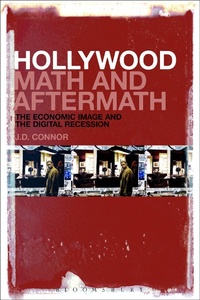
Hollywood Math and Aftermath
The Economic Image and the Digital Recession
1st Edition
Published on 23. August 2018
328 pages
978-1-5013-1440-7 (ISBN)
Description

Money is Hollywood's great theme-but money laundered into something else, something more. Money can be given a particular occasion and career, as box office receipts, casino winnings, tax credits, stock prices, lotteries, inheritances. Or money can become number, and numbers can be anything: pixels, batting averages, votes, likes. Through explorations of all these and more, J.D. Connor's Hollywood Math and Aftermath provides a stimulating and original take on "the equation of pictures," the relationship between Hollywood and economics since the 1970s.
Touched off by an engagement with the work of Gilles Deleuze, Connor demonstrates the centrality of the economic image to Hollywood narrative. More than just a thematic study, this is a conceptual history of the industry that stretches from the dawn of the neoclassical era through the Great Recession and beyond. Along the way, Connor explores new concepts for cinema studies: precession and recession, pervasion and staking, ostension and deritualization.
Enlivened by a wealth of case studies-from The Big Short and The Wolf of Wall Street to Equity and Blackhat, from Moneyball to 12 Years a Slave, Titanic to Lost, The Exorcist to WALLE, Deja Vu to Upstream Color, Contagion to The Untouchables, Ferris Bueller to Pacific Rim, The Avengers to The Village-Hollywood Math and Aftermath is a bravura portrait of the industry coming to terms with its own numerical underpinnings.
Touched off by an engagement with the work of Gilles Deleuze, Connor demonstrates the centrality of the economic image to Hollywood narrative. More than just a thematic study, this is a conceptual history of the industry that stretches from the dawn of the neoclassical era through the Great Recession and beyond. Along the way, Connor explores new concepts for cinema studies: precession and recession, pervasion and staking, ostension and deritualization.
Enlivened by a wealth of case studies-from The Big Short and The Wolf of Wall Street to Equity and Blackhat, from Moneyball to 12 Years a Slave, Titanic to Lost, The Exorcist to WALLE, Deja Vu to Upstream Color, Contagion to The Untouchables, Ferris Bueller to Pacific Rim, The Avengers to The Village-Hollywood Math and Aftermath is a bravura portrait of the industry coming to terms with its own numerical underpinnings.
Reviews / Votes
One of the more original and illuminating explorations of commercial film and television production ... Connor is as funny as he is smart, and he knows that taking the business of movies seriously will involve some ludicrous scenarios. Reading Aftermath often provides the insider thrill of pulling the curtain back to get a glimpse of how the sausage gets made. * Johns Hopkins Magazine * This is a rare book that provides an entirely new way of thinking about Hollywood and the 'equation of pictures.' Eloquent and methodologically aware, JD Connor provides deft analysis of the internalized relation of film to money, excavating the economic image of movies and TV shows with killing insight. For anyone seeking yield in the study of media industries and the stories they tell, this book is worth serious investment. * Paul Grainge, Professor of Film and Television Studies, University of Nottingham, UK * With Hollywood Math and Aftermath, Connor establishes himself as the premier quantum economist of contemporary Hollywood. Bringing film and TV studios' financial logic into dialogue with Deleuzian theory and his own imaginative capital through a series of dexterous case studies spanning the past 50 years, Connor gives new meaning to creative accounting, yielding a profitable, balanced account of industry practices, corporate self-inscription and the politics of entertainment finance. * Mark Gallagher, author of Another Steven Soderbergh Experience: Authorship and Contemporary Hollywood (2013), University of Nottingham, UK * With Hollywood Math and Aftermath, J.D. Connor provides an original, provocative perspective on Conglomerate Hollywood's evolving practices and products. At once historical, philosophical, and industrial in scope, Connor creatively accounts for Hollywood's financial activities in a compelling set of case studies. * Alisa Perren, Associate Professor of Radio-Television-Film, University of Texas at Austin, USA * Deciding where the numbers end and art begins is a mug's game that writers have been trying to play with Hollywood almost since the birth of cinema itself. J. D. Connor's terrifically provocative new book should end this game for once and all. * Los Angeles Review of Books *More details
Edition
1. Auflage
Language
English
Place of publication
New York
United States
Publishing group
Bloomsbury Publishing PLC (Digital)
Target group
Professional and scholarly
Illustrations
96 bw illus
ISBN-13
978-1-5013-1440-7 (9781501314407)
Copyright in bibliographic data and cover images is held by Nielsen Book Services Limited or by the publishers or by their respective licensors: all rights reserved.
Schweitzer Classification
Other editions
Additional editions
Book
02/2020
Bloomsbury Academic
€62.08
Shipment within 15-20 days
Book
08/2018
Bloomsbury Academic USA
€193.13
Shipment within 15-20 days
Person
J.D. Connor is Associate Professor in the Division of Cinema and Media Studies at the University of Southern California, USA. His research focuses on the interplay of art and industry in the contemporary Hollywood system, the history of tape recording, and Kennedy-era media shifts. Connor is the author of the forthcoming The Studios after the Studios (2015) and on the Steering Committee of Post45 (post45.org).
Content
Acknowledgements
Introduction: The Equation of Pictures
1. The Economic Image; Hollywood Dataculture and the Moneyball of Moneyball
I. Precession: Titanic: It's All on the Screen
2. Follow the Money: The Warner '70s
3. High Concept the Chicago way: Dan Rostenkowski, Ferris Bueller, Eliot Ness
4. Like Some Dummy Corporation You Just Move Around the Board: Tax Credits and Time Travel
II. Recession: Two Trailers From the Opening of the Obama Era
5. The Biggest Independent Pictures Ever Made
6. Numbers, Stations: Lost and the Digital Turn in U.S. Television
7. The Piggies and the Market
8. The United States of America v. The Wolf of Wall Street
Conclusion
Bibliography
Index
Introduction: The Equation of Pictures
1. The Economic Image; Hollywood Dataculture and the Moneyball of Moneyball
I. Precession: Titanic: It's All on the Screen
2. Follow the Money: The Warner '70s
3. High Concept the Chicago way: Dan Rostenkowski, Ferris Bueller, Eliot Ness
4. Like Some Dummy Corporation You Just Move Around the Board: Tax Credits and Time Travel
II. Recession: Two Trailers From the Opening of the Obama Era
5. The Biggest Independent Pictures Ever Made
6. Numbers, Stations: Lost and the Digital Turn in U.S. Television
7. The Piggies and the Market
8. The United States of America v. The Wolf of Wall Street
Conclusion
Bibliography
Index
