

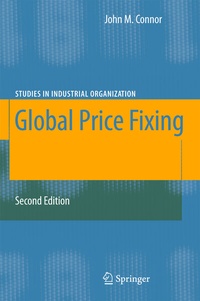
Global Price Fixing
Description

Reviews / Votes
From the review of the second edition by Valerie Y. Suslow, University of Michigan, published in: Journal of Economic Literature Vol. 47 (June 2009): 527-529
[.] John Connor's book, Global Price Fixing, an updated and revised second edition, is an in depth look at the organization, mechanisms of operation, behavior, and effects of three famous international cartels in the citric acid, lysine, and vitamins industries. Empirical researchers often focus on "international cartels"-those with members from two or more countries. Connor focuses on "global cartels," which he defines as "conspiracies that bridge two or more continents" (p. 5). [.]
The scope of the book is wide-ranging, addressing the economics of cartel operation for these three in-depth cases, but at the same time offering an overview of the policy issues as well as commentary on recent developments. Not surprisingly, there is much to bring up to date because "[m]uch has happened in the field of cartels since the first edition was written in 2000" (p. viii). Although the organization of the book is substantially the same, the focus has broadened. [.]
Global Price Fixing continues to be an invaluable reference for those with a deep interest in the economics of cartels, and a very readable and accessible narrative on the stories behind three famous contemporary international cartels. Given the apparent continued proclivity of firms to conspire to fix prices and allocate markets, these stories will continue to be relevant for researchers and policymakers for years to come.
From reviews of the first edition:
"Since 1994, more than 20 global cartels have been discovered . . John Connor has written an immense and marvelous book on the subject. He says . that his goal is 'to describe and analyze the origins, operation and impact of global cartels in the markets for lysine, citric acid, andvitamins'. He succeeds nicely in this goal . . Connors writes in an appealing narrative or journalistic style . . it should become a basic resource for almost everyone interested in industrial organization economics." (Prof. Douglas Greer, Review of Industrial Organization, Vol. 21, 2002)
More details
Other editions
Additional editions
Content
Two top executives of the giant U.S. agribusiness firm Archer Daniels Midland flew from the company's headquarters in Decatur, Illinois to Tokyo, Japan in April 1992. Terrance Wilson, President of the sprawling corn-products division of ADM, disliked long flights because he reacted badly to the effects of jet lag, but he was epitome of the loyal manager, and this trip could make tens of millions of dollars for his company if everything went according to plan.
Along with Wilson was a brash new ADM vice president, Mark Whitacre, who headed up ADM's new Bioproducts Division. Whitacre was a quickly rising star at ADM. With his Ph.D. in nutritional biochemistry from prestigious Cornell University, he was well equipped to handle the technical side of the high-tech bioproducts business. The product the two men were concerned about was lysine, an essential amino acid that speeds up the formation of lean meat on farm animals. After getting his Ph.D., Whitacre had worked for the German company Degussa that was the world's biggest maker of amino acids, and it was there that Whitacre had discovered he had a flair for salesmanship. It was this rare combination of talents that prompted ADM to depart from company practice and hire him away from Degussa rather than promote from within.
Terry Wilson had come as a young man straight from the U.S. Marine Corps to work for ADM. He loved the company and its charismatic leader, Dwayne O. Andreas, who had several times demonstrated that he personally cared for Wilson and his handicapped son. Wilson applied his tough military ways to his jobs at ADM, so that he rose from near the bottom of the company's organization to very near to its pinnacle in his 25 years with ADM. Although Wilson had never gone to college, he had a thing or two to teach his more polished underling who was twenty years his junior. It was not the sort of thing taught in business schools. Terry Wilson was going to teach Mark Whitacre how to fix the world price of lysine.
This was a way of doing business that Terry Wilson knew a lot about. Just a year before this trip to Tokyo, Wilson had taken a very similar mission to Europe with his younger colleague Barrie Cox. In a few months under Wilson's tutelage Cox had turned into an accomplished price fixer of citric acid (see Chapter 5). Now was the time to repeat that highly profitable lesson for Whitacre's Biotechnology Division. Like citric acid, lysine was a high-tech product made by fermentation of the corn sweetener dextrose. Like citric acid, ADM had just entered the industry in a big way but wasn't yet the industry's top dog - ADM's ultimate objective in all its lines of business. Like citric acid, new entry into the industry had precipitated a fierce price war that turned the ink red in all the producer's books.
Now the time was ripe to let ADM's rivals know that it was ready to play ball, to call off their aggressive scramble for market share, and to stanch the outflow of profits precipitated by the bloody yearlong price war. Wilson and Whitacre were on a peace mission to Tokyo to meet their counterparts at Ajinomoto and Kyowa Hakko, the two oldest and still dominant makers of lysine in the world. When the Americans met the Ajinomoto executives for the first time, Wilson made several specific proposals: establishing a lysine trade association, audited sales reports for its members, and a 50% increase in price. The sincerity of ADM's offer to cooperate rather than fight would take a while to sink in, but within a few months the managers of all three companies would be toasting their newly formed partnership in crime.
The lysine cartel held its first formal meeting in June 1992. The event that made the conspiracy possible was ADM's decision in 1989 to build the world's biggest lysine plant. Without the demonstrated power of ADM's large production to disrupt the market and to discipline recalcitrant lysine producers, the cartel would never have formed in the first place. ADM used the carrot of profits for all, the stick of its unused capacity, and diplomacy of a high order to get the others to join and cooperate. For the Asian producers a lengthy price war made them pine for the old days when world pricing was simply a sellers' management decision.
