

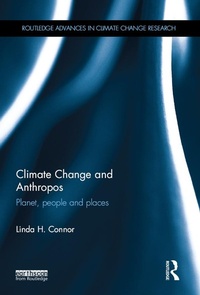
Climate Change and Anthropos
Planet, people and places
Published on 5. February 2016
222 pages
978-1-317-97055-2 (ISBN)
Description

Anthropos, in the sense of species as well as cultures and ethics, locates humans as part of much larger orders of existence - fundamental when thinking about climate change. This book offers a new way of exploring the significance of locality and lives in the epoch of the Anthropocene, a time when humans confront the limits of our control over nature. Many scholars now write about the ethics, policies and politics of climate change, focussing on global processes and effects. The book's innovative approach to cross-cultural comparison and a regionally based study explores people's experiences of environmental change and the meaning of climate change for diverse human worlds in a changing biosphere.
The main study site is the Hunter Valley in southeast Australia: an ecological region defined by the Hunter River catchment; a dwelling place for many generations of people; and a key location for transnational corporations focussed on the mining, burning and export of black coal. Abundant fossil fuel reserves tie Hunter people and places to the Asia Pacific - the engine room of global economic growth in the twenty-first century and the largest user of the planet's natural resources. The book analyses the nexus of place and perceptions, political economy and social organisation in situations where environmental changes are radically transforming collective worlds.
Based on an anthropological approach informed by other ways of thinking about environment-people relationships, this book analyses the social and cultural dimensions of climate change holistically. Each chapter links the large scales of species and planet with small places, commodity chains, local actions, myths and values, as well as the mingled strands of dystopian imaginings and strivings for recuperative renewal in an era of transition.
The main study site is the Hunter Valley in southeast Australia: an ecological region defined by the Hunter River catchment; a dwelling place for many generations of people; and a key location for transnational corporations focussed on the mining, burning and export of black coal. Abundant fossil fuel reserves tie Hunter people and places to the Asia Pacific - the engine room of global economic growth in the twenty-first century and the largest user of the planet's natural resources. The book analyses the nexus of place and perceptions, political economy and social organisation in situations where environmental changes are radically transforming collective worlds.
Based on an anthropological approach informed by other ways of thinking about environment-people relationships, this book analyses the social and cultural dimensions of climate change holistically. Each chapter links the large scales of species and planet with small places, commodity chains, local actions, myths and values, as well as the mingled strands of dystopian imaginings and strivings for recuperative renewal in an era of transition.
Reviews / Votes
In this work, Connor (anthropology, Univ. of Sydney, Australia) brings an "anthropological approach" to the study of climate change. Connor illustrates the relationships between culture, ethics, and policy alongside peoples' perceptions and experience of climate change as she moves between local and global scales and historical and current time frames. Following an overview of anthropological research related to climate change, the book surveys the experience of indigenous peoples living under the pressure of extreme weather in the Arctic and South Pacific. The book then turns to its main focus-an extended study in Australia's Hunter Valley. There is a detailed history, stretching back into the region's geologic past and continuing through its current status as a major coal mining location. This offers context for the thorough anthropological research, which provides an insightful look into the various ways that residents from diverse vantage points conceptualize climate change and, in turn, how this influences their response. Given the theoretically dense academic writing style, this work will be of greatest interest to individuals with a strong background in anthropology.--J. L. Rhoades, Antioch University New England, February 2017 issue of CHOICE
More details
Series
Language
English
Place of publication
London
United Kingdom
Publishing group
Taylor & Francis Ltd
Target group
College/higher education
Illustrations
27 s/w Photographien bzw. Rasterbilder, 30 s/w Abbildungen
27 Halftones, black and white; 30 Illustrations, black and white
File size
24,20 MB
ISBN-13
978-1-317-97055-2 (9781317970552)
Copyright in bibliographic data and cover images is held by Nielsen Book Services Limited or by the publishers or by their respective licensors: all rights reserved.
Schweitzer Classification
Other editions
Additional editions
Book
12/2017
1st Edition
Routledge
€47.90
Shipment within 15-20 days
Book
02/2016
1st Edition
Routledge
€140.40
Shipment within 15-20 days
Person
Linda H. Connor is Professor of Anthropology at the University of Sydney, Australia.
Content
Part 1: The Ecocosmic Sphere 1. Precarious places in a warming world 2. Life and time in a carboniferous zone Part 2: Quotidian Worlds 3. Being in the weather 4. Living environmental change Part 3: Counterpoints 5. Climate Activation 6. Fragile futurity
