

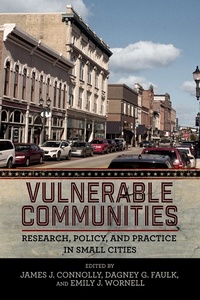
Vulnerable Communities
Description

Vulnerable Communities examines the struggles of smaller cities in the United States, those with populations between 20,000 and 200,000. Like many larger metropolitan centers, these places are confronting change within a globalized economic and cultural order. Many of them have lost their identities as industrial or commercial centers and face a complex and distinctive mix of economic, social, and civic challenges. Small cities have not only fewer resources but different strengths and weaknesses, all of which differentiate their experiences from those of larger communities.
Vulnerable Communities draws together scholars from a broad range of disciplines to consider the present condition and future prospects of smaller American cities. Contributors offer a mix of ground-level analyses and examinations of broader developments that have impacted economically weakened communities and provide concrete ideas for local leaders engaged in redevelopment work. The essays remind policy makers and academics alike that it is necessary to consider cultural tensions and place-specific conflicts that can derail even the most well-crafted redevelopment strategies prescribed for these communities.
More details
Other editions
Additional editions
Persons
James J. Connolly is George and Frances Ball Distinguished Professor of History and Director of the Center for Middletown Studies at Ball State University. He is coeditor and coauthor of several books, including Print Culture Histories beyond the Metropolis.
Dagney G. Faulk is Director of Research in the Center for Business and Economic Research at Ball State University. She is coauthor of Local Government Consolidation in the United States.
Emily J. Wornell is Assistant Professor of Research in the Center for Local and State Policy at Ball State University.
Content
Vulnerable Communities: An Introduction, by James J. Connolly, Dagney G. Faulk, and Emily J. Wornell
Part I: INTERNAL DYNAMICS
1. The Perils of In-Betweenness: Fragmented Growth in a Virginia Small City, by Henry Way
2. Building Civic Infrastructure in Smaller Cities: Lessons from the Boston Fed's Working Cities Challenge on Paving the Way for Economic Opportunity, by Colleen Dawicki
3. Diversity in the Dakotas: Lessons on Intercultural Policies, by Jennifer Erickson
4. Shaking Off the Rust in the America South: Deindustrialization, Abandonment, and Revitalization in Bessemer, Alabama, by William G. Holt
Part II: PATTERNS AND STRATEGIES
5. The Economic Fortunes of Small Industrial Cities and Towns: Manufacturing, Place Luck, and the UrbanTransfer Payment Economy, by Alan Mallach
6. Where Do Small Cities Belong? The Case of theMicropolitan Area, by James Matthew Fannin and Vikash Dangal
7. Conceptualizing Shrinking Inner-Ring Suburbs asSmall Cities: Governance in Communities in Transition, by Hannah Lebovits
8. Local Government Responses to Property Tax Caps: An Analysis of Indiana Municipal Governments, by Dagney G. Faulk, Charles Taylor, and Pamela Schaal
9. Asymmetric Local Employment Multipliers, Agglomeration, and the Disappearance of Footloose Jobs, by Michael J. Hicks
