

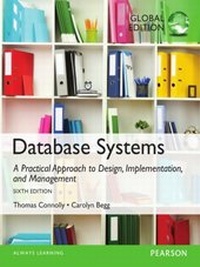
Database Systems: A Practical Approach to Design, Implementation, and Management PDF eBook, Global Edition
Description

Database Systems: A Practical Approach to Design, Implementation, and Management, 6th edition, Global Edition,by Thomas Connolly and Carolyn Begg, introduces you to the theory behind databases in a concise yet comprehensive manner.
The methodology behind relational Database Management Systems is presented in a simple way, with step-by-step instructions, making the text accessible for technical and non-technical readers. The text applies a realistic worked example that you follow across the chapters of the book using three explicit phases (conceptual, logical, and physical database design) to help you relate your knowledge to real-world applications. Designed for one or two-term undergraduate courses in database management or database design, this book can also be used as a working reference for IT professionals.
This 6th edition has been updated with the latest information on the subject, as well as additional learning features compared to the previous edition.
New features include:
- An extended chapter on database architectures and the Web, covering cloud computing.
- A new Section on Data Warehousing and Temporal Databases.
- Updated text to cover the latest version of the SQL standard, which was released late 2011 (SQL:2011).
- An extended chapter on replication and mobile databases.
- Updated chapters on Web-DBMS integration and XML.
- Extended treatment of XML, SPARQL, Xquery 1.0 and Xpath 2.0 (including the new Xquery Update facility), and the new SQL:2011 SQL/XML standard.
- Coverage updated to Oracle 11g.
- New review questions and exercises at the end of chapters allow readers to test their understanding.
With its clear presentation that supports your learning, this book can provide you with a comprehensive understanding of the theory behind databases.
All prices
More details
Other editions
Additional editions
Persons
Thomas M. Connolly is the Head of the Computing and Information Systems division at the University of Paisley.
Carolyn E. Begg is a lecturer at the University of Paisley, with research interests in Information Systems, Database Management Systems, and Decision Support Systems within medicine
Content
- Chapter 1 Introduction to Databases
- Database Environment
- Database Architectures and the Web
- Chapter 4 The Rational Model
- Chapter 5 Relational Algebra and Relational Calculus
- Chapter 6 SQL: Data Manipulation
- Chapter 7 SQL: Data Definition
- Chapter 8 Advanced SQL
- Chapter 9 Object-Relational DBMSs
- Chapter 10 Database System Development Lifecycle
- Chapter 11 Database Analysis and the DreamHome Case Study
- Chapter 12 Entity-Relationship Modeling
- Chapter 13 Enhanced Entity-Relationship Modeling
- Chapter 14 Normalization
- Chapter 15 Advanced Normalization
- Chapter 16 Methodology - Conceptual Database Design
- Chapter 17 Methodology - Logical Database Design for the Relational Model
- Chapter 18 Methodology - Physical Database Design for Relational Databases
- Chapter 19 Methodology - Monitoring and Tuning the Operational System
- Chapter 20 Security and Administration
- Chapter 21 Professional, Legal, and Ethical Issues in Data Management
- Chapter 22 Transaction Management
- Chapter 23 Query Processing
- Chapter 24 Distributed DBMSs - Concepts and Design
- Chapter 25 Distributed DBMSs - Advanced Concepts
- Chapter 26 Replication and Mobile Databases
- Chapter 27 Object-Oriented DBMSs - Concepts and Design
- Chapter 28 Object-Oriented DBMSs - Standard Systems
- Chapter 29 Web Technology and DBMSs
- Chapter 30 Semistructured Data and XML
- Chapter 31 Data Warehousing Concepts
- Chapter 32 Data Warehousing Design
- Chapter 33 OLAP
- Chapter 34 Data Mining
