

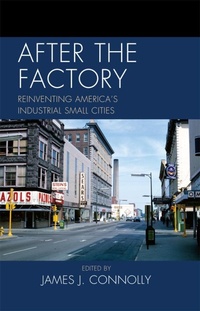
After the Factory
Reinventing America's Industrial Small Cities
1st Edition
Published on 14. October 2010
254 pages
978-0-7391-4825-9 (ISBN)
Description

The most pressing question facing the small and mid-sized cities of America's industrial heartland is how to reinvent themselves. Once-thriving communities in the Northeastern and Midwestern U. S. have decayed sharply as the high-wage manufacturing jobs that provided the foundation for their prosperity disappeared. A few larger cities had the resources to adjust, but most smaller places that relied on factory work have struggled to do so. Unless and until they find new economic roles for themselves, the small cities will continue to decline.
Reinventing these smaller cities is a tall order. A few might still function as nodes of industrial production. But landing a foreign-owned auto manufacturer or a green energy plant hardly solves every problem. The new jobs will not be unionized and thus will not pay nearly as much as the positions lost. The competition among localities for high-tech and knowledge economy firms is intense. Decaying towns with poor schools and few amenities are hardly in a good position to attract the "creative-class" workers they need. Getting to the point where they can lure such companies will require extensive retooling, not just economically but in terms of their built environment, cultural character, political economy, and demographic mix. Such changes often run counter to the historical currents that defined these places as factory towns.
After the Factory examines the fate of industrial small cities from a variety of angles. It includes essays from a variety of disciplines that consider the sources and character of economic growth in small cities. They delve into the history of industrial small cities, explore the strategies that some have adopted, and propose new tacks for these communities as they struggle to move forward in the twenty-first century. Together, they constitute a unique look at an important and understudied dimension of urban studies and globalization.
Reinventing these smaller cities is a tall order. A few might still function as nodes of industrial production. But landing a foreign-owned auto manufacturer or a green energy plant hardly solves every problem. The new jobs will not be unionized and thus will not pay nearly as much as the positions lost. The competition among localities for high-tech and knowledge economy firms is intense. Decaying towns with poor schools and few amenities are hardly in a good position to attract the "creative-class" workers they need. Getting to the point where they can lure such companies will require extensive retooling, not just economically but in terms of their built environment, cultural character, political economy, and demographic mix. Such changes often run counter to the historical currents that defined these places as factory towns.
After the Factory examines the fate of industrial small cities from a variety of angles. It includes essays from a variety of disciplines that consider the sources and character of economic growth in small cities. They delve into the history of industrial small cities, explore the strategies that some have adopted, and propose new tacks for these communities as they struggle to move forward in the twenty-first century. Together, they constitute a unique look at an important and understudied dimension of urban studies and globalization.
More details
Series
Edition
1. Auflage
Language
English
Place of publication
New York
United States
Publishing group
Bloomsbury Publishing Plc
Target group
Professional and scholarly
ISBN-13
978-0-7391-4825-9 (9780739148259)
Copyright in bibliographic data and cover images is held by Nielsen Book Services Limited or by the publishers or by their respective licensors: all rights reserved.
Schweitzer Classification
Other editions
Additional editions
Book
06/2012
Lexington Books
€62.20
Shipment within 10-20 days
Book
10/2010
Lexington Books
€134.20
Shipment within 10-20 days
Persons
James J. Connolly is professor of history and director of the Center for Middletown Studies at Ball State University.
Content
Chapter 1 Can They Do It? The Capacity of Small Rust-Belt Cities to Reinvent Themselves in a Global Economy
Chapter 2 Model Cities, Mill Towns, and Industrial Peripheries: Small Industrial Cities in Twentieth-Century America
Chapter 3 From Satellite City to Burb of the 'Burgh: DeIndustrialization and community Identity in Steubenvill, Ohio
Chapter 4 Creating an "Image Center": Reimagining Omaha's Downtown and Riverfront, 1986-2003
Chapter 5 The Gravity of Capital: Spatial and Economic Transformation in Muncie, Indiana, 1917-1940
Chapter 6 Curing the Rustbelt?: Neoliberal Health Care, Class, and Race in Mansfield, Ohio
Chapter 7 Do Economic Growth Models Explain Midwest City Growth Differences?
Chapter 8 Explaining Household Income Patterns in Rural Midewestern Counties: The Importance of Being Urban
Chapter 9 Small, Green, and Good: The Role of Neglected Cities in a Sustainable Future
Chapter 2 Model Cities, Mill Towns, and Industrial Peripheries: Small Industrial Cities in Twentieth-Century America
Chapter 3 From Satellite City to Burb of the 'Burgh: DeIndustrialization and community Identity in Steubenvill, Ohio
Chapter 4 Creating an "Image Center": Reimagining Omaha's Downtown and Riverfront, 1986-2003
Chapter 5 The Gravity of Capital: Spatial and Economic Transformation in Muncie, Indiana, 1917-1940
Chapter 6 Curing the Rustbelt?: Neoliberal Health Care, Class, and Race in Mansfield, Ohio
Chapter 7 Do Economic Growth Models Explain Midwest City Growth Differences?
Chapter 8 Explaining Household Income Patterns in Rural Midewestern Counties: The Importance of Being Urban
Chapter 9 Small, Green, and Good: The Role of Neglected Cities in a Sustainable Future
