

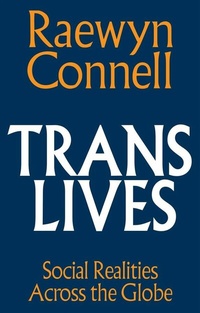
Trans Lives
Description

In this book, Raewyn Connell, a world-leading sociologist and gender researcher, gathers the evidence and writes about the lives of trans women and men, hijra, travesti, and other groups around the world. She looks at the forces shaping trans lives, including medicine and its limitations, precarity and poverty, unequal gender relations, the role of sex work, and encounters with the state and the corporate economy. She discusses what is behind anti-trans campaigns, criticizing the simplistic idea that 'transphobia' explains these, and suggesting more potent causes. Finally, by exploring the creative ways trans groups have organized, she argues for the contribution they can and should make to solving our shared contemporary crises.
Written in clear and vivid language, this book offers illuminating new perspectives on gender transitions, and on gender itself.
More details
Other editions
Additional editions
Person
Raewyn Connell is among the world's leading sociologists and gender researchers, and is herself a trans woman. Her books include Masculinities, Gender and Power, Making the Difference, and Southern Theory. She is Professor Emerita at the University of Sydney.
Content
I
1. Real lives
2. People who are not trans, and the nature of gender
3. Transitions and transition work
II
4. The doctors and trans health
5. The world around us
6. Anti-trans
III
7. Changing the world
In conclusion
Introduction
Call it sex change, gender reassignment, gender affirmation, or gender transition. It is a very intimate and a very public process. It often means changes in the body, and always means changes in the way the body is seen by others. Relationships with family, friends, lovers, neighbours and workmates are likely to change. Transition can redirect one's whole course in life. It can mean new beginnings and new endings, pain and joy, grief and exaltation.
As a change of social position, gender transition is shaped by social structures, customs and laws. Therefore it takes different shapes in different places and times. Social responses change: broadly, in the last half-century there has been increasing acceptance of gender transition, in countries where it was not already an established custom. Support centres have been established, and laws that give better recognition to change of civil status have been passed, such as the pioneering 2012 Law of Gender Identity in Argentina. Research has expanded, and medical treatment has become more sophisticated and usually more respectful.
Yet contrary to media images of glamour and money, many trans groups around the world live in stark poverty. For many, work is precarious, housing is poor, there is a high risk of illness and a short expectation of life. Feminized trans groups especially can face social prejudice, police harassment and vigilante violence, including murder. There are places where defenders speak of 'transfemicide'.
On top of this, in recent years there has been an anti-trans offensive from right-wing politicians, conservative churches, authoritarian governments and even a faction of feminists. Between them, these forces have constructed remarkably hostile fantasies about trans people. Their campaigns have practical effects: in a number of places, rights have been abolished, services have been destroyed and harassment has increased. This can easily get worse.
It is not surprising that there is a mass of public discussion about trans people, in print, on social media and online forums, on the airwaves, in professional forums and public meetings. The public discussion is strong on polemic but weak on basic information about transitions and trans lives. This information is available. The experience of a variety of trans groups has now been documented in good-quality research. There is information, too, about how the medical profession, the state, and various political forces have engaged with trans lives, and how trans groups have organized themselves.
The most influential ideas in this discussion come from the global North, especially the USA. But most trans groups actually live in the post-colonial, majority world. Any attempt to understand transition and the issues around it must take careful account of their experience. I have tried to do that by including narratives, research, and ideas from different parts of Latin America, parts of sub-Saharan Africa, South and South-East Asia, parts of the Islamic world and Oceania, as well as from North America and Europe. The ways gender transitions are made, the societies in which they happen, and the groups that form, differ in many ways and cannot be reduced to variations on a global-North story. But they also have points in common, and often face parallel problems; there is good reason to think about them together. 'Trans' is not an ideal name to collect them, but I haven't found any better.
I hope to make a case for solid social realism about trans lives. We need realism to counter hostile fantasies, and to respond to reasonable questions. I think, too, we need to move beyond the emphasis on identities, norms and transgression that has been central to discussions of trans lives in English-speaking countries for the past twenty to thirty years. In recent years, more activists and researchers have addressed the practical issues of trans life such as poverty and precarity, the impact of racism, migration and colonization, and the role of violence and state power.
I build on this approach, not ignoring identity problems but trying to give a more rounded account of what gender transitions involve, and the powerful institutions and social forces that shape trans lives. Among the institutions I give particular attention to medicine and health professions for their part in shaping public understandings of gender transition as well as for their practical role. Anti-trans politics too needs careful thought. I trace the emergence of several groups of opponents, the stories they circulate and the tools they use. But I also emphasize the capacity of trans groups to respond to circumstances and shape pathways in life.
And I want to bring gender itself, gender as a social structure and a pattern in personal life, back robustly into the discussion of transitions and trans groups. I have no hesitation in speaking of transsexual women and men, and feminized trans groups such as travestis and hijra, as well as transgender, nonbinary and intersex. The popularity of gender-neutral terms like 'transgender community' and 'LGBT', and a certain nervousness about 'the binary', have the curious effect of de-gendering the way we talk about many groups for whom gender matters a lot. For whom gender can be, in fact, a matter of life and death.
I hope to provide information and ideas that will be useful to trans people themselves, and to people who engage with them as family, partners, friends or supporters, professionals or policymakers. More broadly, I hope to provide an understanding of gender transition and what it involves, for anyone who is thinking about the issues raised by trans groups' existence.
The book is in three parts. The first concerns trans lives and gender transitions. Chapter 1 introduces seven trans groups from different countries, and several from the internet, using close-focus research from the last two generations. Chapter 2 considers people who are not trans, and how to understand gender itself. Chapter 3 looks at what is involved in gender transitions, the work they require, and the people who do it.
The second part looks at the wider environment of trans lives. Chapter 4 discusses the doctors and health care, and what happened as trans medicine went commercial and global. Chapter 5 outlines the social structures and major institutions that shape trans lives. Chapter 6 looks at hostility to trans groups, especially the recent anti-trans campaigns and violence.
The third part returns to trans groups themselves. Chapter 7 looks at the varied and inventive ways trans groups have organized and tried to change their worlds. The book ends with a short reflection on the book's themes and the contribution trans groups can make towards a more just, peaceful and survivable world.
Any book of this scope rests on the work of many activists and researchers. I have listed my sources in the endnotes to each chapter, and I really encourage readers to follow up at least some of them, to get closer to the experiences themselves. I would like to record my deep gratitude to Viviane Namaste, who opened so many of these paths; Rose Leontini, who revealed the international medical literature for me; Jesse Hooley and Sophie Cotton, who brought me up to date with the political struggle; Michael Messner, for long friendship and advice on this project; Patricia Selkirk, for technical advice and even longer friendship; and Kylie Benton-Connell, whose unflinching judgement and unfailing support have made this work possible. The book is dedicated to Kylie.
For trans women, telling one's story, accounting for oneself, is constantly required. It is sometimes valuable, sometimes humiliating, sometimes dangerous. When planning this book I wanted to avoid the personal-story mode, both to resist that pressure, and because the story is not only mine. In particular Pam Benton, whose partner I was for twenty-nine years, cannot give her own account; she was a writer and would have done that. But I accept that it may be important for readers of this book to know where the author is coming from, and what stake I have in these issues.
So: I am a transsexual woman, now in my eighties and looking with some amazement at what the years brought. I am Australian, from a white settler-colonial family who migrated to this continent during the British invasion in the nineteenth century. I was born during World War II, grew up in the postwar boom, and have never been in poverty. I worked as a full-time academic, mostly in Australia, for more than forty years. I am a social scientist, and I have done research on questions about gender as well as class, education, the global economy of knowledge, and other problems. I am still a member of my union. I am a socialist and feminist, and, unlike the Australian government, I believe in environmental sanity.
I ran into gender contradictions in childhood, coming to know myself as a girl, while also knowing I had a boy's body. In Australia in the 1950s there were no services concerned with such matters. I tried to live as a boy and a man, pushing the alternative down by willpower. By late adolescence I was in serious trouble with horror and self-harm, close to suicide. Not unusual for trans women! In early adulthood I met and fell in love with Pam; we formed a relationship that turned my life in another direction. By trial and error we arrived at ways of living together that could include both Pam's commitment to women as an active feminist and my identification with women. We became parents and shared the joys...
