

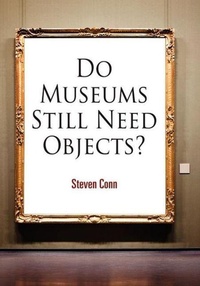
Do Museums Still Need Objects?
1st Edition
Published on 24. November 2010
272 pages
978-0-8122-0165-9 (ISBN)
Description

"We live in a museum age," writes Steven Conn in Do Museums Still Need Objects? And indeed, at the turn of the twenty-first century, more people are visiting museums than ever before. There are now over 17,500 accredited museums in the United States, averaging approximately 865 million visits a year, more than two million visits a day. New museums have proliferated across the cultural landscape even as older ones have undergone transformational additions: from the Museum of Modern Art and the Morgan in New York to the High in Atlanta and the Getty in Los Angeles. If the golden age of museum-building came a century ago, when the Metropolitan Museum of Art, the American Museum of Natural History, the Philadelphia Museum of Art, the Field Museum of Natural History, and others were created, then it is fair to say that in the last generation we have witnessed a second golden age.
By closely observing the cultural, intellectual, and political roles that museums play in contemporary society, while also delving deeply into their institutional histories, historian Steven Conn demonstrates that museums are no longer seen simply as houses for collections of objects. Conn ranges across a wide variety of museum types-from art and anthropology to science and commercial museums-asking questions about the relationship between museums and knowledge, about the connection between culture and politics, about the role of museums in representing non-Western societies, and about public institutions and the changing nature of their constituencies. Elegantly written and deeply researched, Do Museums Still Need Objects? is essential reading for historians, museum professionals, and those who love to visit museums.
By closely observing the cultural, intellectual, and political roles that museums play in contemporary society, while also delving deeply into their institutional histories, historian Steven Conn demonstrates that museums are no longer seen simply as houses for collections of objects. Conn ranges across a wide variety of museum types-from art and anthropology to science and commercial museums-asking questions about the relationship between museums and knowledge, about the connection between culture and politics, about the role of museums in representing non-Western societies, and about public institutions and the changing nature of their constituencies. Elegantly written and deeply researched, Do Museums Still Need Objects? is essential reading for historians, museum professionals, and those who love to visit museums.
Reviews / Votes
"Conn's well-written essays centralize objects as the defining feature of museums as they shifted (albeit incompletely) from being places of public instruction to being places of private consumption, from taxonomic exhibits to narrative ones, influenced by the development of the academic disciplines of science, anthropology, and art history. . . . An interesting and significant contribution to the literatures of museum studies and public history."-American Historical Review"Steven Conn provides an eclectic, provocative, and extremely readable tour of the history of museums in the twentieth-century United States. . . . The easy erudition and wit of Do Museums Still Need Objects? Will appeal to lay readers and museum practitioners, and its hardheaded historical approach and bold opinions will raise debate among scholars in the field of museum studies and cultural history."-Journal of American History
"Steven Conn offers a refreshing look at museums and many of the debates surrounding their development and practices over the past forty years. He is right to frame his inquiry by asking if museums still need objects. Too often these debates have ignored the very characteristic that defines museums and distinguishes them from all other cultural institutions: they collect, preserve, and present things. This is an important, timely book."-James Cuno, President and Director, Art Institute of Chicago
"In this provocative and engaging book, Steven Conn considers the continuing role museums play in contemporary American society. Despite recent shifts in their priorities, Conn argues that museums and their collections possess tremendous potential as sites of learning and places where civic identity is shaped and sustained. Do Museums Still Need Objects? is a must-read for anyone thinking about the social and cultural significance of museums at the beginning of the twenty-first century."-Raymond Silverman, University of Michigan
All prices
More details
Series
Language
English
Place of publication
Pennsylvania
United States
Target group
Adult education
College/higher education
Illustrations
34 illus.
34 illus.
File size
4,62 MB
ISBN-13
978-0-8122-0165-9 (9780812201659)
Copyright in bibliographic data and cover images is held by Nielsen Book Services Limited or by the publishers or by their respective licensors: all rights reserved.
Schweitzer Classification
Other editions
Additional editions
Steven Conn
Do Museums Still Need Objects?
Book
12/2010
University of Pennsylvania Press
€28.50
Shipment within 10-20 days
Person
Steven Conn is the author of Metropolitan Philadelphia: Living with the Presence of the Past, also available from the University of Pennsylvania Press.
Content
Introduction: Thinking about Museums
Chapter 1. Do Museums Still Need Objects?
Chapter 2.Whose Objects? Whose Culture? The Contexts of Repatriation
Chapter 3. Where Is the East?
Chapter 4. Where Have All the Grown-Ups Gone?
Chapter 5. The Birth and the Death of a Museum
Chapter 6. Museums, Public Space, and Civic Identity
Notes
Index
Acknowledgments
Chapter 1. Do Museums Still Need Objects?
Chapter 2.Whose Objects? Whose Culture? The Contexts of Repatriation
Chapter 3. Where Is the East?
Chapter 4. Where Have All the Grown-Ups Gone?
Chapter 5. The Birth and the Death of a Museum
Chapter 6. Museums, Public Space, and Civic Identity
Notes
Index
Acknowledgments

