

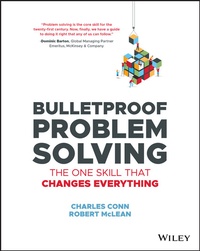
Bulletproof Problem Solving
The One Skill That Changes Everything
1st Edition
Published on 4. March 2019
320 pages
978-1-119-55304-5 (ISBN)
Description

Complex problem solving is the core skill for 21st Century Teams
Complex problem solving is at the very top of the list of essential skills for career progression in the modern world. But how problem solving is taught in our schools, universities, businesses and organizations comes up short. In Bulletproof Problem Solving: The One Skill That Changes Everything you'll learn the seven-step systematic approach to creative problem solving developed in top consulting firms that will work in any field or industry, turning you into a highly sought-after bulletproof problem solver who can tackle challenges that others balk at.
The problem-solving technique outlined in this book is based on a highly visual, logic-tree method that can be applied to everything from everyday decisions to strategic issues in business to global social challenges. The authors, with decades of experience at McKinsey and Company, provide 30 detailed, real-world examples, so you can see exactly how the technique works in action. With this bulletproof approach to defining, unpacking, understanding, and ultimately solving problems, you'll have a personal superpower for developing compelling solutions in your workplace.
* Discover the time-tested 7-step technique to problem solving that top consulting professionals employ
* Learn how a simple visual system can help you break down and understand the component parts of even the most complex problems
* Build team brainstorming techniques that fight cognitive bias, streamline workplanning, and speed solutions
* Know when and how to employ modern analytic tools and techniques from machine learning to game theory
* Learn how to structure and communicate your findings to convince audiences and compel action
The secrets revealed in Bulletproof Problem Solving will transform the way you approach problems and take you to the next level of business and personal success.
Complex problem solving is at the very top of the list of essential skills for career progression in the modern world. But how problem solving is taught in our schools, universities, businesses and organizations comes up short. In Bulletproof Problem Solving: The One Skill That Changes Everything you'll learn the seven-step systematic approach to creative problem solving developed in top consulting firms that will work in any field or industry, turning you into a highly sought-after bulletproof problem solver who can tackle challenges that others balk at.
The problem-solving technique outlined in this book is based on a highly visual, logic-tree method that can be applied to everything from everyday decisions to strategic issues in business to global social challenges. The authors, with decades of experience at McKinsey and Company, provide 30 detailed, real-world examples, so you can see exactly how the technique works in action. With this bulletproof approach to defining, unpacking, understanding, and ultimately solving problems, you'll have a personal superpower for developing compelling solutions in your workplace.
* Discover the time-tested 7-step technique to problem solving that top consulting professionals employ
* Learn how a simple visual system can help you break down and understand the component parts of even the most complex problems
* Build team brainstorming techniques that fight cognitive bias, streamline workplanning, and speed solutions
* Know when and how to employ modern analytic tools and techniques from machine learning to game theory
* Learn how to structure and communicate your findings to convince audiences and compel action
The secrets revealed in Bulletproof Problem Solving will transform the way you approach problems and take you to the next level of business and personal success.
More details
Other editions
Additional editions
Book
02/2019
1st Edition
Wiley
€30.00
Shipment within 15-20 days
Content
- Cover
- Title Page
- Copyright
- Contents
- Foreword
- Introduction: Problem Solving for the Challenges of the Twenty-First Century
- Problem Solving Capability
- Education Gaps
- The Seven-Steps Process
- High Stakes
- Pitfalls and Common Mistakes
- What's in Store?
- Chapter 1 Learn the Bulletproof Problem Solving Approach
- The Bulletproof Problem Solving Cycle
- Prepare for an Avalanche of Trees!
- Let's Start with Some Case Studies
- Case 1: Does Sydney Airport Have Adequate Capacity?
- Case 2: Should Rob Install Solar Panels on His Roof Now?
- Case 3: Where Should I Move?
- Case 4: Making Pricing Decisions in a Start-up Company
- Case 5: Should Charles Support the Local School Levy?
- Chapter 1 Takeaways
- Problems to Try on Your Own
- Chapter 2 Define the Problem
- How a Problem Statement Is Refined: The Case of Pacific Salmon
- Defining the Highest-Level Problem: Steel Company Investments
- Widening the Aperture on the Problem: The Avahan HIV Project in India
- Porpoising to Get the Problem Statement Right
- Design Thinking and Seven Steps
- Chapter 2 Takeaways
- Problems to Try on Your Own
- Chapter 3 Problem Disaggregation and Prioritization
- Introduction
- Types of Logic Trees: Getting Started
- Case Study: Saving Pacific Salmon-From Initial Component Tree to Refined Hypothesis Tree
- Deductive Logic Trees
- Case Study: Battle of the Hardware Kings: Hechinger versus Home Depot
- Case Study: Bay Area Nursing Related Patient Outcomes
- Inductive Logic Trees
- Case Study: Dealing with Contested Historical Legacies-from Inductive Thinking to a Decision Tree
- Step 3: Prioritization-Pruning Your Logic Trees
- Advanced Class: Using Cleaving Frames to Take Apart Problems
- Case Study: Climate Change Abatement and the Cost Curve
- Team Processes in Problem Disaggregation and Prioritization
- Chapter 3 Takeaways
- Problems to Try on Your Own
- Chapter 4 Build a Great Workplan and Team Processes
- Workplanning and Project Management
- Chunky Workplans and Lean Project Plans
- One-Day Answers
- Great Team Processes for Workplanning and Analysis
- Team Structure and Leadership
- Team Norms
- Team Behaviors to Avoid Bias and Error
- Chapter 4 Takeaways
- Problems to Try on Your Own
- Chapter 5 Conduct Analyses
- Heuristics and Rules of Thumb
- Question-Based Problem Solving
- Chapter 5 Takeaways
- Problems to Try on Your Own
- Chapter 6 Big Guns of Analysis
- Firepower Availability
- Sequence Your Thinking
- Which Big Gun to Choose?
- Case Studies for Employing the Big Guns
- Summary of Case Studies
- Data Visualization: Clusters and Hotspots-London Air Quality Example
- Regression Models to Understand Obesity
- Bayesian Statistics and the Space Shuttle Challenger Disaster
- Constructed Experiments: RCTs and A|B Testing
- Natural Experiments: Voter Prejudice
- Simulations: Climate Change Example
- Machine Learning Solutions
- Crowdsourcing Algorithms
- Takeaways
- Problems to Try on Your Own
- Chapter 7 Synthesize Results and Tell a Great Story
- Introduction
- Synthesis of Findings
- From One-Day Answers to Pyramid Structure
- Telling Compelling Stories
- How to Deal with Difficult Audiences
- Chapter 7 Takeaways
- Problems to Try on Your Own
- Chapter 8 Problem Solving with Long Time Frames and High Uncertainty
- Levels of Uncertainty
- Logic Trees to Deal with Uncertainty
- Case Examples of Long Time Frames and Uncertainty
- Case Study: How Should I Choose My Career?
- Case Study: Will My Retirement Savings Last?
- Sketch Out Your Longevity Runway
- Consider Your Risk Tolerance
- Decide What Actions to Take
- Case Study: How to Make Really Long-Term Investments
- Value Including Development Options
- Scenarios for Major Uncertainties
- Case Study: Building New Businesses with Strategic Staircases
- Staircase Architecture
- Staircase Under Construction: Ripper Group Example
- Case Study: Managing a Long-Term Strategy Portfolio, Pacific Salmon Example
- Theory of Change Map
- Portfolio of Strategies Map
- Managing Regional and Topical Strategies
- Chapter 8 Takeaways
- Problems to Try on Your Own
- Chapter 9 Wicked Problems
- Obesity as a Wicked Problem
- Problem Definition
- Cleaving the Problem
- Analysis
- Synthesis and Call to Action
- Overfishing: The Quintessential Wicked Problem
- Problem Definition
- Conventional Solutions
- New Approach to Restructuring
- Morro Bay Case Study
- Conclusion
- Chapter 9 Takeaways
- Problems to Try on Your Own
- Chapter 10 Becoming a Great Problem Solver
- Appendix: Blank Worksheets for You to Try
- About the Authors
- Acknowledgments
- Index
- EULA
