

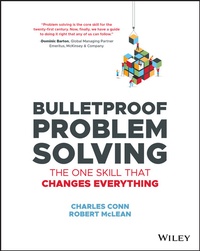
Bulletproof Problem Solving
Description

Complex problem solving is at the very top of the list of essential skills for career progression in the modern world. But how problem solving is taught in our schools, universities, businesses and organizations comes up short. In Bulletproof Problem Solving: The One Skill That Changes Everything you'll learn the seven-step systematic approach to creative problem solving developed in top consulting firms that will work in any field or industry, turning you into a highly sought-after bulletproof problem solver who can tackle challenges that others balk at.
The problem-solving technique outlined in this book is based on a highly visual, logic-tree method that can be applied to everything from everyday decisions to strategic issues in business to global social challenges. The authors, with decades of experience at McKinsey and Company, provide 30 detailed, real-world examples, so you can see exactly how the technique works in action. With this bulletproof approach to defining, unpacking, understanding, and ultimately solving problems, you'll have a personal superpower for developing compelling solutions in your workplace.
* Discover the time-tested 7-step technique to problem solving that top consulting professionals employ
* Learn how a simple visual system can help you break down and understand the component parts of even the most complex problems
* Build team brainstorming techniques that fight cognitive bias, streamline workplanning, and speed solutions
* Know when and how to employ modern analytic tools and techniques from machine learning to game theory
* Learn how to structure and communicate your findings to convince audiences and compel action
The secrets revealed in Bulletproof Problem Solving will transform the way you approach problems and take you to the next level of business and personal success.
More details
Other editions
Additional editions
Content
Introduction
Problem Solving for the Challenges of the Twenty-First Century
Great problem solving has never been more important for business and society. The problems facing humankind are larger, more complex, and moving faster than ever before. Previous approaches to training for careers are now outmoded as change in technologies and business models accelerates. Learning how to define a problem, creatively break it into manageable parts, and systematically work toward a solution has become the core skill for the twenty-first century workforce, the only way to keep up. But how problem solving is taught in our schools, universities, businesses, and organizations is coming up short. We need a new approach.
Let's start with a definition:
We all know the consequences of poor problem solving can be costly to business and communities, human health, and the environment. This book introduces a long-tested and systematic approach that can be taught to anyone who wants to become a better problem solver, from corporate strategists to nonprofit workers. This powerful framework, Bulletproof Problem Solving, is an approach we learned and helped develop at McKinsey & Company, the global consulting firm. This seven-step process hasn't been shared widely outside McKinsey until now. It can be used by individuals, teams, executives, government policy makers, and social entrepreneurs-anyone with a complex and uncertain problem of consequence. This systematic approach to problem solving could help you get a great job, make you more effective in your work, make your role as a citizen more fulfilling, and even make your personal life work better. These are big claims, but we know it works.
Problem Solving Capability
This new era of focus on creative problem solving has been ushered in by massive disruption of the old order in business and society. New business models are rapidly emerging from revolutionary Internet, machine learning, and bioscience technologies that threaten the status quo in every field. New rules are being written for conducting business and dealing with social and environmental challenges. Succeeding requires complex problem solving skills as never before. If you're a product manager who faces disruptive competition, you need to have a game plan and command of resources to overcome competition. You will only get resources if you make a persuasive case based on hypotheses about a winning plan, accompanied by analysis to support the key propositions. If you're a nonprofit leader of a team dealing with communities facing generational disadvantage who has seen new initiatives come and go, you have to be able to articulate a theory of change that links issues with interventions and outcomes if you want support from the board of your organization.
As organizations seek to become clever and agile to address this new world, they take on the persona of problem solving organizations-a drive to be working on the right problems, addressing root causes, engaging teams around short duration work plans, and allocating responsibilities and timelines with accountability. Over the course of our careers, we have seen the focus of organizational capability aspirations shift through distinct eras: from strategy to execution to complex problem solving.
The 70s and 80s were characterized by intense interest in strategy development. That was displaced by an era from the 90s onward that focused on execution, including deep attention to getting things done, as exemplified by the book Execution by Ram Charan and Larry Bossidy, and a number of books on business process redesign.1? However, a ruthless focus on execution assumes you have strategic direction right and can adapt to new competition, frequently from outside your industry. This can no longer be assumed.
As this new era of the problem solving organization takes hold, we expect it will trigger even more interest in how teams go about sharpening complex problem solving and critical thinking skills-what is called mental muscle by the authors of The Mathematical Corporation.2? The other side of the equation is the increasing importance of machine learning and artificial intelligence in addressing fast-changing systems. Problem solving will increasingly utilize advances in machine learning to predict patterns in consumer behavior, disease, credit risk, and other complex phenomena, termed machine muscle.
To meet the challenges of the twenty-first century, mental muscle and machine muscle have to work together. Machine learning frees human problem solvers from computational drudgery and amplifies the pattern recognition required for faster organizational response to external challenges. For this partnership to work, twenty-first century organizations need staff who are quick on their feet, who learn new skills quickly, and who attack emerging problems with confidence. The World Economic Forum in its Future of Jobs Report3? placed complex problem solving at #1 in its top 10 skills for jobs in 2020. Here is their list of important skills that employers are seeking:
It is becoming very clear that job growth is focused in areas where tasks are nonroutine and cognitive, versus routine and manual. The intersection of nonroutine tasks and cognitive ability is the heartland of complex problem solving. The authors of a recent McKinsey Quarterly article made the point that "more and more positions require employees with deeper expertise, more independent judgment, and better problem solving skills."4? We are already seeing that many organizations place a premium on analytic skills and problem solving and make it the essential criterion to be hired. Commentator David Brooks of the New York Times takes this conclusion even further when he says, "It doesn't matter if you are working in the cafeteria or the inspection line of a plant, companies will only hire people who can see problems and organize responses."5?
Education Gaps
If creative problem solving is the critical twenty-first century skill, what are schools and universities doing to develop these skills in students? Not enough. It remains early days in codifying and disseminating problem solving best practices in educational institutions. Andreas Schleicher, Director of Education and Skills and Special Advisor to the Secretary General of the OECD, explains the need for developing problem solving skills in students this way: "Put simply, the world no longer rewards people just for what they know-Google knows everything-but for what they can do with what they know. Problem solving is at the heart of this, the capacity of an individual to engage in cognitive processing to understand and resolve problem situations where a method of solution is not immediately obvious."6?
The OECD Program for International Student Assessment (PISA) started testing individual problem solving skills in 2012 and added collaborative problem solving skills in the 2015 assessments. One of the interesting early findings is that to teach students to become better problem solvers involves other capabilities than simply teaching reading, mathematics, and science literacy well. Capabilities such as creativity, logic, and reasoning are essential contributors to students becoming better problem solvers. That is what this book is about.
Universities and colleges are being challenged to demonstrate that their graduates have developed problem solving skills to prepare them for the demands of the workplace. One method of evaluating whether over a college degree there is improvement in critical thinking is the CLA+ test (Collegiate Learning Assessment plus) developed by the nonprofit Council for Aid to Education (CAE). The Wall Street Journal reported in 2017 that of the 200 colleges that apply the test "a majority of colleges that took the CLA+ made measurable progress in critical thinking"-although some well-respected colleges didn't show much difference between incoming freshmen scores and those of seniors.7? Effective university approaches to develop critical thinking and problem solving range from analyzing classic poems like Beowulf, to teaching logic structures, and setting practical group projects that require demonstration of problem solving abilities. What we glean from the article and college practices generally is an awakening of interest in student problem solving, and expectations that problem solving will be enhanced over the course of a degree program. But we have not seen a common framework or process emerge yet.
The Seven-Steps Process
The heart of the book is a seven-step framework for creative problem solving, Bulletproof Problem Solving, starting with these critical questions:
- How do you define a problem in a precise way to meet the decision maker's needs?
- How do you disaggregate the issues and develop hypotheses to be explored?
- How do you prioritize what to do and what not to do?
- How do you develop a workplan and assign analytical tasks?
- How do you decide on the fact gathering and analysis to resolve the issues, while avoiding cognitive biases?
- How do you go about synthesizing the findings to highlight insights?
- How do you communicate them in...
