

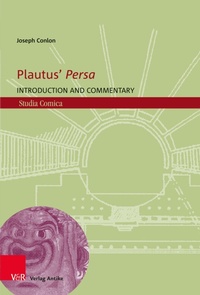
Plautus'Persa
Introduction and Commentary
1st Edition
Published on 13. October 2025
214 pages
978-3-911065-37-5 (ISBN)
Description

This commentary on the Persa is the first full-length treatment of the play in English. The commentary, in addition to collecting comparanda, explaining difficult and corrupt passages, providing necessary cultural and historical context, etc., places particular emphasis on explaining Plautus' language (especially alliteration, proverbs, etymology, the relationship between the colloquial and literary registers of Latin, word choice, and parallels with modern European languages), the staging of the drama, the development of the characters and their relationships, music, and the issues of slavery and gender. The goal throughout is to render the play more accessible to a wider audience of readers.
More details
Other editions
Additional editions
Book
10/2025
1st Edition
Vandenhoeck & Ruprecht
€75.00
Available immediately
Person
Joseph Conlon is Professor of Classics, Director of the Greek Program, and Dean of Graduate studies at Ralston College, USA. He specializes in language acquisition and pedagogy, and is also a translator of katharevousa literature.
Content
- Cover
- Title Page
- Copyright
- Plautus' Persa
- Table of Contents
- Introduction
- I. Why a new commentary on the Persa?
- 1. The Persa and Wilamowitz
- 2. From Wilamowitz to Woytek
- 3. Critique of Woytek
- 4. Modern Plautine scholarship
- 5. Conclusion
- II. The Persa and interests of the commentary
- 1. Staging
- 2. Characters: Slavery, Gender, Race
- a. A cast of slaves: Toxilus, Sagaristio, and Paegnium
- b. Slavery and gender: Saturio and the virgo
- c. Race in the Persa
- 3. Music and Meter
- 4. Language and Register
- a. Colloquial, literary, archaic, classical, comedic, and Plautine Latin
- b. Choice and frequency of words and expressions
- c. Alliteration and Chiasmus
- d. Proverbs and folk wisdom
- III. The text, commentary, manuscripts, and editions
- Commentary
- Bibliography
- Index rerum et nominum
