

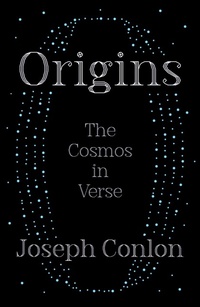
Origins
The Cosmos in Verse
Published on 7. November 2024
160 pages
978-0-86154-912-2 (ISBN)
Description

There raged a thumping cosmic ballyhoo,
A manic dance - a rumpus to arouse
The universe: of Higgs and W,
Electrons, gluons, muons, Zs and taus...
For centuries poetry and science have been improbable, yet constant, bedfellows. Chaucer was an amateur astronomer; Milton broke bread with Galileo; and, before turning to the arts, Keats was a doctor. Meanwhile, scientific luminaries like Ada Lovelace and James Clerk Maxwell moonlighted as poets, composing verse between experiments and equations.
Following in this tradition, theoretical physicist Joseph Conlon spins a dazzling intergalactic epic. Drawing on his scientific expertise, Conlon reveals the origins of our universe through two long-form poems - 'Elements' and 'Galaxies'. Journeying from the Big Bang to the edges of our ever-expanding cosmos, Origins offers a delightful and revelatory adventure through contemporary physics.
A manic dance - a rumpus to arouse
The universe: of Higgs and W,
Electrons, gluons, muons, Zs and taus...
For centuries poetry and science have been improbable, yet constant, bedfellows. Chaucer was an amateur astronomer; Milton broke bread with Galileo; and, before turning to the arts, Keats was a doctor. Meanwhile, scientific luminaries like Ada Lovelace and James Clerk Maxwell moonlighted as poets, composing verse between experiments and equations.
Following in this tradition, theoretical physicist Joseph Conlon spins a dazzling intergalactic epic. Drawing on his scientific expertise, Conlon reveals the origins of our universe through two long-form poems - 'Elements' and 'Galaxies'. Journeying from the Big Bang to the edges of our ever-expanding cosmos, Origins offers a delightful and revelatory adventure through contemporary physics.
Reviews / Votes
'Brilliant, "restructuring the known existing facts", to make this admirable, entertaining, attractive account of the origin of the Universe.' - Professor Dame Jocelyn Bell Burnell 'The universe is intrinsically poetic, but rarely does someone with expert credentials endeavor to describe it in that mode. Joseph Conlon's two extended poems offer a glimpse into the workings of the universe in galloping verse rich with imagery.' -Sean Carroll, author of The Biggest Ideas in the Universe 'This book offers readers an inventive and refreshing opportunity to engage with modern cosmology, at the same time as contributing to our culture's long tradition of connecting science with verse.' -Nature Astronomy 'Joe Conlon is a marvel. His subject - the origin of the universe and our efforts to comprehend it - is vaster and stranger than anything in English poetry. But these fizzy, nonchalantly rhymed, eminently readable poems are also a masterclass in simile. "Elements" and "Galaxies" will tell you about the structure of a hydrogen atom, various intriguing characters in the history of modern physics, and why galaxies' quantum origins ("rough seas of storm-tossed noise") might resemble Twitter.' -Hannah Sullivan, T. S. Eliot Prize-winning author of Three Poems 'Absolutely wonderful... remarkable... What a gift to the cosmologists and non-cosmologists of the world!' -Latham Boyle, Cosmologist at the University of Edinburgh 'These are erudite yet entertaining poems [which] ingeniously explain atomic physics and narrate the birth of the universe in the broadest language, with a tremendous range of allusion, metaphor, imagination, action and humour... an enthralling story and all somehow crafted into rhyming verse.' -Oxford Prospect ArtsMore details
Language
English
Place of publication
Oxford
United Kingdom
File size
0,64 MB
ISBN-13
978-0-86154-912-2 (9780861549122)
Copyright in bibliographic data and cover images is held by Nielsen Book Services Limited or by the publishers or by their respective licensors: all rights reserved.
Schweitzer Classification
Other editions
Additional editions
Book
11/2024
Oneworld Publications
€15.50
Shipment within 3-4 weeks
Person
Joseph Conlon is a Professor of Theoretical Physics at the University of Oxford and a fellow of New College. His research spans particle physics, string theory, cosmology and astrophysics. He is the author of Why String Theory?, a Physics World Book of the Year in 2016, and has authored over seventy scientific papers.
