

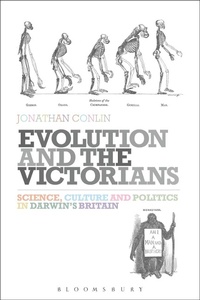
Evolution and the Victorians
Science, Culture and Politics in Darwin's Britain
1st Edition
Published on 16. January 2014
224 pages
978-1-4411-8752-9 (ISBN)
Description

Charles Darwin's discovery of evolution by natural selection was the greatest scientific discovery of all time. The publication of his 1859 book, On the Origin of Species, is normally taken as the point at which evolution erupted as an idea, radically altering how the Victorians saw themselves and others. This book tells a very different story. Darwin's discovery was part of a long process of negotiation between imagination, faith and knowledge which began long before 1859 and which continues to this day.
Evolution and the Victorians provides historians with a survey of the thinkers and debates implicated in this process, from the late 18th century to the First World War. It sets the history of science in its social and cultural context. Incorporating text-boxes, illustrations and a glossary of specialist terms, it provides students with the background narrative and core concepts necessary to engage with specialist historians such as Adrian Desmond, Bernard Lightman and James Secord. Conlin skilfully synthesises material from a range of sources to show the ways in which the discovery of evolution was a collaborative enterprise pursued in all areas of Victorian society, including many that do not at first appear "scientific".
Evolution and the Victorians provides historians with a survey of the thinkers and debates implicated in this process, from the late 18th century to the First World War. It sets the history of science in its social and cultural context. Incorporating text-boxes, illustrations and a glossary of specialist terms, it provides students with the background narrative and core concepts necessary to engage with specialist historians such as Adrian Desmond, Bernard Lightman and James Secord. Conlin skilfully synthesises material from a range of sources to show the ways in which the discovery of evolution was a collaborative enterprise pursued in all areas of Victorian society, including many that do not at first appear "scientific".
Reviews / Votes
Evolution and the Victorians is a fascinating read and is recommended to all those interested in nineteenth-century history. * Isis Journal *More details
Edition
1. Auflage
Language
English
Place of publication
New York
United States
Publishing group
Bloomsbury Publishing PLC (Digital)
Target group
College/higher education
Professional and scholarly
Illustrations
20 illus
ISBN-13
978-1-4411-8752-9 (9781441187529)
Copyright in bibliographic data and cover images is held by Nielsen Book Services Limited or by the publishers or by their respective licensors: all rights reserved.
Schweitzer Classification
Other editions
Additional editions
Book
01/2014
Bloomsbury Academic
€47.30
Shipment within 15-20 days
Person
Jonathan Conlin is Senior Lecturer in Modern History at the University of Southampton, UK. He is the author of Civilisation (2009) and Tales of Two Cities: Paris, London and the Making of the Modern City (2013).
Content
Introduction: 'I think'
Part 1: The Longest Discovery, 1750-1870
1. Natural Theology
2. Comparative Anatomy
3. Writing The Origin
4. Reading The Origin
Part 2: Lines of Descent, 1840-1914
5. Christian Evolution? Charles Kingsley's 'Natural Theology of the Future'
6. Imperial Evolution? 'Greater Britons' and Other Races
7. Progressive Evolution? Herbert Spencer and 'Social Darwinism'
8. Domestic Evolution? Making a Home for Science
9. Sustainable Evolution? Alfred Russel Wallace and the Wonderful Century
Conclusion
Glossary
Index
Part 1: The Longest Discovery, 1750-1870
1. Natural Theology
2. Comparative Anatomy
3. Writing The Origin
4. Reading The Origin
Part 2: Lines of Descent, 1840-1914
5. Christian Evolution? Charles Kingsley's 'Natural Theology of the Future'
6. Imperial Evolution? 'Greater Britons' and Other Races
7. Progressive Evolution? Herbert Spencer and 'Social Darwinism'
8. Domestic Evolution? Making a Home for Science
9. Sustainable Evolution? Alfred Russel Wallace and the Wonderful Century
Conclusion
Glossary
Index
