

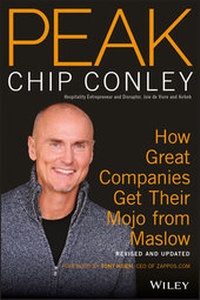
PEAK
Description

More details
Other editions
Additional editions
Persons
Content
Introduction
Books teach me. Even my own. Writing a book helps make sense of what I've learned at the congested crossroads of psychology and business. And I enjoy sharing the wisdom found on the journey. You're welcome to think of me as your crossing guard at that confusing intersection.
It's been 10 years since Peak was published and I'm thrilled the book is still a favorite with so many people, and in so many different industries and countries. This updated edition offers new insights from me, as well as many examples of new companies-from Facebook to WeWork-that use the Peak model in their organizational strategy. You'll also find a whole new chapter on Peak Leadership Practices (Chapter Fourteen) and a new Managerial Assessment tool regarding the Employee Pyramid in the Appendix.
Quite a bit has changed for me in the past decade. Just six months after Peak came out in 2007, it was clear we were entering the Great Recession, not long after recovering from the dot-com bust. Who knew my company would experience two once-in-a-lifetime downturns in the same decade? Déjà vu. Joie de Vivre (JdV). Don't worry, this isn't a French lesson; let's just say I felt a whole lot of déjà vu at JdV between 2008 and 2010.
During difficult times, it's natural to feel paralyzed and to operate exclusively in survival mode. Most of us are working in infectious fear factories, where risk aversion runs rampant at a time when creativity, innovation, and teamwork are more needed than ever. That's where you, the leader, come in. W. Edward Deming, father of the total quality movement, once said that the primary duty of every leader is to remove fear from the workplace. But organizational wellness doesn't emerge simply from the absence of fear. Fear must be replaced with a positive spirit of fulfillment and vitality that comes from the principles outlined in this book. What's true of the companies we love is true of the leaders we love. They are deeply admired for being passionate, smart, resilient, trustworthy, original, and humane-the same qualities we admire in people.
Joie de Vivre made it through that difficult time. But I had a health scare in late 2008, which woke me up to the fact that my new calling was to primarily be a writer and speaker. Of course, that was confusing to me, and everyone around me, as we thought I'd be the owner and CEO of my company for at least another 25 years. Ultimately, I sold Joie de Vivre, the brand and the management company, in mid-2010. But I kept ownership in much of the hotel real estate, and provided guidance to the new ownership team (led by John Pritzker of Geolo Capital, whose father started the Hyatt hotel chain). This gave me time to sort through my emotions after my heart literally stopped at age 47, which led me to write Emotional Equations.
In March 2013, I was approached by Brian Chesky, the CEO and cofounder of Airbnb, at the time a small start-up home-sharing company. He and some of the young execs had read Peak and were intrigued by how it might apply to Airbnb's business model. Brian asked if I wanted to "democratize hospitality," which sounded pretty nifty to me. But I only wanted to do it part-time since I'd just launched a business, Fest300 (now part of Everfest), to share my passion for the world's best festivals. Not surprising, the part-time consulting gig turned into a full-time obsession and leadership role for this "retired" CEO. Fifteen hours a week became 15 hours a day. How many chances do you get to disrupt your favorite industry? For me it happened not just once-as a boutique hotelier long ago-but a second time, at the forefront of the sharing economy.
My initial title was Hospitality Guru, which in a few weeks morphed into Head of Global Hospitality and Strategy. Brian said he liked the way my mind worked strategically and also asked me to create a Learning and Development department. Over four years, I oversaw more than a half-dozen departments and key initiatives for the company before moving into my Strategic Advisor role-and back to blessed part-time status. But what a fascinating journey it's been! We weren't really called a hospitality company in early 2013, and we were thought of as a travel tech start-up with a design focus. Today, we offer more accommodations than the top three hotel companies in the world combined-Marriott (including their Starwood acquisition), Hilton, and Intercontinental-and our private market valuation has surpassed $30 billion.
Today, I also see pyramids on whiteboards all over Airbnb's headquarters and our more than 20 offices around the world. But I remember just four months into my tenure, when Brian asked me to lead a three-day retreat for Estaff-our dozen-person senior leadership team-and I introduced the principles of Peak to develop our 2014 strategic initiatives. It's been a true peak experience to see the business model I developed applied at such a deep level to a fast-growing, high-profile company playing on a global canvas. Airbnb was going to succeed whether I was there or not. But I do feel a certain joy and honor at how my contribution helped this fledgling and extremely talented leadership team earn Inc. magazine's Company of the Year cover story in December 2014, and Glassdoor's Best Places to Work award in December 2015. And, I do believe the underpinning of Peak's humane approach to business has helped Airbnb steer clear of some of the cultural, personality, and strategic challenges that have hurt the reputations of other sharing economy companies.
While it turned into a huge disruption in my life, I'm glad I said yes to Brian. Many hoteliers couldn't see Airbnb coming. But I recognized that Brian's investment in the company's culture, and the fact that home sharing was addressing an unrecognized need for travelers-living like a local affordably-meant Airbnb had the potential to go big. As I point out in Chapters Seven through Nine on the Customer Pyramid, established companies can miss innovation if they get too fixated at the base and address only the expectations of their core customers.
A more mobile populace leads to changes in lodging needs. There's a growing number of mostly Millennials choosing to be "digital nomads," living parts of the year in places like Bali or Baja, and the rest of the year in cities such as Boston or Austin. These folks are less interested in being upwardly mobile and are, instead, outwardly mobile. Equipped with a laptop and a smartphone, a Wi-Fi connection and a coworking space, these freelancers, entrepreneurs, and other modern merchants are not typically weighed down by home or car ownership.
My Baby Boomer generation saw work and leisure as an "either/or" proposition. With an occasional sabbatical to moderate workaholism, the global nomad phenomenon is "both/and"-enjoy a great life while doing work on the road. Add in the "bleisure" trend, where business travelers tack on a few extra days of leisure to an interesting destination, and you see an upward trajectory in the extended-stay lodging market. Nearly 60 percent of Airbnb's room-night demand in many major metropolitan markets is guests staying a week or longer, whereas the average length of stay for most urban hotels is less than three days. Thinking about the expectations, desires, and unrecognized needs of these new kinds of travelers has helped Airbnb deliver a level of guest satisfaction that far exceeds the hotel industry average (based upon net promoter score as the common metric). This is part of the reason we've grown so quickly.
Over the past decade, I've been introduced to so many business leaders who are also "peakers." What's been surprising is how universal this Peak model is, no matter the industry, geography, or culture of the company. Some might be surprised that investment bankers are also intrigued by this humanistic approach to business, yet Merrill Lynch has invited me to give eight speeches to their various employees and customers around the world.
But it's another investment bank, Houlihan Lokey, that woke me up to the biggest realization I've had about my Maslovian model since I wrote the book: the two lines that define the boundaries between the Survive, Success, and Transformation levels of the Employee, Customer, and Investor pyramids are not fixed. When I was leading a workshop for Houlihan Lokey's top leaders, one astutely pointed out that, depending upon the industry and the economy, the bottom of the pyramid that defines survival could represent 80 percent of the pyramid. For example, investment bankers are money-obsessed. So, the base of their employee pyramid takes huge precedence. But, interestingly enough, both Merrill Lynch and Houlihan Lokey execs have agreed that the next two levels of the pyramid (Recognition and Meaning), while thin in the world of investment banking, represent the differentiators for an employer. This is where loyalty is created with their slightly mercenary bankers. As one exec said to me, "Peak helped us see that many of our bankers are stuck at the success level of the pyramids, not seeing the disruptive transformation available at the peak." I call this "the illusion of being ahead" that afflicts many...
