

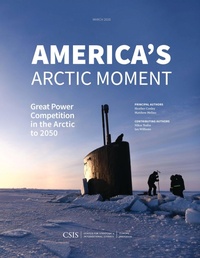
America's Arctic Moment
Great Power Competition in the Arctic to 2050
Published on 13. October 2021
1 pages
979-8-216-35866-4 (ISBN)
Description

In July 2018, CSIS embarked on a major analytical assessment that centered on the following research question:
What will be the strategic consequences for the United States by 2050 if America's two near-peer military competitors, China and Russia, continue to develop their long-term economic and security interests in the Arctic, but the United States does not?
Russia's growing economic and military ambitions in the Arctic, as well as China's increased physical presence in the region, underscore that both nations have long-term strategic designs for the Arctic region. Data analysis, satellite imagery, and scenario development all demonstrate the continued growth of Russian and Chinese presence in the Arctic and heighten the sense of stasis in the U.S. military and economic presence. Unless the United States wishes to lose access to portions of the Arctic and have increasingly diminished capabilities to defend and deter attack against the homeland, the United States must return to the Arctic.
What will be the strategic consequences for the United States by 2050 if America's two near-peer military competitors, China and Russia, continue to develop their long-term economic and security interests in the Arctic, but the United States does not?
Russia's growing economic and military ambitions in the Arctic, as well as China's increased physical presence in the region, underscore that both nations have long-term strategic designs for the Arctic region. Data analysis, satellite imagery, and scenario development all demonstrate the continued growth of Russian and Chinese presence in the Arctic and heighten the sense of stasis in the U.S. military and economic presence. Unless the United States wishes to lose access to portions of the Arctic and have increasingly diminished capabilities to defend and deter attack against the homeland, the United States must return to the Arctic.
More details
Language
English
Place of publication
United States
File size
1,36 MB
ISBN-13
979-8-216-35866-4 (9798216358664)
Copyright in bibliographic data and cover images is held by Nielsen Book Services Limited or by the publishers or by their respective licensors: all rights reserved.
Schweitzer Classification
Other editions
Additional editions
Heather A. Conley | Matthew Melino
America's Arctic Moment
Great Power Competition in the Arctic to 2050
Book
10/2021
Rowman & Littlefield Publishers
€68.35
Shipment within 3-4 weeks
Persons
Heather A. Conley was senior vice president for Europe, Eurasia, and the Arctic and director of the Europe, Russia, and Eurasia Program at CSIS. During her tenure, she oversaw the development and publication of all three Kremlin Playbook reports.
Content
CONTENTS
ACKNOWLEDGMENTS III
EXECUTIVE SUMMARY 1
The United States Recognizes Great Power Competition in the Arctic 1
Russian Military Developments in the Arctic Pose the Most Significant Challenge to U.S. National Security 2
Understanding the Implications of China's Growing Maritime Presence in the Arctic 3
Arctic Energy and Economic Developments 4
Mapping America's Return to the Arctic 5
1. INTRODUCTION 8
Revitalizing the Red Arctic 8
Background: Separating Arctic Fact from Fiction 10
Russian Visions for the Arctic 12
Russia's Military Vision for the Arctic 13
Chinese Visions for the Arctic 15
Implications for the United States 20
2. NEAR-PEER COMPETITOR MILITARY POSTURE IN THE ARCTIC TO 2050: THREE SCENARIOS 25
Russian Military Scenarios 25
Baseline Plus: A2/AD and Power Projection 27
China's Dual-use Military Strategy for the Arctic 30
A Collaborative Sino-Russian Arctic Military Strategy 32
3. ARCTIC ECONOMIC DYNAMICS TO 2050 34
4. MAPPING AMERICA'S RETURN TO THE ARCTIC: HOW TO RESTORE U.S. PRESENCE AND LEADERSHIP TO A STRATEGIC REGION 41
The Arctic Equation: Presence Equals Influence 41
Pillar 1: Increasing U.S. Diplomatic and Security Presence in the Arctic 42
Pillar 2: Strengthening Science, Research, and Sustainable Economic Opportunities 43
CONCLUSION 44
ABOUT THE AUTHORS 45
APPENDIX: SCENARIOS FOR ARCTIC HYDROCARBON DEVELOPMENT TO 2050 46
ACKNOWLEDGMENTS III
EXECUTIVE SUMMARY 1
The United States Recognizes Great Power Competition in the Arctic 1
Russian Military Developments in the Arctic Pose the Most Significant Challenge to U.S. National Security 2
Understanding the Implications of China's Growing Maritime Presence in the Arctic 3
Arctic Energy and Economic Developments 4
Mapping America's Return to the Arctic 5
1. INTRODUCTION 8
Revitalizing the Red Arctic 8
Background: Separating Arctic Fact from Fiction 10
Russian Visions for the Arctic 12
Russia's Military Vision for the Arctic 13
Chinese Visions for the Arctic 15
Implications for the United States 20
2. NEAR-PEER COMPETITOR MILITARY POSTURE IN THE ARCTIC TO 2050: THREE SCENARIOS 25
Russian Military Scenarios 25
Baseline Plus: A2/AD and Power Projection 27
China's Dual-use Military Strategy for the Arctic 30
A Collaborative Sino-Russian Arctic Military Strategy 32
3. ARCTIC ECONOMIC DYNAMICS TO 2050 34
4. MAPPING AMERICA'S RETURN TO THE ARCTIC: HOW TO RESTORE U.S. PRESENCE AND LEADERSHIP TO A STRATEGIC REGION 41
The Arctic Equation: Presence Equals Influence 41
Pillar 1: Increasing U.S. Diplomatic and Security Presence in the Arctic 42
Pillar 2: Strengthening Science, Research, and Sustainable Economic Opportunities 43
CONCLUSION 44
ABOUT THE AUTHORS 45
APPENDIX: SCENARIOS FOR ARCTIC HYDROCARBON DEVELOPMENT TO 2050 46
