

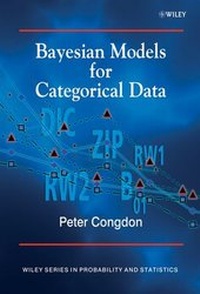
Bayesian Models for Categorical Data
Description

Reviews / Votes
"...a good book on the shelves of researchers in categoricaldata analysis." (Technometrics, May 2007) "...valuable for anyone interested in how Bayesian ideasapply in practice an should prove useful for anyone using theWINBUGS package for categorical data analysis." (Biometrics,March 2007) "...an excellent resource for biostatisticians and medicalresearchers." (Doody's Health Services) "...perfectly suited as a reference for anypractitioner....Congdon has done a laudable job of introducingjointly the concepts of categorical data and Bayesian analysis."(Journal of the American Statistical Association, June2006) "The author's clear and logical approach makes the bookaccessible" (Zentralblatt MATH Volume 1079)More details
Other editions
Additional editions
Person
Content
Chapter 1 Principles of Bayesian Inference.
1.1 Bayesian updating.
1.2 MCMC techniques.
1.3 The basis for MCMC.
1.4 MCMC sampling algorithms.
1.5 MCMC convergence.
1.6 Competing models.
1.7 Setting priors.
1.8 The normal linear model and generalized linear models.
1.9 Data augmentation.
1.10 Identifiability.
1.11 Robustness and sensitivity.
1.12 Chapter themes.
References.
Chapter 2 Model Comparison and Choice.
2.1 Introduction: formal methods, predictive methods and penalized deviance criteria.
2.2 Formal Bayes model choice.
2.3 Marginal likelihood and Bayes factor approximations.
2.4 Predictive model choice and checking.
2.5 Posterior predictive checks.
2.6 Out-of-sample cross-validation.
2.7 Penalized deviances from a Bayes perspective.
2.8 Multimodel perspectives via parallel sampling.
2.9 Model probability estimates from parallel sampling.
2.10 Worked example.
References.
Chapter 3 Regression for Metric Outcomes.
3.1 Introduction: priors for the linear regression model.
3.2 Regression model choice and averaging based on predictor selection.
3.3 Robust regression methods: models for outliers.
3.4 Robust regression methods: models for skewness and heteroscedasticity.
3.5 Robustness via discrete mixture models.
3.6 Non-linear regression effects via splines and other basis functions.
3.7 Dynamic linear models and their application in non-parametric regression.
Exercises.
References.
Chapter 4; Models for Binary and Count Outcomes.
4.1 Introduction: discrete model likelihoods vs. data augmentation.
4.2 Estimation by data augmentation: the Albert-Chib method.
4.3 Model assessment: outlier detection and model checks.
4.4 Predictor selection in binary and count regression.
4.5 Contingency tables.
4.6 Semi-parametric and general additive models for binomial and count responses.
Exercises.
References.
Chapter 5 Further Questions in Binomial and Count Regression.
5.1 Generalizing the Poisson and binomial: overdispersion and robustness.
5.2 Continuous mixture models.
5.3 Discrete mixtures.
5.4 Hurdle and zero-inflated models.
5.5 Modelling the link function.
5.6 Multivariate outcomes.
Exercises.
References.
Chapter 6 Random Effect and Latent Variable Models for Multicategory Outcomes.
6.1 Multicategory data: level of observation and relations between categories.
6.2 Multinomial models for individual data: modelling choices.
6.3 Multinomial models for aggregated data: modelling contingency tables.
6.4 The multinomial probit.
6.5 Non-linear predictor effects.
6.6 Heterogeneity via the mixed logit.
6.7 Aggregate multicategory data: the multinomial-Dirichlet model and extensions.
6.8 Multinomial extra variation.
6.9 Latent class analysis.
Exercises.
References.
Chapter 7 Ordinal Regression.
7.1 Aspects and assumptions of ordinal data models.
7.2 Latent scale and data augmentation.
7.3 Assessing model assumptions: non-parametric ordinal regression and assessing ordinality.
7.4 Location-scale ordinal regression.
7.5 Structural interpretations with aggregated ordinal data.
7.6 Log-linear models for contingency tables with ordered categories.
7.7 Multivariate ordered outcomes.
Exercises.
References.
Chapter 8Discrete Spatial Data.
8.1 Introduction.
8.2 Univariate responses: the mixed ICAR model and extensions.
8.3 Spatial robustness.
8.4 Multivariate spatial priors.
8.5 Varying predictor effect models.
Exercises.
References.
Chapter 9 Time Series Models for Discrete Variables.
9.1 Introduction: time dependence in observations and latent data.
9.2 Observation-driven dependence.
9.3 Parameter-driven dependence via DLMs.
9.4 Parameter-driven dependence via autocorrelated error models.
9.5 Integer autoregressive models.
9.6 Hidden Markov models.
Exercises.
References.
Chapter 10 Hierarchical and Panel Data Models
10.1 Introduction: clustered data and general linear mixed models.
10.2 Hierarchical models for metric outcomes.
10.3 Hierarchical generalized linear models.
10.4 Random effects for crossed factors.
10.5 The general linear mixed model for panel data.
10.6 Conjugate panel models.
10.7 Growth curve analysis.
10.8 Multivariate panel data.
10.9 Robustness in panel and clustered data analysis.
10.10 APC and spatio-temporal models.
10.11 Space-time and spatial APC models.
Exercises.
References.
Chapter 11 Missing-Data Models.
11.1 Introduction: types of missing data.
11.2 Density mechanisms for missing data.
11.3 Auxiliary variables.
11.4 Predictors with missing values.
11.5 Multiple imputation.
11.6 Several responses with missing values.
11.7 Non-ignorable non-response models for survey tabulations.
11.8 Recent developments.
Exercises.
References.
Index.
