

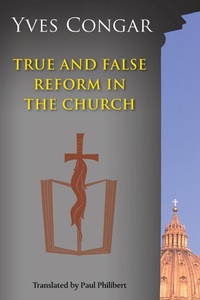
True and False Reform in the Church
Description

Archbishop Angelo Roncali (later Pope John XXIII) read True and False Reform during his years as papal nuncio in France and asked, A reform of the church 'is such a thing really possible?" A decade later as pope, he opened the Second Vatican Council by describing its goals in terms that reflected Congar's description of authentic reform: reform that penetrates to the heart of doctrine as a message of salvation for the whole of humanity, that retrieves the meaning of prophecy in a living church, and that is deeply rooted in history rather than superficially related to the apostolic tradition. Pope John called the council not to reform heresy or to denounce errors but to update the church's capacity to explain itself to the world and to revitalize ecclesial life in all its unique local manifestations. Congar's masterpiece fills in the blanks of what we have been missing in our reception of the council and its call to "true reform."
Yves Congar, OP, a French Dominican who died in 1995, was the most important ecclesiologist in modern times. His writings and his active participation in Vatican II had an immense influence upon the council documents. With a few other contemporaries, Congar pioneered a new style of theological research and writing that linked the great tradition of Scripture and the Fathers to contemporary pastoral questions with lucidity and passion. His key concerns were the unity of the church, lay apostolic life, and a revival of the church's theology of the Holy Spirit. He was named a cardinal by Pope John Paul II in recognition of his profound contributions to the Second Vatican Council.
Paul Philibert, OP, has taught pastoral theology in the United States and abroad. He is a Dominican friar of the Southern Province. His translation of a collection of Congar's essays on the liturgy has recently been published by Liturgical Press under the title At the Heart of Christian Worship. His book The Priesthood of the Faithful: Key to a living Church (Liturgical Press, 2005) reflects the ecclesiology of Yves Congar and his Vision of the apostolic life of the faithful."All prices
More details
Other editions
Additional editions
Persons
Content
- Intro
- Half Title Page
- Title Page
- Copyright
- Contents
- Translator's Introduction
- Preface to the Second Edition (1967)
- Foreword
- The Methodology of this Study
- The Plan of the Book
- Introduction (1950)
- I. The Church is Constantly Reforming Itself
- II. Contemporary Self-Criticism and Reformism (Especially in France)
- III. The Church Today: How Did Self-Criticism Become Suspect?
- IV. Four Traits of Contemporary Self-Criticism
- V. The Reasons for Today's Self-Criticism: A Passion for Authenticity
- VI. Applying these Insights: The Need to Adapt or Revise
- Part One: Why and How Does the Church Reform Itself?
- Chapter 1: The Church's Holiness and Our Failures
- I. The Point of View of Antiquity and that of the Present with Respect to the Problem of Evil in the Church
- II. The Teachings of the Bible, the Fathers, and the Magisterium
- 1. Holy Scripture
- 2. The Fathers: Their Theology is Essentially "Symbolic"
- 3. The Teaching of the Magisterium and of Theologians
- III. Principles for a Solution: Several Meanings of the Word "Church"
- God Alone is Infallible
- Two Aspects of the Church: Institution and Community
- Four Meanings of the Word "Church"
- Additional Remarks on this Theme
- IV. Application of these Principles: Holiness and Failure in Light of the Different Meanings of Church
- In its Formal Principles (Given by God) the Church is Infallible
- As a People Made up of Human Beings, the Church is Fallible
- The Church as the Ensemble of Churchmen or Hierarchical Persons
- The Concrete Church, Synthesizing the Preceding Elements
- Excursus: Evil in the Church in the View of Several Contemporary Theologians
- Chapter 2: Why and in What Way Do the People of God Need to be Reformed?
- I. God's Plan and How God's People Should Respond to it: Situating the Problem of Reform
- II. The Need for Reform in Light of the Temptation to "Pharisaism"
- III. The Need for Reform in Light of the Temptation to Become a "Synagogue"
- Chapter 3: Prophets and Reformers
- Prophets: Their Role and their Character
- Prophecy in the Church
- 1. Specially Insightful Knowledge about the things of God
- 2. A Knowledge or Mission Related to Executing God's Plan
- 3. Predicting the Future: "Natural Analogs of Prophecy"
- The Reform Spirit and Prophecy
- The Situation of Prophecy within the Church
- The Perils of Prophetic Activity
- Why St. Augustine was a Source of Encouragement for Reformers
- Schematic Table Summarizing these Points
- Part Two: Conditions for Authentic Reform without Schism
- The Problem
- The Possibility of Deviations in any Reform Movement
- The Ambivalence of "Seeds"
- Möhler's Distinction: Gegensatz (Contrast) and Widerspruch (Contradiction)
- Two Types of One-Sidedness
- First Condition: The Primacy of Charity and of Pastoral Concerns
- The Prophetic Initiative Should Not Develop into a System
- Successful Reforms were Motivated by Pastoral Concern
- Reforms that Tried to Create a System Turned Out Badly
- Second Condition: Remain in Communion with the Whole Church
- The Whole Truth is Grasped Only in Communion with the Whole Church
- This Communion Makes the Difference between Catholic and Schismatic
- Sentire cum Ecclesia
- The Center and the Periphery
- Need for Support from the Base
- Need for Approval from the Central Powers of the Church
- "Pneumatological" and "Prophetic" Functioning of the Hierarchy
- Application of These Principles to Religious Orders (Troeltsch)
- Being Connected to the Community
- Communion Justifies the Possibility for a Breakthrough
- The Responsibility of the Center to Listen to the Periphery
- Third Condition: Having Patience with Delays
- The Nature of Patience and its Role
- The Boastful Spirit of the Reformers
- The Link between Impatience and an Intellectual and Dialectical Point of View
- Blocked by the Church, the Impatient Reformer Appears to Be Persecuted
- The Church is Against Ultimatums and the Via Facti
- The Church's Via Facti vs. the Wrong and Revolutionary Via Facti
- The Tension that Results for the Faithful Reformer
- Responsibility of Church Leaders Not to be Too Patient
- Fourth Condition: Genuine Renewal through a Return to the Principle of Tradition (Not through the Forced Introduction of Some "Novelty")
- Two Kinds of Adaptation: As Development and as Innovation
- Adaptation as Development Comes About through Ressourcement
- The Church Needs to Live in Contact with Its Deepest Tradition
- Conclusion: Perspectives on the Attitude to Take toward Concrete Reform Initiatives
- A) About the Élan and Spirit of Reform in General
- 1) For or Against the Idea of Reform
- 2) Among Reformers, the Distinction between the Faithful and the Revolutionaries
- Medieval Apostolic and Evangelical Movements
- Sixteenth-Century Reforms
- Lamennais and Lacordaire
- B) Considering Contemporary Reform (Text from 1950)
- 1) Three Motives for Optimism about Contemporary Reforms (in France)
- 2) The Problem of a Divided Spirit among Catholics
- Afterword (July 1968)
- Appendixes
- Appendix I: Collective Responsibility
- Appendix II: Two Types of Fidelity
- Appendix III: His Holiness Paul VI Speaks about the Reform of the Church (From the Encyclical Ecclesiam Suam, August 6, 1964)
