

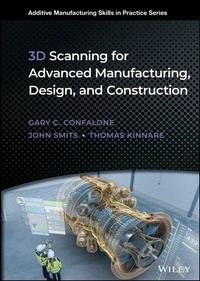
3D Scanning for Advanced Manufacturing, Design, and Construction
Description

Learn how 3D scanning technology drives advanced manufacturing and modern construction
3D scanning technology allows non-contact scanning of objects for unprecedented data collection, analysis, and modeling. 3D models created this way are valuable at every stage of the design and build process and they have become a staple in additive manufacturing or 3D printing. As 3D printing transforms global industry at every scale, there has never been a better time for engineers and industrial professionals to be competitive in the area of 3D scanning, a multibillion-dollar market that continues to grow.
3D Scanning Technology for Advanced Manufacturing, Design, and Construction provides a comprehensive introduction to 3D scanning and its applications in both the AEC and manufacturing industries. After establishing the history and basic principles of 3D scanning, it includes discussions of the various scanner types and software interfaces, the use of 3D point clouds for analysis and reverse engineering, and much more. It covers the full range of technology and processes that engineers, architects, and manufacturing professionals use to increase accuracy and quality while reducing project timelines.
Readers of 3D Scanning Technology for Advanced Manufacturing, Design, and Construction will also find:
* Case studies that highlight techniques useful for specific real-world applications
* Comparisons of various scanning devices and software that aid in choosing the proper technologies for a specific project
* Resources and references for online learning, organizations, and certifications
Perfect for engineers, technicians, students, and industry professionals new to laser scanning, 3D Scanning Technology for Advanced Manufacturing, Design, and Construction will earn its place in libraries of technical, vocational, and continuing education audiences seeking to improve their knowledge of 3D scanning.
More details
Other editions
Additional editions
Persons
Gary C. Confalone, BSEE, MSME, is the CEO of ECM Global, a company specializing in 3D scanning and reverse engineering. He has spent the past three decades working in the metrology industry with the first half of his career focused on the development of laser-based measurement systems, and processes, for the aerospace industry. He has served as Chair for both the Coordinate Metrology Society and the 3D Certification Committee, and was recently awarded the American Society for Quality (ASQ) Hromi Medal. Gary received a Bachelor's degree from the University of Massachusetts, and a Master's Degree from Boston University.
John Smits, AIA, is VP of ECM, AEC Division, a registered architect, and one of the initial adopters of large volume 3D laser scanning technology as applied specifically to the architecture, engineering, and construction professions. He has shared his expertise as a speaker at trade shows, conferences, and online webinars, and authored articles in academic journals and trade magazines. John earned a Bachelor's degree in Architecture from the University of Virginia and a Master's degree in Architecture from Washington University in St. Louis.
Thomas Kinnare, BSME, is Principal Engineer and lead developer of the ECM Training Division. Over the past two decades, Tom has been instrumental in the advancement of 3D metrology practices throughout the industry, working to institute an international metrology education and certification training program. He currently serves on the American Society of Mechanical Engineers (ASME) Y14.45, GD&T Reporting Subcommittee, and the Coordinate Measurement Society Certification Committee. Tom earned his Bachelor's degree from Massachusetts Institute of Technology.
Content
Preface xi
How to Use This Book xiii
Chapter 1 History of Metrology 1
1.1 Introduction 2
1.2 The History of Metrology 2
1.3 The International System of Units (SI) 3
1.4 The History of the Metric System 3
1.5 The History of the British Imperial System (IS) 4
1.6 Evolution of Metrology 13
1.7 Milestones of Metrology 22
Chapter 2 3D Scanning Basics 25
2.1 Basics of Laser Light Technology 25
2.2 Laser Safety 25
2.3 So What Exactly Is a Laser? 28
2.4 Laser Types 29
2.5 LIDAR vs Laser-Radar 32
2.6 Laser-Radar 32
2.7 Basics of 3D Scanning 35
2.8 How It Works 35
2.9 Limitations 35
2.10 Accuracy 36
2.11 Modern Metrology 37
Chapter 3 Scanning Equipment 39
3.1 Introduction 39
3.2 Triangulating Laser Scanners 39
3.3 Data Acquisition Variables 41
Chapter 4 Data Acquisition and Processing Software 65
4.1 Introduction 65
4.2 Data Acquisition Software 66
4.3 Inspection Software 71
4.4 Data Export Options 72
4.5 Point Clouds 73
4.6 Processing and Registration 78
4.7 Survey Controls 80
4.8 Polygonal Mesh 81
4.9 Using Processed Datasets 82
Chapter 5 Post-Processing 85
5.1 Introduction 85
5.2 Coordinate Systems 86
5.3 Scaling 93
5.4 Mapping Techniques 93
5.5 CAD to Part Comparison 97
5.6 Root Mean Square and Standard Deviation 98
5.7 The Method of Least Squares 99
5.8 What Is Uncertainty? 102
5.9 Contributing Factors to Uncertainty 105
5.10 Typical Post-processing Workflow 108
Chapter 6 Reverse Engineering for Industrial and Consumer Applications 111
6.1 Introduction 111
6.2 Industrial Applications 112
6.3 Case Studies 118
6.4 Racing Yacht Boat Build 118
6.5 Reverse Engineering: Cessna Caravan Performance Upgrade 121
6.6 Replication of a Classic Propeller Design 123
6.7 Roller Coaster Inspection 126
6.8 Argomaiden Sculpture 129
Chapter 7 Reverse Engineering for Architecture, Engineering, and Construction 133
7.1 Introduction 133
7.2 Modeling for Architects and Engineers 134
7.3 Case Studies 142
7.4 Research Facility Coordinate Control System 142
7.5 Architectural Ornament Replication 146
7.6 Fonthill Castle, Bronx, NY 149
7.7 Infrastructure Preservation 153
7.8 Generating Station Turbine Replacement 158
Chapter 8 Future Directions 161
8.1 Software Development 162
8.2 Technology 162
8.3 Extended Reality 163
8.4 UAV and AV 165
8.5 Industry Trends 165
8.6 Summary 168
Chapter 9 Resources 169
9.1 Units of Measure 175
9.2 Coordinate Metrology Society (CMS) Certification 181
9.3 Certification Committee 181
9.4 CMS Certification Levels 183
9.5 CMS Level-Two Certification 185
9.6 National Metrology Laboratories and Institutes 187
Metrology Glossary 191
Index 201
Chapter 1
History of Metrology
The regulation of weights and measures is necessary for science, industry, health care, and commerce. The importance of establishing uniform national standards was demonstrated by the drafters of the US Constitution, who gave Congress in Article 1, Section 8, the power to fix the Standard of Weights and Measures. "Weights and Measures," said John Quincy Adams in 1821, "may be ranked among the necessaries of life to every individual of human society."1
Weights and measures may be ranked among the necessaries of life, to every individual of human society. They enter into the economical arrangements and daily concerns of every family. They are necessary to every occupation of human industry; to the distribution and security of every species of property; to every transaction of trade and commerce; to the labours of the husbandman; to the ingenuity of the artificer; the studies of the philosopher; to the researches of the antiquarian; to the navigation of the mariner, and the marches of the soldier; to all the exchanges of peace, and all the operations of war. The knowledge of them, as in established use, is among the first elements of education, and is often learnt by those who learn nothing else, not even to read and write. This knowledge is riveted in the memory by the habitual application of it to the employments of men throughout life. (John Quincy Adams, Report to Congress, 1821)
1.1 INTRODUCTION
To understand 3D laser scanning technology, a person must have an understanding of metrology. Metrology is defined as the science of measurement. It is the language that engineers use to communicate to manufacturers.
When studying science, technology, engineering, and math, you will use units and the universal language of metrology which was developed thousands of years ago and continues to evolve today. Often the parameters of these units are referred to as geometric dimensioning and tolerancing (GD&T). This language consists of formulas, numbers, and symbols that when interpreted correctly can yield the most magnificent of outcomes. It is the language of technical professionals in manufacturing and construction, or the language the designer uses to describe what he wants to the builder and end user. And once you learn this language and become indoctrinated into this world, you will see things in a different light. I often tell students to look at my coffee cup and tell me what you see. I go on to explain that everything in this classroom was designed by an engineer using a blueprint or a formula. The blueprint will dimension the cup; and the formula will define the contents. Both the blueprint and the formula use metrology to make sure they are built to the design specifications or the proper recipe.
So, you may ask, what does this have to do with 3D laser scanning. This book will focus on the applications of laser scanners as they are used to measure and reproduce 3D results. Often the reproduction of these results is referred to as Reverse Engineering or As-Built documentation. Both topics will be explored in the subsequent text.
1.2 THE HISTORY OF METROLOGY
Archeologists believe that measurement standards have been with us for over 6,000 years and probably longer. With the adoption of agriculture to what was once a nomadic species, humans needed a way to measure their land and crop yields to communicate fair trade to others. But measurement was not only limited to the agricultural industry, free trade also created a need for measurement in all facets of life in a growing industrial world market. This of course resulted in a wide variety of measurement systems being developed throughout the world.
It was not until 1875 that engineers and scientists began to establish an internationally recognized system at the "Metre Convention" held in Paris. At the Metric Convention of 1875, as it is called in English, a treaty was signed between 17 countries including the US to establish the international Bureau of Weights and Measures, which would work to standardize the four basic measurement standards: mass (weight), distance or length, area, and volume. [Today standardization also includes temperature, pressure, luminosity, and electric current.]
1.3 THE INTERNATIONAL SYSTEM OF UNITS (SI)
In 3D scanning and surveying, length, angle, area, and volume are the primary units of measure. The two systems used for specifying these units of measure in the world today are the Metric System and the British Imperial System.
The Metric System was developed in France in late eighteenth century and is maintained by the General Conference on Weights and Measures (GCWM). Since the metric system is almost universally used today, it is often referred to as the International System of Units and abbreviated SI (Système International d'Unités).
Units in the British Imperial System (BIS or IS) are derived from the English System of units which is rooted in historical units from both Roman and Anglo-Saxon units. To make things more complicated, the US Customary Measurement System is a system based on the English System which was the measurement system used in Britain prior to the introduction of the British Imperial System in 1826.
I know all of this can be confusing and you can only imagine what it was like hundreds of years ago before the internet was able to do a unit conversion. The differences between the US and British systems are only as they relate to volume and will not impact the discussions in this text. Our focus here will primarily be concerned with dimensional metrology.
A Message from the President to the Senate of the United State:
I transmit to the Senate for consideration, with a view to ratification, a metric convention between the United States and certain foreign governments, signed at Paris, on the 20th of May 1875, by Mr. E. B. Washburne, the minister of the United States at that capital, acting on behalf of this government, and by the representatives acting on behalf of the foreign powers therein mentioned. (Washington, March 10, 1876. Ulysses S. Grant)
1.4 THE HISTORY OF THE METRIC SYSTEM
With over 700 recorded units of measure in France, a movement was made after the French Revolution where engineers looked for standards that were based on pure natural occurring physics. Strangely enough around 1790, the Metre was introduced as one ten-millionth of the shortest distance from the North Pole to the equator (Quarter Meridian) passing through Paris. To define this, the measurements and construction of the standards were entrusted to the Institute of France and international representatives who served as deputies of this commission. Jean-Baptiste Joseph Delambre and Pierre-Francois Meçhain then set forth to identify the meter by making geodetic and astronomical measurements along the meridian from Dunkirk to Barcelona. This took 7 years of extensive survey triangulation work to complete. From these results there was constructed a one-meter bar of platinum whose length was measured between its two ends, and it became known as the "Meter of Archives."
By 1795 the Decimal Metric system evolved to recognize the Metre as the standard unit of measure. This simplistic system soon became a weights and measures law throughout the globe noting also that a cube having sides of length equal to one-tenth of a meter was to be the unit of capacity, the liter, and the mass of a volume of pure water equal to a cube of one-tenth of a meter at the temperature of melting ice was to be the unit of mass, the kilogram.
Referring to the original standards became difficult over the years so to be more practical, the platinum bar that was held in Paris to define this metre (meter) was replaced 100 years later in 1889 by the International Geodetic Association with 30 platinum-iridium bars that were distributed throughout the world. It was not until 1960 that a new definition was derived using the physical properties of light. The spectral emission of Krypton-86 radiated light at 606 nanometers (orange) became the new international length standard from 1960 to 1983.
Today the meter is defined by research performed by the National Institute for Standards and Technology (NIST) as the length of light travel in 1/299,792,458 of a second in a vacuum. Table 1.1 lists the SI units of measure commonly used to define length.
Table 1.1 Metric system - length units of measure
Base Unit Symbol Meter Equivalent Kilometer km 103 Meter m 1 m Decimeter dm 10-1 m Centimeter cm 10-2 m Millimeter mm 10-3 m Micrometer µm 10-6 m Nanometer nm 10-9 m1.5 THE HISTORY OF THE BRITISH IMPERIAL SYSTEM (IS)
So as not to be outdone by the French, the Imperial System of units was established by the British Weights and Measures Act of 1824. The imperial units were preceded by the Winchester Standards which were in place from 1588 to 1825. Derived from hundreds of Roman, Celtic, and Anglo-Saxon units, the British Imperial System was the primary...
