

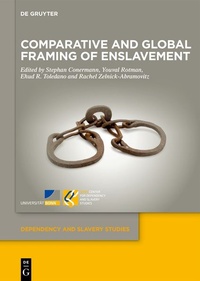
Comparative and Global Framing of Enslavement
Description

The study of enslavement has become urgent over the last two decades. Social scientists, legal scholars, human rights activists, and historians, who study forms of enslavement in both modern and historical societies, have sought - and often achieved - common conceptual grounds, thus forging a new perspective that comprises historical and contemporary forms of slavery. What could certainly be termed a turn in the study of slavery has also intensified awareness of enslavement as a global phenomenon, inviting a comparative, trans-regional approach across time-space divides. Though different aspects of enslavement in different societies and eras are discussed, each of the volume's three parts contributes to, and has benefitted from, a global perspective of enslavement. The chapters in Part One propose to structure the global examination of the theoretical, ideological, and methodological aspects of the "global," "local," and "glocal." Part Two, "Regional and Trans-regional Perspectives of the Global," presents, through analyses of historical case studies, the link between connectivity and mobility as a fundamental aspect of the globalization of enslavement. Finally, Part Three deals with personal points of view regarding the global, local, and glocal. Grosso modo, the contributors do not only present their case studies, but attempt to demonstrate what insights and added-value explanations they gain from positioning their work vis-à-vis a broader "big picture."
More details
Other editions
Additional editions
Persons
S. Conermann , University of Bonn, Germany; Y. Rotman , E. R. Toledano and R. Zelnick-Abramovitz , Tel Aviv University, Israel.
