

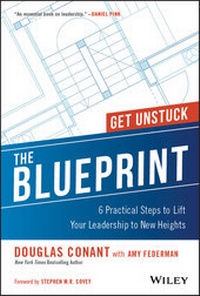
The Blueprint
Description

Lift your leadership to new heights
Doug Conant, Founder of ConantLeadership, former CEO of Campbell Soup Company, and former President of Nabisco Foods, shares transformational insights in his new book, The Blueprint. Conant is the only former Fortune 500 CEO who is a New York Times bestselling author, a top 50 Leadership Innovator, a Top 100 Leadership Speaker, and a Top 100 Most Influential Author in the World.
Get Unstuck
In 1984, Doug Conant was fired without warning and with barely an explanation. He felt hopeless and stuck but, surprisingly, this defeating turn of events turned out to be the best thing that ever happened to him. Doug began to consider what might be holding him back from realizing his potential, fulfilling his dreams, and making a bigger impact on the world around him.
Embarking on a journey of self-reflection and discovery, he forged a path to revolutionize his leadership and transform his career trajectory. Ultimately, Doug was able to condense his remarkable leadership story into six practical steps. It wasn't until Doug worked through these six steps that he was able to lift his leadership to heights that ultimately brought him career success, joy, and fulfillment.
* Reach High - Envision
* Dig Deep - Reflect
* Lay the Groundwork - Study
* Design - Plan
* Build - Practice
* Reinforce - Improve
In The Blueprint, part leadership manifesto, part practical manual, Doug teaches leaders how to work through the same six steps that he used to transform his journey. The six steps are manageable and incremental, designed to fit practically within the pace of busy modern life. Knowing how daunting the prospect of change can be, Doug arms readers with exercises and practices to realistically bring their foundation to life in every situation. Now, today's leaders who feel stuck and overwhelmed finally have a blueprint for lifting their leadership to make meaningful change in their organizations and in the world.
More details
Other editions
Additional editions
Person
Learn more at conantleadership.com.
Content
Authors' Note xv
Introduction: The Raw Materials of Change Are Already within You xvii
Part I Blueprint: Get Unstuck Your Foundation is Everything 3
Your Life Story is Your Leadership Story 15
Step 1 Envision: The Power of Intention and Purpose 29
Step 2 Reflect: Dig Deep 49
Step 3 Study: Lay Your Groundwork 73
Step 4 Plan: Design Your Leadership Model 91
Step 5 Practice: Build Your Leadership Profile 107
Step 6 Improve: Reinforce Your Foundation 121
Putting It All Together: Your Five-Day Action Plan 135
Part II Manifesto: Maximize Your Impact Leadership That Works: It's All about the People 149
High Performance 167
Abundance 181
Inspire Trust 193
Purpose 207
Courage 221
Integrity 233
The "Grow or Die" Mindset 255
Humility 271
How Can I Help? 287
Have Fun 297
Stay True to Yourself 307
Afterword by Mette Norgaard 313
Acknowledgments 317
About the Authors 319
Appendix: Understanding the ConantLeadership Flywheel 323
Index 331
Introduction
The Raw Materials of Change Are Already within You
"Start where you are. Use what you have. Do what you can."
-Arthur Ashe, American tennis player
"Your job has been eliminated. Clear out your desk by noon."
Those were the words that changed my life. In the spring of 1984, when I was 32 years old, I drove to my job as the director of marketing for the Parker Brothers Toy & Game Company in Beverly, Massachusetts. I can remember the commute vividly. The salty sea air wafting off Boston's North Shore filled my senses. A snap of wintry briskness lingered in the air but there was a whisper of warmer weather to come. It was a beautiful day, serene and promising. I felt good. Sure, our company had recently changed ownership, and things had been chaotic, but I was still confident in my ability to contribute. I walked into my job that day energized, expecting to put in another honest day's work moving things forward for the organization.
When I arrived, I was asked to report directly to the office of the VP of marketing, who was fidgeting nervously and waiting for me outside his door. Gravely, he asked me to step into his office. He was having trouble looking at me, his eyes darting around at everything else in the room - landing on inanimate objects like his stapler, the doorknob, his chair - anything but me. Despite his strange temperament, I had no idea what was coming. Once we were both settled in his office, he fired me immediately, and with barely an explanation.
I couldn't understand it; there had been no warning whatsoever. All he could muster as a reason for letting me go was that my job had been "eliminated" and I was too blindsided to choke out any follow-up questions. Gesturing toward the door, he asked me to clear out my desk and go, ushering me out of his office as quickly as possible
Although it would have monumental impact on my life for years thereafter, the whole miserable conversation came and went in manner of minutes. It was crushing. In a daze, as I made my way toward my desk, a storm of feelings converged inside me: I was stunned, hurt, indignant, angry, and most of all, humiliated. How could this be happening to me? And, worse, how did I not see it coming?
As I gathered my things and left the building, my feelings gave way to an even heavier sensation of dread as I realized I would have to deliver this disastrous news to my wife. How I would break it to her? We had young children and a hefty mortgage; everyone was relying on me. What was I going to do?
As I drove home, my self-esteem was in freefall. The drive that had felt so full of promise hours earlier now had the feel of a funeral procession. The refreshing spring sea air that had wafted through my window before now felt thick and stagnant. Without a doubt, it was the most awful day in my entire career. And in the wake of it, I felt hopeless and stuck. This wasn't how I envisioned my journey; as a dedicated and committed professional, I had always hoped for more. Now, all I felt was uncertainty.
But as you'll learn, this defeating experience turned out to be the best thing that ever happened to me; it was the beginning of my leadership story, not the end. It was in this crucible moment, after this abrupt and devastating firing, that I first began to consider what might be holding me back from realizing my potential, fulfilling my dreams, and making a bigger impact on the world around me. It was the first step toward total reinvention.
Ups and Downs
People are often surprised when I tell them this story. Since that harrowing time when I was fired, I've been blessed with much success on my leadership journey. I'm fortunate to have become well-known (at least in the business world) as a president, Fortune 300 CEO, and chairman. I've served as president of Nabisco Foods, president and CEO of Campbell Soup Company, and chairman of Avon Products. I've had the joy of starting my own company and the privilege of serving as a board member for many others, in the public, the nonprofit, and the academic sectors. It's been an honor. When I tell people that I once got fired and struggled to find my footing, they often admit they had assumed that my success story was smooth and seamless. But of course it wasn't. As is so often the case, my journey could have easily turned out very differently.
My career got off to a floundering start. I began at the very bottom of the ladder as an entry-level marketing assistant at General Mills. It was my first experience working in a corporate office environment and I was out of my depth. I certainly didn't look the part: On my first day, I walked into the corporate offices in a tacky khaki suit and long, wild, curly hair. Everyone else was clean-cut. I didn't act the part quite right either; I was shy and hesitant, not comfortable in my own skin. Struggling to find my footing, I worked hard but delivered lackluster results at first. Early in that role, in my first performance review, my most senior manager only wrote six words: "You should look for another job." It was tough feedback to receive so early in my career and I was discouraged.
But I persevered. With encouragement and support from my direct manager, eventually I was promoted, and I made a predictable ascent to better jobs with more responsibilities. Although I wasn't very flashy, outgoing, or even remarkable, I was always committed to working hard, putting my best foot forward, and helping those around me, so I managed to make some progress.
Back to Square One
Then I faced the big setback, the crippling one: I got fired.
When I got home on that fateful day, I felt bitter and hopeless. I'll never forget walking through my front door to face my family, feeling defeated. Usually an agreeable guy, I felt an uncharacteristic anger rising inside me. My calm demeanor was riled so much that when the HR manager called me later that day to follow up on my exit package and transition details, I cursed and hung up on him mid-sentence, slamming the phone down in frustration.
The worst part was that I felt like a victim. I didn't have a sense of agency or control over my life. And I went down a dangerous road of self-pity. It seemed like my entire career had been flushed down the toilet. All my hard work, all that striving, all my quiet adherence to rules and expectations, behaving how I thought I was supposed to - what had it amounted to? I didn't know how to deal with the large mortgage payments looming, or how to overcome the shy temperament that had kept me removed from the world around me. I was stuck.
The Question
The more I thought about it, the less I understood it. Why weren't my efforts yielding the career I envisioned? Why was I experiencing these setbacks? Even though I'd had modest success in my career, something was always holding me back from achieving a breakthrough, from being the leader I believed I could be. But what?
It wasn't that I lacked ambition or work ethic; I had always kept my head down, worked hard, and done exactly what I thought I was supposed to do. It wasn't that I lacked a competitive drive; the grit that had carried me to success as a Division 1 collegiate tennis player still burned within me. It wasn't that I wasn't competent; I'd always shown a proficiency for the work I was given. And it certainly wasn't that I didn't have strong values. Family, faith, and a commitment to community and public service were deeply ingrained in my personhood, instilled in me since childhood.
I had a lot going for me. But there was a glaring problem: I hadn't figured out how to translate all of these characteristics into a winning formula for success. I hadn't yet learned how to leverage the parts of my personality, motivations, temperament, and beliefs that were uniquely mine and transform them into a Foundation for limitless possibility and greater impact. What's more, nobody at the time would have ever known any of these defining things about me; always playing it safe, I mostly kept to myself. I had no approach for reflecting on my inner self or communicating to others what mattered to me. But all of that, luckily, was about to change.
A Game-Changing Lesson
At this rock-bottom point in my life, I knew I wanted to stop merely going along to get along. I wanted more. I yearned to love my work, to be really good at it, and to feel fulfilled by the difference I was making in the world. But, like so many of the leaders I speak to every day, I didn't know how to do it. Amid the competing pressures of my life and job search, I had no idea where to look, or how to start. I felt like my life was happening to me, not like I had influence over it; I wanted to be the driver of my circumstances, not a mere passenger along for the ride.
What I know now that I didn't know then is you can start where you are, with what you have within you. And you can start small. You already have the raw materials to change your leadership life.
But I didn't learn that lesson on my own. I had help. My best clue as to how to elevate my leadership came from a straight-shooting outplacement counselor named Neil Mackenna, who was hired to support me after I got...
