

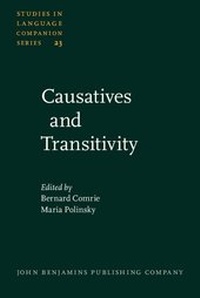
Causatives and Transitivity
1st Edition
Published on 9. September 1993
X, 399 pages
978-90-272-8586-7 (ISBN)
Description

This volume brings together 18 typological studies of causative and related constructions (transitivity, voice, other expressions of cause) by 19 scholars from North America, Western Europe, and Russia. The inspirations for the volume is the pioneering work on causative constructions by the Leningrad Typology Group; several of the contributors have close connections to the charter members of that group, others have appreciated this work from a distance. The volume as a whole is based on the concept of causative constructions as embracing both morphology and syntax, with an important semantic component as well. In addition to general studies concerning the morpho syntactic and semantic typology and the history of causative constructions and relations to other phenomena, the following individual languages are treated in detail: Russian, English, Dutch, Svan, Even, Korean, Yukaghir, Alutor, Aleut, Haruai, Dogon, Athabaskan languages. The volume will be of interest to typologists, to other linguists interested in causative constructions and transitivity relations, and to all who are interested in the linguistic expression of causal relations.
More details
Other editions
Additional editions
Bernard Comrie | Maria Polinsky
Causatives and Transitivity
Book
09/1993
John Benjamins Publishing Co
€132.50
Shipment within 10-15 days
Content
- CAUSATIVES AND TRANSITIVITY
- Editorial page
- Title page
- Copyright page
- Table of contents
- Preface
- REFERENCES
- The inflectional category of voice: towards a more rigorous definition
- 1. The problem stated
- 2. The theoretical framework: The Meaning-Text theory
- 3. Underlying concepts
- 4. The concept of voice and particular voices
- 5. Open problems related to voice
- voice as a supercategory
- 5.1 Monovalent verbs
- 5.2 Trivalent verbs
- 6. Two categories closely related to voice
- 6.1 Transitivation
- 6.1.1 General remarks
- 6.1.2 Concept of transitivation
- 6.1.3 Transitivation as an "imperfect" category
- 6.1.4 The status of the 'neuter' grammeme
- 6.1.5 Illustrations of transitivation
- 6.1.6 "Antipassive
- 6.2 Affectedness
- 7. Conclusions
- 7.1 Complex voice-like categories
- 7.2 Impurity of actual voices
- 7.3 Fickle differences between categories
- ACKNOWLEDGMENTS
- ABBREVIATIONS
- NOTES
- REFERENCES
- Transitivity increase in Athabaskan languages
- 1. Introduction
- 2. Transitivity indicators
- 3. Pathways of transitivity increase
- 3.1 Causativization
- 3.2 Possessivization
- 3.3 Agentivization
- 3.4 A ction perfectivization/patient affection
- 3.5 Action intensification
- 3.6 Comparative
- 4. Are transitivity indicators arbitrary?
- 5. Evaluation of results
- 6. Conclusions
- NOTES
- REFERENCES
- Transitive and causative in the Slavic lexicon: Evidence from Russian
- 1. Introduction
- 2. Text frequencies of valence types
- 3. Inter-text variation in valence frequency
- 4. Frequencies of aspect categories in valence classes
- 5. Inter-text variation in aspect frequency
- 6. Lexical frequency
- 7. Lexical frequency of roots
- 8. Lexical derivations
- 9. Diachronic change
- 10. Conclusions
- NOTES
- REFERENCES
- SOURCES
- More on the typology of inchoative/causative verb alternations
- 1. Formal and semantic basic-derived relationships
- 2. Formal types of inchoative/causative verb pairs
- 3. Semantic restrictions on inchoative/causative verb pairs
- 4. The sample
- 5. Difficulties with the formal classification of inchoative/causative verb pairs
- 6. Typological characterization of the languages
- 7. Different preferences for the direction of derivation in different verbs
- 8. Conceptual simplicity as the basis of semantic basic-derived relationships
- NOTES
- REFERENCES
- APPENDIX
- The "second causative": A typological sketch
- 1. Introduction
- 2. Morphology
- 2.1
- 2.2 Morphological productivity, regularity, and doublet forms
- 2.3 Double affix reduction
- 2.4 "Empty" causative markers and "one-and-a-half causatives".
- 2.5 The triple causative and causatives of higher degrees
- 3. Semantics
- 4. Hierarchy of causatives
- 5. Syntax
- 5.1 The marking of the causee
- 5.2
- 5.3 Adverbial scope
- 6. Some remarks on diachrony
- NOTES
- REFERENCES
- Make" and the semantic origins of causativity: a typological study
- 1. Introduction
- 2. Grammatical uses of "make"-verbs
- 3. How does "make" so frequently acquire a causative meaning?
- 4. The semantic primitives of causation and the expression of causativity in the world's languages
- 5. Conclusion
- NOTES
- REFERENCES
- Causatives and causality: towards a semantic typology of causal relations
- 1. Introduction
- 2. Encoding of causative relations
- 3. Causation and argumentation
- 4. Causation and other types of implicative relations
- 5. Causation and control
- 6. Causation and estimation
- 7. Conclusion
- REFERENCES
- Causee and patient in the causative of transitive: Coding conflict or doubling of grammatical relations?
- 1. Introduction
- 2. Theoretical preliminaries
- 2.1 Coding options
- 2.2 Coding conflict and syntactic doubling
- 2.3 Approach
- 3. Korean
- 3.1 Data
- 3.1.1 General
- 3.1.2 The biclausal vs. monoclausal analysis of periphrastic causatives
- 3.2 Direct Object properties in Korean
- 3.3 Other biaccusative constructions
- 3.3.1 Possessor Ascension clause
- 3.3.2 Ditransitive clause
- 3.3.3 Benefactive Advancement clause
- 3.3.4 Clause with the adverbial accusative
- 3.4 Causatives: Syntactic analysis
- 3.4.1 Causee referent and patient referent are hierarchically similar
- 3.4.2 Causee referent is hierarchically higher than the patient referent
- 3.4.3 Other extraction tests
- 3.4.4 Conclusion on syntax
- 3.5 Biaccusative constructions: Semantic analysis
- 3.5.1 Causee: Accusative vs. dative marking
- 3.5.2 Causative of transitives
- 3.5.3 Other biaccusative constructions
- 4. Dutch
- 4.1 Data
- 4.1.1 Causatives: arguments for monoclausality
- 4.1.2 Causatives of transitives
- 4.2 Other coding conflict constructions
- 4.3 Direct Object properties in Dutch
- 4.4 Coding conflict constructions: A syntactic analysis
- 4.4.1 Grammatical relations in the causative construction
- 4.4.2 Grammatical relations in the ditransitive clause
- 4.4.3 Causee/Recipient: Indirect Object or a non-term?
- 4.5 Causatives: Semantic and communicative analysis
- 4.6 Conclusion on Dutch
- 5. Word order and passive in coding conflict causatives
- 5.1 Coding conflict and word order
- 5.1.1 Agent-before-Patient orders
- 5.1.2 Patient-before-Agent orders
- 5.2 Passivization, extraction, and suppression
- 5.2.1 Relevant notions
- 5.2.2 Suppression in coding conflict constructions
- 5.2.3 Problem
- 5.2.4 The functional view of the problem
- 5.2.5 Processing of extraction, passivization, and suppression
- 6. Conclusion
- NOTES
- REFERENCES
- Bystander voice in English: A generalization masked in some versions of theta theory
- 1. A syntactic generalization split by theta roles
- 2. Non-auxiliary behavior
- so-called "semi-auxiliaries
- 3. Bystander Voice in Romance?
- 4. Conclusions
- 4.1 A Bystander Voice paradigm
- 4.2 Need for a reconsideration of theta roles
- 4.3 Towards a functional-cultural explanation
- NOTES
- REFERENCES
- Causative constructions in Svan: further evidence for role domination
- 1. Introduction
- 2. Role vs. reference domination in causativization
- 3. Causative constructions in Svan
- 3.1 Preliminary remarks
- 3.2 Svan data
- 3.3 Interpretation
- 4. Other evidence of role domination in Svan
- 4.1 Verbal classification and case-marking
- 4.2 Control properties
- 4.3 Conclusions
- NOTES
- REFERENCES
- The causative in Yukaghir
- 1. Introduction
- 2. Causative suffixes
- 2.1 Correlative pairs
- 2.2 Morphological (regular) causatives
- 2.2.1 The first causative
- 2.2.2 The second causative.
- 2.3 Lexical causatives
- 3. Causative vs. multiplicative/distributive
- 4. The case of the causee
- NOTES
- REFERENCES
- Alutor causatives, noun incorporation,and the Mirror Principle
- 1. Introduction
- 1.1 Preamble
- 1.2 General information on Alutor
- 2. Forming causatives in Alutor
- 3. The syntax of the morphological causative in Alutor
- 4. Causativization and incorporation
- 4.1 Introduction
- 4.2 Incorporation in Alutor: General
- 4.3 Causatives and incorporation in Alutor
- 4.3.1 Incorporation in causatives: General rules
- 4.3.2 Causatives from intransitive verbs
- 4.3.3 Double causatives
- 4.3.4 Causatives from transitive verbs
- NOTES
- REFERENCES
- Some remarks on causatives and transitivity in Haruai
- 1. Introduction
- 2. Causative of intransitive verbs
- 3. Causative of transitive verbs
- 4. Reflexives and reciprocals
- 5. Conclusion
- NOTES
- REFERENCE
- Through the looking-glass, and how causativos look there
- 1. Introduction
- 2. Causatives and their asymmetric structure
- 3. Causatives and their looking-glass counterparts
- 4. On Russian consecutives
- 4.1 Verbs in do-...-sja
- 4.2 Other candidates for consecutivesin Russian
- 4.3 Verbs with the prefix za-
- 5. Consecutives and some adjacent categories
- 5.1 Consecutives and Aktionsarten
- 5.2 Consecutivesand perfect
- 5.3 Some relevant criteria for discerning consecutives from other categories
- 6. Some parameters for a typological classification of consecutives
- 6.1 Semantics
- 6.2 Diathesis types
- 7. Conclusion
- NOTES
- REFERENCES
- Hybrid causative constructions: Benefactive causative and adversity passive
- 1. Introduction: The benefactive causative
- 2. Causative, passive, and voice
- 3. Canonical passivization
- 4. Canonical causativization
- 5. Hybrid causativization: The benefactive causative in Russian
- 6. The adversity passive in Japanese
- NOTES
- REFERENCES
- Adversative constructions in Even in relation to passive and permissive
- 1. Introduction
- 2. Grammar note
- 2.1 Nominal morphology
- 2.2 Verbal morphology
- 2.3 The syntax of causative constructions
- 3. The basic types of adversative constructions
- 4. A derivational approach to the analysis of ADVCs
- 4.1 Arguments for and against the passive analysis of ADCs
- 4.2 Arguments for and against a causative analysis of ADCs
- 5. A definitional approach to the analysis of ADCs
- 6. Some typological implications: Even adversative and the correlation between passive and causative
- NOTES
- REFERENCES
- On non-causative effects of causativity in Aleut
- 1. Introduction
- 2. Overlapping of causative and aspectual meanings
- 3. Conclusion
- NOTES
- REFERENCES
- Three causatives in Dogon and the overlapping of causative and passive markers
- 1. Introductory
- 2. Causative markers
- 2.1 The suffix -nd-
- 2.2 The suffix -r-
- 2.3 The suffix -mò
- NOTES
- REFERENCES
- Index of Languages
- The series Studies in Language Companion Series
