

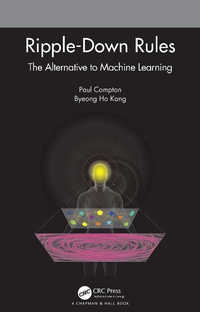
Ripple-Down Rules
The Alternative to Machine Learning
1st Edition
Published on 30. May 2021
196 pages
978-1-000-36358-6 (ISBN)
Description

Machine learning algorithms hold extraordinary promise, but the reality is that their success depends entirely on the suitability of the data available. This book is about Ripple-Down Rules (RDR), an alternative manual technique for rapidly building AI systems. With a human in the loop, RDR is much better able to deal with the limitations of data.
Ripple-Down Rules: The Alternative to Machine Learning starts by reviewing the problems with data quality and the problems with conventional approaches to incorporating expert human knowledge into AI systems. It suggests that problems with knowledge acquisition arise because of mistaken philosophical assumptions about knowledge. It argues people never really explain how they reach a conclusion, rather they justify their conclusion by differentiating between cases in a context. RDR is based on this more situated understanding of knowledge. The central features of a RDR approach are explained, and detailed worked examples are presented for different types of RDR, based on freely available software developed for this book. The examples ensure developers have a clear idea of the simple yet counter-intuitive RDR algorithms to easily build their own RDR systems.
It has been proven in industrial applications that it takes only a minute or two per rule to build RDR systems with perhaps thousands of rules. The industrial uses of RDR have ranged from medical diagnosis through data cleansing to chatbots in cars. RDR can be used on its own or to improve the performance of machine learning or other methods.
Ripple-Down Rules: The Alternative to Machine Learning starts by reviewing the problems with data quality and the problems with conventional approaches to incorporating expert human knowledge into AI systems. It suggests that problems with knowledge acquisition arise because of mistaken philosophical assumptions about knowledge. It argues people never really explain how they reach a conclusion, rather they justify their conclusion by differentiating between cases in a context. RDR is based on this more situated understanding of knowledge. The central features of a RDR approach are explained, and detailed worked examples are presented for different types of RDR, based on freely available software developed for this book. The examples ensure developers have a clear idea of the simple yet counter-intuitive RDR algorithms to easily build their own RDR systems.
It has been proven in industrial applications that it takes only a minute or two per rule to build RDR systems with perhaps thousands of rules. The industrial uses of RDR have ranged from medical diagnosis through data cleansing to chatbots in cars. RDR can be used on its own or to improve the performance of machine learning or other methods.
Reviews / Votes
"In this era of deep learning, where is our deeper understanding of AI? The answer is, here, in this book. Compton and Kang's ideas are a "must-read" for anyone working with AI. Based on very many examples of real-world applications, they show us a better way to use AI. If your AI models are confusing to understand and hard to maintain, then this book is for you."-- Tim Menzies, Professor, North Carolina State University "In this era of deep learning, where is our deeper understanding of AI? The answer is, here, in this book. Compton and Kang's ideas are a "must-read" for anyone working with AI. Based on very many examples of real-world applications, they show us a better way to use AI. If your AI models are confusing to understand and hard to maintain, then this book is for you."
-- Tim Menzies, Professor, North Carolina State University
More details
Edition
1. Auflage
Language
English
Place of publication
London
United Kingdom
Publishing group
Taylor & Francis Ltd
Target group
College/higher education
Professional and scholarly
Illustrations
4 Tables, black and white; 112 Illustrations, color
ISBN-13
978-1-000-36358-6 (9781000363586)
Copyright in bibliographic data and cover images is held by Nielsen Book Services Limited or by the publishers or by their respective licensors: all rights reserved.
Schweitzer Classification
Other editions
Additional editions
Book
05/2021
1st Edition
Chapman & Hall/CRC
€197.50
Shipment within 15-20 days
Book
05/2021
1st Edition
Chapman & Hall/CRC
€92.80
Shipment within 15-20 days
Persons
Paul Compton initially studied philosophy before majoring in physics. He spent 20 years as a biophysicist at the Garvan Institute of Medical Research, and then 20 years in Computer Science and Engineering at the University of New South Wales, where he was head of school for 12 years and is now an emeritus professor.
Byeong Ho Kang majored in mathematics in Korea, followed by a PhD on Ripple-Down Rules at the University of New South Wales and the algorithm he developed is the basis of most industry RDR applications. He is a professor, with a research focus on applications, and head of the ICT discipline at the University of Tasmania."
Byeong Ho Kang majored in mathematics in Korea, followed by a PhD on Ripple-Down Rules at the University of New South Wales and the algorithm he developed is the basis of most industry RDR applications. He is a professor, with a research focus on applications, and head of the ICT discipline at the University of Tasmania."
Content
Preface
Acknowledgements
1 Problems with Machine Learning and Knowledge Acquisition
1.1 Introduction
1.2 Machine Learning
1.3 Knowledge Acquisition
2 Philosophical issues in knowledge acquisition
3 Ripple-Down Rule Overview
3.1 Case-driven knowledge acquisition
3.2 Order of cases processed
3.3 Linked Production Rules
3.4 Adding rules
3.5 Assertions and retractions
3.6 Formulae in conclusion
4 Introduction to Excel_RDR
5 Single Classification Example
5.1 Repetition in an SCRDR knowledge base
5.2 SCRDR evaluation and machine learning comparison
5.3 Summary
6 Multiple classification example
6.1 Introduction to Multiple Classification Ripple-Down Rules (MCRDR)
6.2 Excel_MCRDR example
6.3 Discussion: MCRDR for single classification
6.4 Actual Multiple classification with MCRDR
6.5 Discussion
6.6 Summary
7 General Ripple-Down Rules (GRDR)
7.1 Background
7.2 Key Features of GRDR
7.3 Excel_GRDR demo
7.4 Discussion: GRDR, MCRDR and SCRDR
8 Implementation and Deployment of RDR-based systems
8.1 Validation
8.2 The role of the user/expert
8.3 Cornerstone Cases
8.4 Explanation_
8.5 Implementation Issues
8.6 Information system interfaces
9 RDR and Machine learning
9.1 Suitable datasets
9.2 Human experience versus statistics.
9.3 Unbalanced Data
9.4 Prudence
9.5 RDR-based machine learning methods
9.6 Machine learning combined with RDR knowledge acquisition
9.7 Machine learning supporting RDR
9.8 Summary_
Appendix 1 - Industrial Applications of RDR
A1.1 PEIRS (1991-1995)
A1.2 Pacific Knowledge Systems
A1.3 Ivis
A1.4 Erudine Pty Ltd
A1.5 Ripple-Down Rules at IBM
A1.6 YAWL
A1.7 Medscope
A1.8 Seegene
A1.9 IPMS
A1.10 Tapacross
Appendix 2 - Research-demonstrated Applications
A2.1 RDR Wrappers
A2.2 Text-processing, natural language processing and information retrieval
A2.3 Conversational agents and help desks
A2.4 RDR for operator and parameter selection
A2.5 Anomaly and event detection
A2.6 RDR for image and video processing
References
Index
Acknowledgements
1 Problems with Machine Learning and Knowledge Acquisition
1.1 Introduction
1.2 Machine Learning
1.3 Knowledge Acquisition
2 Philosophical issues in knowledge acquisition
3 Ripple-Down Rule Overview
3.1 Case-driven knowledge acquisition
3.2 Order of cases processed
3.3 Linked Production Rules
3.4 Adding rules
3.5 Assertions and retractions
3.6 Formulae in conclusion
4 Introduction to Excel_RDR
5 Single Classification Example
5.1 Repetition in an SCRDR knowledge base
5.2 SCRDR evaluation and machine learning comparison
5.3 Summary
6 Multiple classification example
6.1 Introduction to Multiple Classification Ripple-Down Rules (MCRDR)
6.2 Excel_MCRDR example
6.3 Discussion: MCRDR for single classification
6.4 Actual Multiple classification with MCRDR
6.5 Discussion
6.6 Summary
7 General Ripple-Down Rules (GRDR)
7.1 Background
7.2 Key Features of GRDR
7.3 Excel_GRDR demo
7.4 Discussion: GRDR, MCRDR and SCRDR
8 Implementation and Deployment of RDR-based systems
8.1 Validation
8.2 The role of the user/expert
8.3 Cornerstone Cases
8.4 Explanation_
8.5 Implementation Issues
8.6 Information system interfaces
9 RDR and Machine learning
9.1 Suitable datasets
9.2 Human experience versus statistics.
9.3 Unbalanced Data
9.4 Prudence
9.5 RDR-based machine learning methods
9.6 Machine learning combined with RDR knowledge acquisition
9.7 Machine learning supporting RDR
9.8 Summary_
Appendix 1 - Industrial Applications of RDR
A1.1 PEIRS (1991-1995)
A1.2 Pacific Knowledge Systems
A1.3 Ivis
A1.4 Erudine Pty Ltd
A1.5 Ripple-Down Rules at IBM
A1.6 YAWL
A1.7 Medscope
A1.8 Seegene
A1.9 IPMS
A1.10 Tapacross
Appendix 2 - Research-demonstrated Applications
A2.1 RDR Wrappers
A2.2 Text-processing, natural language processing and information retrieval
A2.3 Conversational agents and help desks
A2.4 RDR for operator and parameter selection
A2.5 Anomaly and event detection
A2.6 RDR for image and video processing
References
Index
