

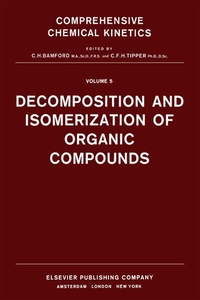
Decomposition and Isomerization of Organic Compounds
Published on 1. January 1971
778 pages
978-0-08-086800-4 (ISBN)
Description

Decomposition and Isomerization of Organic Compounds
More details
Other editions
Additional editions

C.F.H. Tipper# | R. G. Compton | Bamford
Comprehensive Chemical Kinetics: Decomposition and Isomerization of Organic Compounds v. 5
Book
12/1972
Elsevier
€247.28
Article exhausted; check different version
Content
- Front Cover
- Decomposition and Isomerisation of Organic Compounds, Volume 5
- Copyright Page
- Contents
- Contributors to Volume 5
- Preface
- Chapter 1. The Decomposition and Isomerization of Hydrocarbons
- 1. Introduction
- 2. Reactions of Cyclic Hydrocarbons
- 3. Cis-Trans Isomerizations About Double Bonds
- 4. Pyrolysis
- 5. Photolysis
- 6. Photosensitized Decomposition
- 7. Radiolysis
- 8. Inhibition Mechanisms
- References
- Chapter 2. The Decomposition of Halogen Compounds
- 1. Introduction
- 2. Thermally Induced Decompositions
- 3. Radiation and Particle Induced Decomposition
- 4. Recent Studies
- References
- Chapter 3. The Decomposition of Aldehydes and Ketones
- Introduction
- PART I. THERMAL REACTIONS
- 1. Thermal Decomposition of Acetaldehyde
- 2. Thermal Decomposition of Propionaldehyde
- 3. Thermal Decomposition of Benzaldehyde
- 4. Thermal Decomposition of Cyclobutanecarboxaldehyde
- 5. Thermal Decomposition of Acetone
- 6. Thermal Decomposition of Biacetyl
- 7. Thermal Decomposition of Ketene
- 8. Thermal Decomposition of Cycloalkyl Ketones and Ezocyclic Ketones
- References (Part I)
- PART II. PHOTOCHEMICAL REACTIONS
- 1. Photochemistry of Acetaldehyde
- 2. Photochemistry of Aliphatic Aldehydes with a Hydrogen Atom in the ? Position
- 3. Photochemistry of a-ß Unsaturated Aldehydes
- 4. Photochemistry of Cyclopropanecarboxaldehyde
- 5. Photochemistry of Acetone
- 6. Photochemistry of Aliphatic Ketones with a Hydrogen Atom in the ? Position
- 7. Photochemistry of Biacetyl
- 8. Photochemistry of Cyclic Ketones
- References (Part II)
- Chapter 4. The Unimolecular Decomposition and Isomerization of Oxygenated Organic Compounds (Other than Aldehydes and Ketones)
- 1. Introduction
- 2. Decomposition of Esters in the Gas Phase
- 3. Decomposition of Esters in Solution
- 4. Decomposition of Carbonate Esters in the Gas Phase
- 5. Thermolysis of Anhydrides in the Gas Phase
- 6. Decomposition of Carbonic Anhydrides in Solution
- 7. Reactions of Ethers in the Gas Phase
- 8. Decomposition of Ethers in Solution
- 9. Decomposition of Alcohols in the Gas Phase
- 10. Decomposition of Carboxylic Acids in the Gas Phase
- 11. Decomposition of Carboxylic Acids in Solution
- 12. Decomposition of Peroxides in the Gas Phase
- 13. Decomposition of Peroxides in Solution
- 14. Appendix
- References
- Chapter 5. Unimolecular Homogeneous Decompositions and Isomerizations of Nitrogen Compounds
- 1. Azocompounds
- 2. Diazo Compounds
- 3. Azides
- 4. Amines and Imines
- 5. Nitrogen Heterocycles
- 6. Azines and Hydrazines
- 7. Miscellaneous Nitrogen Compounds
- Acknowledgement
- References
- Chapter 6. Unimolecular Homogeneous Decompositions and Isomerizations of Sulfur Compounds
- 1. Introduction
- 2. Thiols
- 3. Sulfides
- 4. Disulfides
- 5. Polysulfides
- 6. Cyclic Sulfides
- 7. Thiophenes
- 8. Sulfones and Sulfoxides
- 9. Chlorosulfites and Sulfites
- 10. Thiolsulfonates and Sulfinates
- 11. Thiocyanates and Isothiocyanates
- Acknowledgement
- References
- Index
