

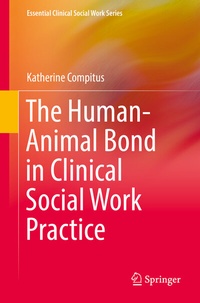
The Human-Animal Bond in Clinical Social Work Practice
Description

In this book, the author includes a discussion of the myriad of ways that clinicians can directly help people care for their pets, such as crisis intervention services, policy issues, grief counseling for pet loss, and compassion fatigue in the veterinary profession. There also is a thorough discussion of animal-assisted therapy (AAT) as a distinct and unique modality. The adaptive nature of AAT is not only due to the symbiotic relationship between humans and animals, but also because of the flexible nature of the model; it can be used with clients of all demographics and with most mental illnesses. Research shows that the majority of mental health practitioners believe that AAT is a valid treatment modality, but AAT has not yet been manualized and clinicians are left confused about where to start.
The Human-Animal Bond in Clinical Social Work Practice is a unique and essential resource that provides guidelines for developing AAT treatment plans and integrating AAT with existing therapeutic models. The book answers the questions that social workers, psychologists, psychiatrists, and other mental health counselors may have about the benefits of the human-animal bond and ways to tap into that special bond in direct practice.
More details
Other editions
Additional editions
Person
Katherine Compitus , DSW, LCSW, MSEd, MA is a doctor of clinical social work and a licensed clinical social worker. Her research focuses primarily on social policy, mental health, and the human-animal bond. Katherine is the founder and chairman of Surrey Hills Sanctuary, a non-profit organization providing veterinary social work services to trauma and abuse survivors in New York State. She has lectured extensively on Animal-Assisted Therapy, Grief Counseling for Pet Loss, Suicidality in Veterinary Professionals, and Crisis Intervention for People with Pets. Katherine is currently a lecturer in the graduate social work schools at Columbia University, Fordham University, and New York University (NYU), where she developed and currently teaches the Human-Animal Bond course at NYU's Silver School of Social Work. Early in her social work career Katherine provided bilingual animal-assisted therapy at the NYU Hospital for Joint Diseases, helped establisha therapy animal program at an AHRC preschool, and was a grief counselor for pet loss at the Animal Medical Center in New York City. Born and raised in New York City, she now spends most of her time in upstate New York with her husband and the 30+ animals at the sanctuary, including chickens, potbellied pigs, pigeons, cats, dogs, and two naughty steer (bulls).
