

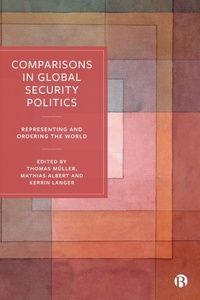
Comparisons in Global Security Politics
Representing and Ordering the World
Bristol University Press
1st Edition
Published on 26. September 2024
290 pages
978-1-5292-4185-3 (ISBN)
Description

Available open access digitally under CC-BY-NC-ND licence.
Comparative practices are integral to global security politics. The balance of power politics, status competitions and global security governance would not be possible without them. Yet, they are rarely treated as the main object of study.
Exploring the varied uses of comparisons, this book addresses three key questions:
* How is comparative knowledge produced?
* How does it become politically relevant?
* How do comparative practices shape security politics?
This book takes a bold new step in uniting disparate streams of research to show how comparative practices order governance processes and modulate competitive dynamics in world politics.
Comparative practices are integral to global security politics. The balance of power politics, status competitions and global security governance would not be possible without them. Yet, they are rarely treated as the main object of study.
Exploring the varied uses of comparisons, this book addresses three key questions:
* How is comparative knowledge produced?
* How does it become politically relevant?
* How do comparative practices shape security politics?
This book takes a bold new step in uniting disparate streams of research to show how comparative practices order governance processes and modulate competitive dynamics in world politics.
Reviews / Votes
"A groundbreaking volume that redefines comparative practices as a crucial policy tool in global security politics and that shows how comparison influences governance across traditional as well as novel security issues." Thorsten Bonacker, University of Marburg "This is an important volume featuring a stellar cast of contributors. It is a rare example of an edited book that is more than the sum of its parts. The contents should be of interest not only to those who study global security but anyone interested in how comparative knowledge is produced. Indeed, any scholar of international relations will appreciate this volume." Ayse Zarakol, University of CambridgeMore details
Edition
First Edition
Language
English
Place of publication
Bristol
United Kingdom
Target group
Professional and scholarly
Illustrations
10 s/w Zeichnungen, 12 s/w Abbildungen
10 Line drawings, black and white; 12 Illustrations, black and white
File size
2,21 MB
ISBN-13
978-1-5292-4185-3 (9781529241853)
Copyright in bibliographic data and cover images is held by Nielsen Book Services Limited or by the publishers or by their respective licensors: all rights reserved.
Schweitzer Classification
Other editions
Additional editions
Comparisons in Global Security Politics
Representing and Ordering the World
Book
09/2024
1st Edition
Bristol University Press
€30.50
Shipment within 3-4 weeks
Persons
Thomas Mueller is Senior Lecturer in the Faculty of Sociology at Bielefeld University.
Mathias Albert is Professor of Political Science in the Faculty of Sociology at Bielefeld University.
Kerrin Langer is Research Associate at the Department of Social Sciences at TU Dortmund University.
Mathias Albert is Professor of Political Science in the Faculty of Sociology at Bielefeld University.
Kerrin Langer is Research Associate at the Department of Social Sciences at TU Dortmund University.
Contributions
Geneva Graduate Institute
University of Copenhagen
Eberhard Karls University of Tuebingen
Bielefeld University
International Institute for Strategic Studies (IISS)
Institute for International Relations, TU Braunschweig
Peace Research Institute Frankfurt (PRIF)
University of Cambridge
University of Massachusetts Amherst
Content
Introduction: Practices All the Way Down? Comparisons in Global Security Politics - Thomas Mueller, Mathias Albert and Kerrin Langer
PART I: Teasing Out Comparative Practices
2. The Construction of Status in Security Politics: Rules, Comparisons and Second-Guessing Collective Beliefs - Paul Beaumont
3. Defence Analysis and Military Data at the IISS: How to Count and When is a Tank Modern? - Bastian Giegerich and James Hackett
4. Seeing Deterrence and Defence: Visual Representations of Military Force Comparisons between NATO and the Warsaw Pact in the 1980s - Gabi Schlag
5. What Drives Status Comparisons? An Experimental Study of Status Attribution in the Field of Space Exploration - Paul Musgrave and Steven Ward
PART II: How Comparisons Constitute Governance Objects
6. Not Yet Comparable? Maritime Security Knowledge and the Messiness of Epistemic Infrastructures - Christian Bueger
7. Framing (State) Fragility: The Construction of Imaginary Global Spaces - Keith Krause
8. Mapping the Dark and Ornamenting the Order: Comparisons in Global Crime Governance - Anja P. Jakobi and Lena Herbst
9. The Cybersecurity Ecosystem and the Datafication of Threats and Capabilities - Madeleine Myatt and Thomas Mueller
PART III: How Comparisons Reshape Competitive Dynamics
10. 'The Old World Fought, the Modern World Counts': Naval Armament Policies, Force Comparisons and International Status, 1889-1922 - Kerrin Langer
11. Force Comparison and Conventional Arms Control at the End of the East-West Conflict - Hans-Joachim Schmidt
12. 'Winning the Technology Competition': Narratives, Power Comparisons and the US-China AI Race - Nike Retzmann
13. Conclusion: Comparative Ordering in Security Politics and Beyond - Thomas Mueller
PART I: Teasing Out Comparative Practices
2. The Construction of Status in Security Politics: Rules, Comparisons and Second-Guessing Collective Beliefs - Paul Beaumont
3. Defence Analysis and Military Data at the IISS: How to Count and When is a Tank Modern? - Bastian Giegerich and James Hackett
4. Seeing Deterrence and Defence: Visual Representations of Military Force Comparisons between NATO and the Warsaw Pact in the 1980s - Gabi Schlag
5. What Drives Status Comparisons? An Experimental Study of Status Attribution in the Field of Space Exploration - Paul Musgrave and Steven Ward
PART II: How Comparisons Constitute Governance Objects
6. Not Yet Comparable? Maritime Security Knowledge and the Messiness of Epistemic Infrastructures - Christian Bueger
7. Framing (State) Fragility: The Construction of Imaginary Global Spaces - Keith Krause
8. Mapping the Dark and Ornamenting the Order: Comparisons in Global Crime Governance - Anja P. Jakobi and Lena Herbst
9. The Cybersecurity Ecosystem and the Datafication of Threats and Capabilities - Madeleine Myatt and Thomas Mueller
PART III: How Comparisons Reshape Competitive Dynamics
10. 'The Old World Fought, the Modern World Counts': Naval Armament Policies, Force Comparisons and International Status, 1889-1922 - Kerrin Langer
11. Force Comparison and Conventional Arms Control at the End of the East-West Conflict - Hans-Joachim Schmidt
12. 'Winning the Technology Competition': Narratives, Power Comparisons and the US-China AI Race - Nike Retzmann
13. Conclusion: Comparative Ordering in Security Politics and Beyond - Thomas Mueller
