

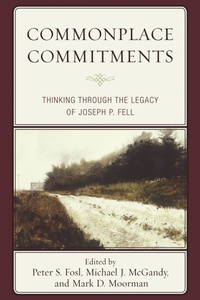
Commonplace Commitments
Thinking Through the Legacy of Joseph P. Fell
Bucknell University Press,U.S.
1st Edition
Published on 30. September 2016
324 pages
979-8-216-35688-2 (ISBN)
Description

Joseph P. Fell proposes that the solution to the problem of nihilism is found in the common experience of persons and the everyday commitments that one makes to people, practices, and institutions. In his landmark 1979 book Heidegger and Sartre, and in his subsequent essays, Fell describes a quiet but radical reform in the philosophical tradition that speaks to perennial dilemmas of thought and pressing issues for action.
Since Descartes, at least, we have been puzzled as to what we can know, how we should act, and what we should value. The skeptical influence of modern dualism-distilled in the mind-body problem at arose with the assertion "I think, therefore I am"-has shot through not just philosophy and psychology, but also society, politics, and culture. With dualism arose radical subjectivism and the concomitant problems of nihilism and alienation. The broad aim of phenomenology is to repair the rupture of self and world. Announced by Edmund Husserl and developed by Jean-Paul Sartre, Martin Heidegger, and John William Miller, who drew from the North American tradition, this is the project to which Fell has devoted more than a half century of reflection and technical elaboration.
In this volume, an array of scholars consider, criticize, and cultivate Fell's key contributions to the phenomenological project. Ranging from analyses of key texts in Fell's phenomenology to probing examinations of his crucial philosophical presuppositions to the prospects for Fell's call to find the solution to nihilism in everyday experience-these essays gather the work of the authors thinking with and through Fell's key works on Sartre, Heidegger, and Miller. Also included are seminal statements from Fell on his pedagogical practice and his conception of philosophy.
Since Descartes, at least, we have been puzzled as to what we can know, how we should act, and what we should value. The skeptical influence of modern dualism-distilled in the mind-body problem at arose with the assertion "I think, therefore I am"-has shot through not just philosophy and psychology, but also society, politics, and culture. With dualism arose radical subjectivism and the concomitant problems of nihilism and alienation. The broad aim of phenomenology is to repair the rupture of self and world. Announced by Edmund Husserl and developed by Jean-Paul Sartre, Martin Heidegger, and John William Miller, who drew from the North American tradition, this is the project to which Fell has devoted more than a half century of reflection and technical elaboration.
In this volume, an array of scholars consider, criticize, and cultivate Fell's key contributions to the phenomenological project. Ranging from analyses of key texts in Fell's phenomenology to probing examinations of his crucial philosophical presuppositions to the prospects for Fell's call to find the solution to nihilism in everyday experience-these essays gather the work of the authors thinking with and through Fell's key works on Sartre, Heidegger, and Miller. Also included are seminal statements from Fell on his pedagogical practice and his conception of philosophy.
More details
Edition
1. Auflage
Language
English
Place of publication
United States
Publishing group
Associated University Presses
Target group
Professional and scholarly
Illustrations
1 BW Photo
ISBN-13
979-8-216-35688-2 (9798216356882)
Copyright in bibliographic data and cover images is held by Nielsen Book Services Limited or by the publishers or by their respective licensors: all rights reserved.
Schweitzer Classification
Other editions
Additional editions
Peter S. Fosl | Michael J. Mcgandy | Mark D. Moorman
Commonplace Commitments
Thinking through the Legacy of Joseph P. Fell
Book
09/2016
Bucknell University Press,U.S.
€128.50
Shipment within 3-4 weeks
Persons
Peter S. Fosl is professor of philosophy and chair of PPE at Transylvania University.
Michael J. McGandy is senior editor with Cornell University Press.
Mark D. Moorman is an independent scholar.
Michael J. McGandy is senior editor with Cornell University Press.
Mark D. Moorman is an independent scholar.
Content
Preface
byPeter S. Fosl, Michael J. McGandy, and Mark D. Moorman
Introduction: Joseph P. Fell and the Traditions of Phenomenological Existentialism in America
by Michael J. McGandy
Part 1. Orientations
What is Philosophy?by Joseph P. Fell
Joseph Fell as Teacherby Mark D. Moorman
Style in Teaching Philosophyby Peter S. Fosl
The Eclipse and Rebirth of American Philosophical Pluralismby Armen T. Marsoobian
Part 2. The European Tradition
An Aristotelian Argument against the Inquiring of the Nicomachean Ethics by Jeffrey S. Turner
Why Heidegger? by David Weinberger
Placing Common Life: Fell and Skepticismby Peter S. Fosl
"Honoring one's commitments...."by Dennis Schmidt
Part 3. Joining the American Tradition
From Place to Midworld: A Key Development in the Philosophy of Joseph P. Fellby Mark D. Moorman
The Reclamation of History: Does Miller's Philosophical Project Preclude a "Radical Will?" by Vincent M. Colapietro
Ordinary Studies: Conceptual Brackets-Textual Momentsby Richard Fleming
Part 4. Prospects
Re-Orienting Thinking: Philosophy in the Midst of the World by Jeffery Malpas
Heideggerian Pathways through Existential Crisis: A "Hermeneutics of Facticity" by Scott D. Churchill
The Humanity of the Severely Handicapped within Sartre's Ethicsby Kenneth L. Anderson
The Integrity of Finitude: Existential Reckoning in the Work of John William Millerby Katie Terezakis
Descartes, Nihilism, and Jonas's "Third Road"by Gary Steiner
Coda: More I Cannot Wish You
by Joseph P. Fell
A Bibliography of Joseph Fell's Work
Contributors
Endnotes
Index
byPeter S. Fosl, Michael J. McGandy, and Mark D. Moorman
Introduction: Joseph P. Fell and the Traditions of Phenomenological Existentialism in America
by Michael J. McGandy
Part 1. Orientations
What is Philosophy?by Joseph P. Fell
Joseph Fell as Teacherby Mark D. Moorman
Style in Teaching Philosophyby Peter S. Fosl
The Eclipse and Rebirth of American Philosophical Pluralismby Armen T. Marsoobian
Part 2. The European Tradition
An Aristotelian Argument against the Inquiring of the Nicomachean Ethics by Jeffrey S. Turner
Why Heidegger? by David Weinberger
Placing Common Life: Fell and Skepticismby Peter S. Fosl
"Honoring one's commitments...."by Dennis Schmidt
Part 3. Joining the American Tradition
From Place to Midworld: A Key Development in the Philosophy of Joseph P. Fellby Mark D. Moorman
The Reclamation of History: Does Miller's Philosophical Project Preclude a "Radical Will?" by Vincent M. Colapietro
Ordinary Studies: Conceptual Brackets-Textual Momentsby Richard Fleming
Part 4. Prospects
Re-Orienting Thinking: Philosophy in the Midst of the World by Jeffery Malpas
Heideggerian Pathways through Existential Crisis: A "Hermeneutics of Facticity" by Scott D. Churchill
The Humanity of the Severely Handicapped within Sartre's Ethicsby Kenneth L. Anderson
The Integrity of Finitude: Existential Reckoning in the Work of John William Millerby Katie Terezakis
Descartes, Nihilism, and Jonas's "Third Road"by Gary Steiner
Coda: More I Cannot Wish You
by Joseph P. Fell
A Bibliography of Joseph Fell's Work
Contributors
Endnotes
Index
