

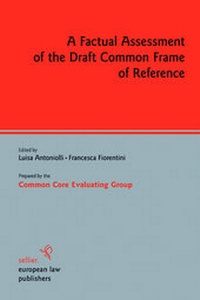
A Factual Assessment of the Draft Common Frame of Reference
Factual Assessment of the Draft Common Frame of Reference
Published on 20. December 2010
XVIII, 476 pages
978-3-86653-869-6 (ISBN)
Description

This book contains a case-based assessment of the Draft Common Frame of Reference carried out by the Common Core Evaluating Group, which gathers a number of well-established and younger scholars coming from Eastern and Western countries of the European Union using the working method of the research project "The Common Core of European Private Law" (www.common-core.org). The aim of the assessment is to test how the Draft Common Frame of Reference could work when applied in different national legal systems. To this end, a number of factual situations, i.e. hypothetical cases, have been drafted by the authors and solved through the application of both national rules and rules of the DCFR. Thereby, similarities and differences in the outcome of the cases have been analysed, together with difficulties - if any - in the application of the "Principles of European Law". The Common Core assessment has been carried out as part of the "Joint Network of European Private Law" Project (CoPECL), financed by the EU Commission.
More details
Other editions
Additional editions
Common Core Evaluating Group | Luisa Antoniolli | Francesca Fiorentini
A Factual Assessment of the Draft Common Frame of Reference
Book
12/2010
1st Edition
Sellier European Law Publishers
€89.00
No shipping information available
Content
- Intro
- Table of Contents
- Authors
- Preface by the General Editors of "The Common Core of European Private Law" Project
- Preface by the Editors in Chief of the Case-Based Assessment
- Introduction
- 1. From the Europeanization of Private Law to the Project of a European Common Frame of Reference
- 1.1. Towards a European Private Law
- 1.2. The Academic Groups Working for a European Private Law
- 1.3. The EU Institutions and Harmonization of Private Law
- 2. The Draft Common Frame of Reference and Its Features
- 2.1. The Draft Common Frame of Reference
- 2.2. Content
- 2.3. Scope, Sources and Structure
- 2.4. The Drafting Process and Its Method
- 2.5. Language and Style
- 2.6. Purposes
- 2.7. Possible Use of the DCFR by the EU Institutions
- 2.8. Fundamental Principles, Overriding Principles and Clashing Values
- 3. The Common Frame of Reference and the EU Legal Process: Institutional Boundaries, EU Competences and Social Justice
- 3.1. EC/EU Competences and Legal Harmonization: Market v. Social Values
- 3.2. The DCFR as a Toolbox or a Code - "Constitutional" Implications
- 4. The Common Core of European Private Law and the Case-Based Assessment of the Draft Common Frame of Reference
- 4.1. Project's Aims
- 4.2. Method
- 4.3. Results and Long-Term Goals
- 4.4. Case-Based Assessment of the DCFR. Aims and Object
- 4.5. Method, Limits and Value of the Factual Assessment
- 4.6. Critical Essays
- Case-Based Assessments
- Unfair Terms
- 1. General Introduction
- 2. Negotiated, Non Negotiated Terms and Standard Terms. Case 1
- 3. Coverage by Reference To Substantive Effects of Terms (A). Case 2
- 4. Coverage by Reference To Substantive Effects of Terms (B). Case 3
- 5. Concluding Comments
- Change of Circumstances
- 1. Introduction
- 2. Three Cases
- Case 1: Hardship
- Case 2: Force majeure
- Case 3: Changeof circumstances in aleatory contract
- 3. Concluding Remarks
- Plurality of Debtors
- 1. Three Cases
- Case 1: Forms of plurality of debtors
- Case 2: Effect of prescription of creditor's claim against one co-debtor
- Case 3: Effect of creditor's release in favour of one co-debtor
- 2. General Observations
- Sales
- 1. Three Cases
- Case 1: Lack of promised qualities
- Case 2: Passingofrisk
- Case 3: Exclusion or limitation of buyer's rights in case of lack of conformity of goods
- 2. Comparison and Evaluation
- Lease of Goods
- 1. Three Cases
- Case 1: Lease for definite and indefinite period
- Case 2: Financial leasing
- Case 3: Lackofconformityofthe leased good
- 2. Final Remarks
- Mandate
- 1. Introduction
- 1.1. A Wide and Unified Concept of Mandate
- 1.2. Implied Mandate, Right to Compensation and Gratuitous Representative
- 1.3. Termination of the Mandate Relationship
- 2. Three Cases
- Case 1: Irrevocable mandate
- Case 2: Consequencesofacting beyond mandate
- Case 3: Conflictofinterests
- Personal Security
- 1. Three Cases
- Case 1: Dependent personal security in professional context
- Case 2: Dependent personal security in consumer context
- Case 3: Independent personal security in consumer context
- 2. Comparative Analysis
- Non-contractual Liability Arising out of Damage Caused to Another
- 1. Introduction
- 1.1. Preliminary Remarks
- 1.2. The Two-track Structure of Tort Law in Europe
- 2. Three Cases
- Case 1: Fault-based versus strict liability, on legal categories
- Case 2: Pure economic loss and loss of a chance
- Case 3 : Prevention and mitigation of damage
- 3. Conclusion
- 3.1. Findings of the Research under the Hypotheticals
- 3.2. Critical Remarks on the Integrative Effects of the DCFR on Non-contractual Liability
- Unjustified Enrichment
- 1. Introduction
- 2. Three Cases
- Case 1: Buildingonanother's land
- Case 2: Mistaken payment
- Case 3: Supplying goods or services without a contract
- 3. Critical Evaluation
- 3.1. The Taxonomy of Book VII Draft CFR
- 3.2. The Function of Unjustified Enrichment Law
- 3.3. The Function of the DCFR
- Acquisition and Loss of Ownership of Goods
- 1. Three Cases
- Case 1: Sale out of a bulk
- Case 2: Sale and transfer through constitutum possessorium by non-owner to bona fide purchaser
- Case 3: Retentionofownership-production?
- 2. Critical Evaluation
- Critical Essays
- The 'Three Lives' of European Private Law
- 1. Introduction
- 2. The First Life-The CFR Process
- 3. The Second Life-EU Consumer Contract Law
- 4. The Third Life: ECJ Jurisprudence
- 5. Conclusion
- Draft Common Frame of Reference and Terminology
- 1. Introduction
- 2. Common Frame of Reference (CFR) and Terminology
- 3. The Draft Common Frame of Reference (DCFR) As a "Tool-Box"
- 3.1. General Function
- 3.2. Structure and Terminology
- 3.3. Definitions and Terminology
- 4. Conclusion
- Social Contracts in the Light of the Draft Common Frame of Reference for a Future EU Contract Law
- 1. The Ignored Social Dimension of the DCFR
- 2. The Limitation to Consumer Sales
- 3. Its Political Threat to Social Contracts
- 3.1. A European Commercial Code for Social Interests?
- 3.2. Political Programme in a Legal Form
- 3.3. An English Welfare Model for Social Contracts?
- 3.4. Collective Interests as Charity
- 4. A Problematic Concept of Contractual Justice
- 4.1. Justice "without regard to the person"
- 4.2. What Justice for Social Contracts?
- 4.3. National Social Law as Distributive Contractual Justice
- 4.4. "The DCFR Is Particularly Concerned to Promote What Aristotle Termed Corrective Justice"
- 5. Ignoring Labour Contracts
- 5.1. National Employment Law Is More Than the Law of The Contract of Employment
- 5.2. The Social Dimension of the Commercial Contract Between the Temporary Work Agency and the User
- 6. Ignoring Consumer Credit Contracts
- 6.1. Consumer Credit in Modern Contract Law
- 6.2. The Asocial Concept of Consumer Protection
- 6.3. The Impact for General Contract Law
- 6.4. The Failure to Provide Answers for Responsible Credit
- 7. Conclusion
- Concluding Remarks
- Part I: Comparative Factual Results
- Part II: Comparative Comments
- Abbreviations
- Bibliography
- Comparative Law, European Law and European Private Law
- Austria
- Bulgaria
- Czech Republic
- Estonia
- France
- Germany
- Hungary
- Italy
- The Netherlands
- Poland
- Romania
- Scotland
- Spain
- Switzerland
- United Kingdom
- United States of America
- Case Law
- European Court of Justice
- European Court of First Instance
- Australia
- Austria
- Bulgaria
- Czech Republic
- Estonia
- France
- Germany
- Hungary
- Italy
- The Netherlands
- Poland
- Romania
- Switzerland
- United Kingdom
- United States of America
