

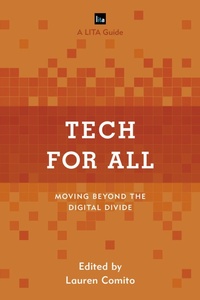
Tech for All
Moving Beyond the Digital Divide
1st Edition
Published on 8. February 2019
216 pages
978-1-5381-2219-8 (ISBN)
Description

How can libraries ensure that patrons from all socio-economic and ethnic backgrounds have access to advanced technology training and hardware? Everyone knows libraries provide access to computers and the internet for day to day use, but many libraries have gone beyond those basic services. Makerspaces and advanced tech training are often not equitably distributed between differing communities. The digital divide is still very real, and by not providing equal access to maker spaces and other similar services libraries may be unintentionally contributing to that divide.
This book examines how the unequal distribution of resources between communities can limit access to emerging technologies. Chapters from librarians across the country give real world examples of libraries going the extra mile to bring more than just email access to their communities, regardless of economic status or geographic distribution.
You'll find practical plans put forward by working professionals who have sought pragmatic solutions to issues of digital literacy. Access is a through line in this work as people look at the larger ideas of access as inclusive of training, diverse technologies, and the time and space to make genuine growth in tech literacy.
Chapters include:
working with immigrants, low cost laptops for library use, deep dives into the underpinnings of the maker movement, and developing community-focused technology training. After reading this book, librarians should have practical ideas to address the issue of equity in access to emerging technologies in their own communities.
This book examines how the unequal distribution of resources between communities can limit access to emerging technologies. Chapters from librarians across the country give real world examples of libraries going the extra mile to bring more than just email access to their communities, regardless of economic status or geographic distribution.
You'll find practical plans put forward by working professionals who have sought pragmatic solutions to issues of digital literacy. Access is a through line in this work as people look at the larger ideas of access as inclusive of training, diverse technologies, and the time and space to make genuine growth in tech literacy.
Chapters include:
working with immigrants, low cost laptops for library use, deep dives into the underpinnings of the maker movement, and developing community-focused technology training. After reading this book, librarians should have practical ideas to address the issue of equity in access to emerging technologies in their own communities.
More details
Series
Edition
1. Auflage
Language
English
Place of publication
New York
United States
Publishing group
Bloomsbury Publishing Plc
Illustrations
24 b/w photos; 4 tables
ISBN-13
978-1-5381-2219-8 (9781538122198)
Copyright in bibliographic data and cover images is held by Nielsen Book Services Limited or by the publishers or by their respective licensors: all rights reserved.
Schweitzer Classification
Other editions
Additional editions
Book
02/2019
Rowman & Littlefield Publishers
€63.30
Shipment within 3-4 weeks
Person
Lauren Comito has been working to level the playing field for New York City library users for over a decade. Currently the Neighborhood Library Supervisor at the Mill Basin Branch of the Brooklyn Public Library, in her previous work as the Job & Business Academy Manager at Queens Library she developed a team that has helped hundreds of people find employment opportunities. She created the Where in Queens mobile website as a development on the ideas put forth by ZenDesk and LinkSF, with whom she laid the groundwork for a partnership while she was presenting at SXSW Interactive. Lauren has logged hundreds of hours training people how to use technology to improve their lives and job opportunities.
Lauren is also very invested in the Library ecosystem serving in numerous capacities in ALA (Council, Committee on Library Advocacy) and in the New York Library Association (President Leadership & Management Section, Chair of the Communication Committee). She is the Chair of the Board of Urban Librarians Unite as well as being a founding member of the org. She started ULU's Urban Librarians Conference and has organized this highly regarded conference for four years with speakers and attendees from across the country.
Lauren Comito was awarded a Library Journal Mover & Shaker award for her work with tech training and job readiness. Her workgroup received the 2015 Gale Cengage Award for Excellence in Reference & Adult Library Services for the Where in Queens project. She is regularly asked to speak at regional and national conferences on topics of tech, tech training, women in leadership, cross generational management, and library advocacy.
Lauren is also very invested in the Library ecosystem serving in numerous capacities in ALA (Council, Committee on Library Advocacy) and in the New York Library Association (President Leadership & Management Section, Chair of the Communication Committee). She is the Chair of the Board of Urban Librarians Unite as well as being a founding member of the org. She started ULU's Urban Librarians Conference and has organized this highly regarded conference for four years with speakers and attendees from across the country.
Lauren Comito was awarded a Library Journal Mover & Shaker award for her work with tech training and job readiness. Her workgroup received the 2015 Gale Cengage Award for Excellence in Reference & Adult Library Services for the Where in Queens project. She is regularly asked to speak at regional and national conferences on topics of tech, tech training, women in leadership, cross generational management, and library advocacy.
Content
Foreword
Preface
Acknowledgments
Part 1: Identifying the problem
Introduction - Digital Equity in Libraries
Lauren Comito
Chapter 1: Fund All the Things: Finding Money to Do Great Work
Erica Freudenberger
Part 2: Physical Access
Chapter 2: Technology on the Border: Bringing STEAM-Based Learning and Digital Technologies to Southern Arizona
Emily Scherer
Chapter 3: Linux Laptops for Libraries
Alex Lent
Chapter 4: Shifting Focus Toward Imminent Needs: The Importance of Flexibility in Digital Literacy Training to Teens Within the Maker Movement
Ricci Yuhico
Part 3: Training
Chapter 5: Cracking the Code: The IMLS/Mozilla Web Literacy for Library Staff Project
Davis Erin Anderson
Chapter 6: You Can Do I.T.: Raising Tech Confidence and Competencies in Rural Texas
Carson Block, Cindy Fisher, and Henry Stokes
Chapter 7: Experiment, Learn, Respond at the Salt Lake City Public Library: The First Year of the Tech League Initiative
Tommy Hamby, Shauna Edson, and Elaine Stehel
Part 4: Makerspaces
Chapter 8: The Best Things Made in a Makerspace, Aren't the Physical Ones
Steve Teeri
Chapter 9: Library Makerspaces and Interest-Based Learning as Tools for Digital Equity
Lyndsey Runyan
Chapter 10: Improving Education with Library STEM Programs and Access to New Technologies
Maria Mucino
Part 5: Technology for Employment and Business
Chapter 11: Evolution of Community Services in Saint Paul
Rebecca Ryan and Pang Yang
Chapter 12: Creative Opportunity for All: Makerspaces for Youth and Adult Workforce Populations in an Urban Setting
Amanda Feist, Katrina Hartz Taylor, and Xenia Hernández
Chapter 13: Learning from Our Community - Using an Assessment Tool to Meet Patrons at the Point of Need
Amy Honisett, Gloria Jacobs, Judy Anderson, Jill Castek, Cindy Gibbon, and Matthew Timberlake
About the Editor and Contributors
Index
Preface
Acknowledgments
Part 1: Identifying the problem
Introduction - Digital Equity in Libraries
Lauren Comito
Chapter 1: Fund All the Things: Finding Money to Do Great Work
Erica Freudenberger
Part 2: Physical Access
Chapter 2: Technology on the Border: Bringing STEAM-Based Learning and Digital Technologies to Southern Arizona
Emily Scherer
Chapter 3: Linux Laptops for Libraries
Alex Lent
Chapter 4: Shifting Focus Toward Imminent Needs: The Importance of Flexibility in Digital Literacy Training to Teens Within the Maker Movement
Ricci Yuhico
Part 3: Training
Chapter 5: Cracking the Code: The IMLS/Mozilla Web Literacy for Library Staff Project
Davis Erin Anderson
Chapter 6: You Can Do I.T.: Raising Tech Confidence and Competencies in Rural Texas
Carson Block, Cindy Fisher, and Henry Stokes
Chapter 7: Experiment, Learn, Respond at the Salt Lake City Public Library: The First Year of the Tech League Initiative
Tommy Hamby, Shauna Edson, and Elaine Stehel
Part 4: Makerspaces
Chapter 8: The Best Things Made in a Makerspace, Aren't the Physical Ones
Steve Teeri
Chapter 9: Library Makerspaces and Interest-Based Learning as Tools for Digital Equity
Lyndsey Runyan
Chapter 10: Improving Education with Library STEM Programs and Access to New Technologies
Maria Mucino
Part 5: Technology for Employment and Business
Chapter 11: Evolution of Community Services in Saint Paul
Rebecca Ryan and Pang Yang
Chapter 12: Creative Opportunity for All: Makerspaces for Youth and Adult Workforce Populations in an Urban Setting
Amanda Feist, Katrina Hartz Taylor, and Xenia Hernández
Chapter 13: Learning from Our Community - Using an Assessment Tool to Meet Patrons at the Point of Need
Amy Honisett, Gloria Jacobs, Judy Anderson, Jill Castek, Cindy Gibbon, and Matthew Timberlake
About the Editor and Contributors
Index
